Showing posts with label Ted Williams. Show all posts

Monday, April 20, 2015

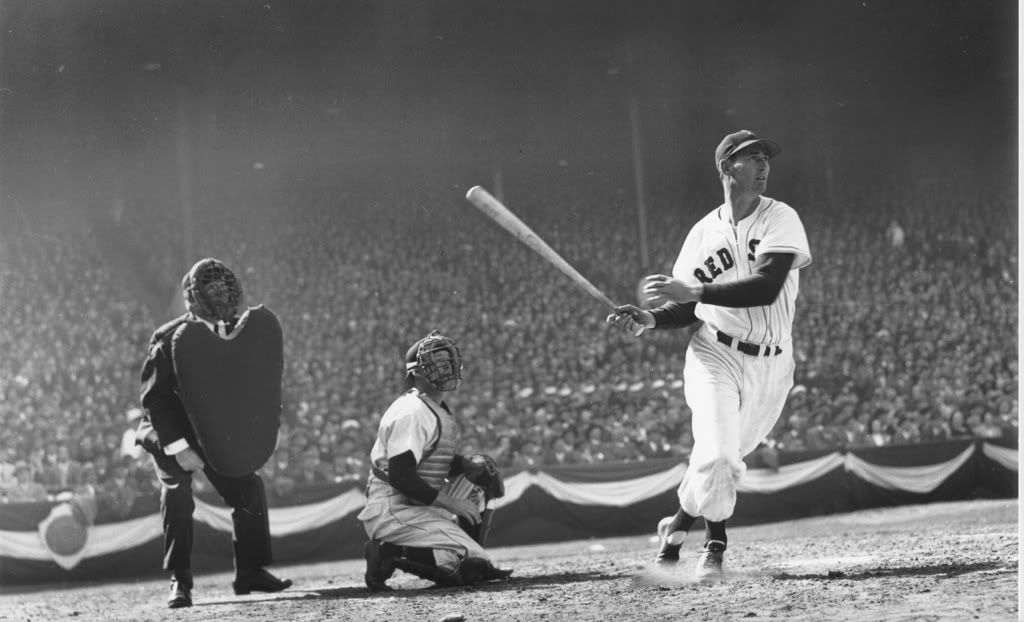
Ted Williams Debuts For The Boston Red Sox April 20, 1939

On This Day in Baseball History April 20. 1939: 20-year old Boston Red Sox rookie outfielder Ted Williams made his debut against the New York Yankees at Yankee Stadium. Williams would start in Right Field and bat fifth in the lineup. Williams would get his first career hit, a double and went 1 for 4 with three putouts in the field in a 2-0 loss.

The New York Times article Yanks Blank Red Sox Before 30,278 at Stadium Opener dated April 21, 1939 makes nary a mention of Williams. The only time he is mentioned is in respect to catching a line drive, that the fading Lou Gehrig hit with runners in scoring position, that seemed to "lack the old Gehrig depth". Since the paper didn't say much about Williams, I decided to go straight to the source. According to pages 60 and 61 of Ted Williams' autobiography My Turn at Bat: The Story of My Life:
I'll never forget that day sitting on the bench watching the Yankees take batting practice. I'm all eyes and ears. Lou Gehrig was still on the club, the only time I ever saw him play. He was already sick, and nobody knew it. He looked tired just walking up the stairs after the game. But there they were, Frank Crosetti and Charlie Keller and DiMaggio and Tommy Heinrich and Bill Dickey. A hell of a lineup. And Joe Gordon. I'm watching them, studying them all, and I remember so distinctly - this was one of those ten days - I said to myself, I know I can hit as good as these guys. Just a young kid's reaction, seeing the greats, building up his confidence.
Painting By Graig Kreindler
Red Ruffing was the Yankee pitcher. I watched him warm up - a big guy, I mean big, but a real easy-going style, like he didn't give a damn. When he came in with it though, the ball whistled. I got up the first time and fouled one off, then he threw me a little curve and I fouled that one off too, then he struck me out on a high fastball. The second time up the same thing: curve, curve, high fastball, strike three
Well, here's this smart-talking kid rookie from California striking out in his first two times up, and burning. I got to the bench and plopped down, and out of the corner of my eye I see ol' Jack Wilson, one of our pitchers, coming to me. We'd be needling each other all spring, and I'd been telling him how I was going to wear Ruffing out, and Jack's really got the old needle out now. He says, "Whata ya think of this league now, Bush?"
By this time I'm boiling. I said, "Screw you. That is one guy" - pointing to Ruffing - "I know I am going to hit, and if he puts it in the same place again, I'm riding it out of here."
Well it so happened the next time up Ruffing hot it high again, and I hit one to right center just a foot from going into the bleachers. I'd gotten under it a little bit or it would have gone out.
When I got to second base, there was Gordon. We played against each other on the coast in 1937, and he came over smiling. "You nervous?"
I said, "Boy, am I. Nervous as hell."
It turned out to be a wonderful first year for me.
Well that's an understatement. Not only was it a wonderful first year for Williams, it would be one of the best first years for any player. In 149 games, Williams finished his rookie season with a slash line of .327/.436/.609 with 185 hits (44 2B/11 3B/31 HR) and 145 RBI. Williams walked 107 and struck out a career high 64 times.

To me, out of all of Williams' rookie statistics, this is the one that stands out to me. He never struck out more than 64 times in a season AFTER his rookie season. The most he struck out after 64 times was 54 times and that was the NEXT season. Most players as they age and continue to develop their power stroke end up gaining more strikeouts. Not so for Ted Williams.

He would finish 4th in the Most Valuable Player race after Joe DiMaggio, teammate Jimmie Foxx and Bob Feller. It would be one of the only two seasons (along with 1952 when Williams served in the Korean War) that Ted Williams wouldn't be an American League All-Star.

Here is the box score of the Boston Red Sox vs New York Yankees game of April 20, 1939:


To look at Ted Williams' career statistics is just mind boggling. Give them a look: Ted Williams career statistics courtesy of Baseball Reference. We'll never see a hitter like Ted Williams ever again.

Until Then Keep Playing Ball,
Baseball Sisco
#baseballsisco
#baseballsiscokidstyle

Sunday, September 28, 2014

Ted Williams Finishes With a .406 Batting Average September 28, 1941

On this day in Baseball History September 28, 1941: Entering the last day of the 1941 season, Ted Williams led the league with a .39955 batting average. Sitting out the doubleheader to end the season against the Philadelphia Athletics would have given Williams a .400 average. Instead of being given the achievement, Williams decided to play both games going 4 for 5 in the first game and 2 for 3 in the second game finishing the season with a .4057 batting average rounded up to .406. In doing so, Williams became the first Major League to hit .400 or more since Bill Terry of the New York Giants hit .401 in 1930. Williams became the first American League player to hit .400 or more since Harry Heilman did so in 1923.

The article Star Gets 6 Hits As Red Sox Split from the September 29, 1941 edition of the New York Times states:
Williams made his thirty-seventh home run and three singles in five chances in the opener, and a double and a single in three attempts in the second encounter.

For the season he batted in 120 runs, scored 135 and walked 151 times. He struck out twenty-six times. Williams is the sixth American Leaguer to bat .400. Nap Lajoie, Ty Cobb, George Sisler, Joe Jackson and Heilman were the others. Jackson hit .408 for Cleveland in 1911, but lost the batting title to Cobb, who finished with .420.
Here are the boxscores for the two games played by the Boston Red Sox against the Philadelphia Athletics on September 28, 1941:


What did Ted Williams think about his chase for .400? On pages 85 and 89-90 of the book My Turn At Bat: The Story of my Life by Ted Williams with John Underwood, Williams describes what he felt that fateful day:
It came to the last day of the season, and by now I was down to .39955, which according to the way they do it, rounds out to an even .400. We had a doubleheader left at Philadelphia. I'd slumped as the weather got cooler, from a high of .436 in June, down to .402 in late August, then up again to .413 in September. In the last ten days of the season my average dropped almost a point a day. Now it was barely .400. The night before the game Cronin offered to take me out of the lineup to preserve the .400. They used to do that. Foxx lost a batting championship to Buddy Myer one year when he sat out the last game and Myer got two hits.

I told Cronin I didn't want that. If I couldn't hit .400 all the way I didn't deserve it. It sure as hell meant something to me then

Now it was the last day of the 1941 season, and it turned up cold and miserable in Philadelphia. It had rained on Saturday and the game had been rescheduled as part of a Sunday doubleheader. They still had 10,000 people in Shibe Park, I suppose a lot of them just curious to see if The Kid really could hit .400. I have to say that I felt good despite the cold. And I know just about everybody in the park was for me. As I came to bat for the first time that day, the Philadelphia catcher, Frankie Hayes, said, "Ted, Mr. Mack told us if we let up on you he'll run us out of baseball. I wish you all the luck in the world, but we're not giving you a damn thing."

Bill McGowan was the plate umpire, and I'll never forget it. Just as I stepped in, he called time and slowly walked around the plate, bent over and began dusting it off. Without looking up, he said, "To hit .400 a batter has got to be loose. He has got to be loose."

I guess I couldn't have been much looser. First time up I singled off Dick Fowler, a liner between first and second. Then I hit a home run, then I hit two more singles off Porter Vaughn, a left-hander who was new to me, and in the second game I hit one off the loudspeaker horn in right field for a double. For the day I would up six for eight. I don't remember celebrating that night, but I probably went out and had a chocolate milk shake. During the winter Connie Mack had to replace the horn.
The last player to come close to the .400 plateau was Tony Gwynn of the San Diego Padres. Gwynn hit .3938 during the strike shortened 1994 season. The last player to come close during a full season was George Brett of the Kansas City Royals. Brett hit .3898 during the 1980 season.

Williams narrowly missed winning the American League Triple Crown (2nd in RBI to Joe DiMaggio's 125 RBI) and would follow his 1941 campaign with the American Triple-Crown in the 1942 season. He would be the runner up in the American League MVP race to Joe DiMaggio and Joe Gordon of the Yankees. Williams would join the war effort, losing three full seasons before returning to play in the 1946 season where he continued with his hitting finally winning the American League MVP award. Williams was truly an amazing player and I wish that I had the opportunity to have watched him play in person.

Getting four hits out of every ten at-bats over the course of an entire season is a daunting task. Hitting .400 for the season, let alone reaching Williams' .406 seems to be one of those records that will probably not get broken in this era of free swinging hitters, batters who don't choke up and defend the plate with two strikes and high strikeout totals. Will we ever see .400 or more in our lifetime? I wouldn't bet on it but with the game of baseball, you just never can tell.

Until Then Keep Playing Ball,
Baseball Sisco
#baseballsisco
#baseballsiscokidstyle

For Further Reading:
- Click here to access Ted Williams' career statistics from Baseball Reference.com
- Click here to access the article What Do You Think of Ted Williams Now? by Richard Ben Cramer from Esquire Magazine dated January 8, 2013 originally published in the June 1986 issue of Esquire

Wednesday, September 10, 2014

Mickey Mantle Hit The Ball OUT of Tiger Stadium September 10, 1960

From The Cards
That Never Were
On this day in Baseball History September 10, 1960: At Briggs Stadium (later known as Tiger Stadium) in Detroit, Mickey Mantle of the New York Yankees strides to the plate with two men on base and two outs against Detroit starter Paul Foytack in the seventh inning. Mantle being a switch hitter took his place in the left-hand hitter box.

Yankees announcer Phil Rizzuto described Mantle's swing as "putting good wood on the ball" as Mantle swung at the 2-0 offering by Foytack and put the ball over the right field roof of Briggs Stadium. Let me repeat that, he hit the ball OVER the roof of Briggs Stadium. The ball landed at a lumberyard across the street. Though not measured at the time, a measurement "after the fact" estimated that the ball traveled a distance of 643 feet. The article Mickey Mantle's 10 Longest Home Runs by Lewis Early from The Mick.com describes the story in detail about Mantle's homer and the measurement:
Detroit's Tiger Stadium (the name was changed from Briggs Stadium) was a favorite Mantle hunting ground for legendary home run blasts. On September 10, 1960, with two out and two on in the seventh, Mickey worked the count to 2-0. Righty Paul Foytack fired a fastball right into the Mick's killing zone and he jumped on it. He crushed a spectacular drive that easily cleared the right-field roof (something Mickey had done several times by this point in his career), crossed Trumbull Avenue and landed at the base of a shed in the Brooks lumberyard across from the ballpark.

For spectators that day it was another of many tape measure homers Mantle hit during his career. For the Yankees the win - coupled with a Baltimore Orioles loss - put them back in first place in a tight pennant race. This overshadowed the magnitude of Mickey's blast in the stories that appeared in newspapers the next day. That plus the fact that spectacular Mantle home runs were becoming somewhat commonplace. So much so that Yankees' PR director Bob Fishel (Red Patterson's successor), who had many other duties, couldn't keep up with every tape measure blast Mantle hit. For that matter, Fishel wasn't with the Yankees in Detroit on that trip, so there was no one to emphasize to the press what Mickey had accomplished, and the Tigers certainly had no motivation to point it out.

But this one turns into quite a story a quarter of a century later. As told by Mark Gallagher in his excellent book, Explosion!, Dr. Paul Susman, a true Mantle fan, was convinced that this home run was special. As part of Dr. Susman's research for Gallagher's book, he went to Detroit to see if he could get the necessary information to calculate the exact distance the ball traveled.

It turns out that the story of Mickey's historic drive was well known at Brooks Lumber. Paul Borders, a Brooks employee, saw exactly where the ball landed. Susman and fellow researcher Robert Schiewe calculated the distance through Schiewe's use of the Pythagorean Theorem. The result was a prodigious 643 feet. This is the longest home run to have actually been measured from the point it was hit to the point at which it landed. Although it was measured after the fact, the point of impact was well-known and we believe this distance to be completely reliable. This is no computer estimate. This is the distance the ball traveled in the air from home plate to the place where it landed. The Guinness Book of Sports Records notes it as the longest home run in a major league game to be measured "after the fact." It is the longest home run ever hit in a major league game where it was possible to get the exact measurement. Considered along with the Bovard Field homer, it demonstrates that Mickey's unheard of home run distances are no flukes.
Now as the article Tigers beaten 5-1 by John Drebinger in the New York Times of September 11, 1960 states:
In one of Mantle's two previous clouts over this same roof, Foytack was also the victim. That occurred on June 18, 1956. Mantle's second one was hit off of Jim Bunning on Sept. 17, 1958.

Prior to that, only one homer cleared that Detroit rampart and this took place more than twenty-one years ago. (Ted) Williams did it on May 4, 1939.
Here is the box score for the September 10, 1960 game between the New York Yankees and the Detroit Tigers from the September 11, 1960 New York Times:


Mantle would go on to hit a total of 536 homers over an 18-year career. In doing so, Mantle sits at the top of the list of the most home runs by a switch-hitter in the history of the game (Eddie Murray is second with 504 homers). Mantle would retire in 1968 and would be inducted to the National Baseball Hall of Fame in 1974 with 88.2% of the vote (322/365 ballots).

Ok, let me rant for a minute. How the hell does Mickey Mantle not get at least 90% of the vote for induction. We're talking about Mickey "F'n" Mantle here. You ever get into a discussion with a person who believes that the Hall of Fame should have less members and their criteria is "If you have to think about someone being a Hall of Famer then they shouldn't be in"? If I'm going by that, the Mick is a no-brainer. You don't have to think if the Mick was a Hall of Famer. He was. HE IS!!! Bar none. His getting 88.2% of the vote is downright embarrassing. Mays got 94.6% of the vote (409/432 ballots) and in my mind, I think Mays and Mantle goes hand-in-hand. I know the Yankees dominated during Mantle's time with the era, so the Yankees hate must have been really strong. LOL. Getting off the soapbox now.


Many people wonder if we'll ever see a player like Mickey Mantle. Switch-hitting aside, I think Mike Trout is as close as we'll get this generation to a player of Mantle's caliber. Now only time will tell if Trout will continue on the pace he's playing at to make this a fair comparison.

Until Then Keep Playing Ball,
Baseball Sisco
#baseballsisco
#baseballsiscokidstyle

For Further Reading:
- Click here to access Mickey Mantle's career statistics from Baseball Reference.com
- Click here to access the article Mickey Mantle's 10 Longest Home Runs by Lewis Early from The Mick.com
- Click here to access Distance of Longest Batted Baseball from The Physics Factbook Edited by Glenn Elert -- Written by his students from the Physics Factbook website

Monday, July 14, 2014

Mathews and Aaron hit the 500 HR Plateau on the Same Day One Year Apart

On this day in Baseball history July 14, a year apart (1967 and 1968), against the same opponents, former teammates Eddie Mathews and Hank Aaron hit their 500th homeruns against the San Francisco Giants.


On July 14, 1967, as a member of the Houston Astros Mathews hit his 500th homerun against future Hall of Famer Juan Marichal at the Houston Astrodome. Mathews became the seventh player to reach the 500 homerun plateau, doing so two months after Mickey Mantle of the New York Yankees hit his 500th.


On July 14, 1968, the 500th homerun plateau was once again reached against the San Francisco Giants. This time it was Hank Aaron who hit his 500th against Mike McCormick at Atlanta-Fulton County Stadium. Aaron became the eight player to reach the 500 homerun plateau.

At the time of Aaron's reaching 500 homeruns, here is how the list looked like (with date of reaching the 500 homerun plateau):

  1. Babe Ruth August 11, 1929
  2. Jimmie Foxx September 24, 1940
  3. Mel Ott August 1, 1945
  4. Ted Williams June 17, 1960
  5. Willie Mays September 13, 1965
  6. Mickey Mantle May 14, 1967
  7. Eddie Mathews July 14, 1967
  8. Hank Aaron July 14, 1968

Aaron and Mathews would combine for a total of 863 homeruns as teammates from 1953-1965. An amazing accomplishment by teammates who often are overlooked when talking about the best one-two combinations in a major league lineup.

Until Then Keep Playing Ball,
Baseball Sisco
#baseballsisco
#baseballsiscokidstyle

For Further Reading:
- Click here for the box score from July 14, 1967 between the San Francisco Giants and the Houston Astros from BaseballAlmanac.com
- Click here for the box score from July 14, 1968 bewteen the San Francisco Giants and the Atlanta Braves from BaseballAlmanac.com


Monday, June 16, 2014

Tony Gwynn (1960-2014)

Today I woke up to the news that Hall of Famer, Tony Gwynn (1960-2014) had passed away at the age of 54. Now instead of going into Gwynn's stats and accomplishments during his playing days, I wanted to touch on something that I happened to talk about last night at the bar.

My friend John and I were discussing the whole Inter-league in MLB and how John feels that the All-Star game no longer has a place due to diminishing interest in the game. That years ago he would have a crowd come into the bar he worked to watch the game and now he's lucky to get one or two customers joining him to watch the game. I believe that the advent of the 24-hour sports cable networks, the ability to watch a game nightly on any combination of channels and the ability to follow your team either at home or online for a yearly fee has made it easier for fans to watch not only their team but any team on a regular basis. Here is where a player like Tony Gwynn comes in.

To show my age, I grew up in an era where I consider myself lucky compared to other fans. In an era before Inter-league Baseball, I could watch the Yankees play the American League teams on WPIX 11 while I could watch the Mets play the National League teams on WWOR 9 on network tv. So in theory I could see players from both leagues that other fans didn't have a chance to see regularly. Add to this we had the Baseball Game of the Week which was shown on Saturday afternoons and for a brief time ABC Monday Night Baseball then Thursday Night Baseball in the 1970's through the late 1980's.

Sportscenter? Fughettaboutit. I would catch up on player accomplishments by pouring over the box scores in either the New York Daily News or the New York Post, watching the Mel Allen narrated This Week in Baseball (How About That!!!) usually on before the Baseball Game of the Week and late night on the weekends with The George Michael Sports Machine. So to watch players like Tony Gwynn was a special treat that came along once in a while. Since the Padres weren't in the playoffs very often, the only time I really got to watch Gwynn was in the Mid-Summer Classic.

To watch the very best of the Major Leagues on the same field during the All-Star Game was (and I still believe that it is) a very special thing. Granted, like John states that the popularity of the game has diminished, I still think the pomp and circumstance surrounding the game still makes it something special. I really can't point to any particular at-bat that Tony Gwynn had during the All-Star games I saw him in. But the fact that back then in the era where Baseball fans had limited options to see opposing players, I have small moments in time where I saw players like Tony Gwynn ply their trade.

The world today lost a good man. Gwynn was a teacher and an amazingly classy role model in a world of selfish sports figures. He spoke with his bat rather than his mouth. He wasn't built with the best physique. He didn't have to. Gwynn was the player who came closest to the magical .400+ batting average in 1994 with a .394 average. If the players strike didn't prematurely end the 1994 season, who knows where he would have finished. His hero, Ted Williams was the last player to finish with a .400+ average in 1941 with a .406 average. He represented his hometown of San Diego with pride and given the chance to leave the Padres for potentially more lucrative contracts elsewhere, Gwynn decided to spend his entire 20-year career in San Diego. As Gwynn was quoted in the New York Times during his final season: “Twenty years in one place, one city. It looks good.”

Indeed it does. Thank you for the memories Tony. That is one dominant lineup with you and the Splendid Splinter batting in front of you at the big ballpark in the sky. May You Rest in Peace.

I leave you with a small video by the National Baseball Hall of Fame entitled The Baseball Hall of Fame Remembers Tony Gwynn:


Until Then Keep Playing Ball,
Baseball Sisco
#baseballsisco
#baseballsiscokidstyle

For Further Reading:
- Click Here to access Tony Gwynn's career statistics from BaseballReference.com
- Click Here to accces the article by Chad Finn entitled Tony Gwynn: A Kindred Spirit Of Ted Williams, A Favorite Of Anyone Who Loves Baseball from Boston.com dated June 16, 2014
- Click Here to access Matt Snyder's article entitled Did the 1994 strike cost Tony Gwynn a .400 batting average? from CBS Sports Eye on Baseball website dated June 16, 2014

Monday, July 19, 2010

Possible AL Triple Crown and NL ERA Dominance

Amid all the talk of Robinson Cano having an MVP type season for the New York Yankees this season, there is a possibility that there may be a legitimate shot at someone achieving the batting Triple Crown for the first time in 43 years. To clarify, the batting Triple Crown is achieved by one person leading the league in the following categories: Batting Average, Home Runs and Runs Batted In. This milestone has been reached by only 14 players with Carl Yastrzemski of the Boston Red Sox being the last to do so in 1967. The Triple Crown has happened nine times in the American League while only five times in the National League. Two players have won the Triple Crown twice: Ted Williams (1942, 1947) of the Boston Red Sox and Rogers Hornsby (1922, 1925) of the St. Louis Cardinals. The remaining list is full of baseball royalty such as Nap Lajoie, Ty Cobb, Jimmie Foxx, Lou Gehrig, Mickey Mantle, Frank Robinson, Chuck Klein and Joe Medwick among others. So who among the current crop of Major League players in is contention? Read on.

- Miguel Cabrera
Last season, Cabrera garnered the one first place vote for MVP that did not go to eventual league MVP Joe Mauer. This season he continues the torrid pace with a .337 average (currently 3rd place behind Josh Hamilton .347 and Justin Morneau .342), 22 homers (currently tied for 2nd place behind Jose Bautista 25) and is first in RBI's with 79.

- Josh Hamilton of the Texas Rangers
Hamilton continues to write the story of his miraculous comeback from drug abuse and adversity by currently leading the majors with a .347 average, has 22 homers (currently tied for 2nd place behind Jose Bautista 25) and has 66 RBI's (currently 7th).

-Vladimir Guerrero of the Texas Rangers
Arguably the longshot of the three to win the Triple Crown, Guerrero has re-established himself as an offensive force in baseball after a number of injury plagued seasons with the Los Angeles Angels of Anaheim (I really hate having to call the Angels that, LOL). Guerrero is batting .322 (currently 8th) with 20 homers (currently 11th) and 76 RBI (currently 2nd behind Miguel Cabrera)

There you go folks, here is a listing of some of the dominant well-rounded hitting in the post "*" baseball landscape (as my friend Harper refers to the "steroid" era) during the recently christened Year of the Pitcher. And speaking of the Year of the Pitcher.

-The National League ERA race
Ubaldo Jimenez generated the early season buzz in terms of a low ERA. As I posted on my Latinoball blog page on June 13, 2010 called Ubaldo Jimenez is Chasing History at the time Jimenez was 12-1 with 1.16 ERA. This placed him in the company of such pitchers as Juan Marichal and Eddie Cicotte while being in mentioned in the discussion of possibly reaching the pinnacle that Bob Gibson accomplished in 1968: 1.12 ERA. Since then, Jimenez is still on pace for an over 20-win season. He is currently 15-1 with a 2.20 ERA in 127 innings pitched with 3 complete games. Jimenez has 113 K's, 46 BB's and has given up 87 hits for a WHIP of 1.05. This is definitely not shabby in the least but Josh Johnson of the Florida Marlins has stepped his game up to trump Jimenez.

Johnson is currently 10-3 with a league leading 1.62 ERA in 128 innings pitched with 1 complete game. Johnson has 130 K's with only 28 BB's and has given up 96 hits for a WHIP of 0.97. This is especially impressive since the Florida Marlins are not an offensive force and Johnson has single-handed done his best to balance the lack of offense with a lack of runs allowed. In his last 10 starts, Johnson is 6-2 with a 0.76 ERA in 71 innings pitched. Johnson has only given up 6 earned runs in those last 10 starts. What is a shame is that in both losses in that stretch, Johnson has given up only 2 earned runs in 15 innings pitched (one was a 2-1 loss to the San Diego Padres and the other was a 1-0 loss where Roy Halliday pitched a perfect game for the Phillies). It gets even worse for Johnson. During the two no-decisions that he is credited with during that stretch, Johnson gave up only 2 earned runs in 14 innings pitched. That is truly amazing feat of pitching in a situation where run support is limited. But that's not all. Let me shed light on one more pitcher.

Adam Wainwright of the St. Louis Cardinals should not be left out of the discussion. Wainwright is currently 14-5 with a 2.02 ERA in 142.1 inning pitched with 4 complete games and 1 shutout. Wainwright has 130 K's, 30 BB's with 107 hits for a WHIP of 1.00. Wainwright poses a serious threat to both Jimenez and Johnson in the Cy Young award race. I'm thinking he's salivating for another crack at the award especially since he went 19-8 with a 2.63 ERA last season with the award going to San Francisco's Tim Lincecum.

As with the Triple Crown race in the AL, it'll be interesting to see which one of the three pitchers I highlighted will come out on top in the NL.

FH

For Further Reading:
- Click Here for a listing of the Triple Crown Winners from Baseball Almanac.com

Wednesday, February 21, 2007

1st Latino Baseball Superstar?

I know many of you will probably disagree with me on this post but if you give me a chance I think you might see things my way. Now I have always said that Roberto Clemente is the best Latino player to ever play the game of baseball. This can always be debated in the same manner with respect to the Black and Latino players of color who were not allowed to play with the White players until 1947. Without the benefit of having a level playing field where all played against each other, it’s hard to make comparisons on who was the best across generations.

Now, in terms of Latino ballplayers, the Latinos have been playing baseball since pretty much the beginning of the game. Even with the “Gentlemen’s Agreement” which was used to restrict the blacks from playing professional ball with the whites, Latinos have been a part of the game. Many of them were marginal players who really couldn’t compare statistically with the superstars of their generations. This was so until the 1st real Latino superstar came on the scene. Now there was only one problem, it wasn’t until recently that it came to light that this ballplayer was of Latino descent. So to get to the point of my discussion and possible disagreement, I have only one name: Ted Williams.

Ted Williams (1918-2002) was born Theodore Samuel Williams on August 30, 1918 in San Diego California. His father, Sam Williams, was a World War I veteran of Welsh-English descent and his mother, May Venzor, was half-Mexican. Now the question is why wasn’t this fact ever brought out at the time. Ted Williams himself relates this in his 1969 autobiography, "My Turn At Bat," written with John Underwood. Williams said:

"If I had my mother's name, there is no doubt that I would have run into problems in those days, the prejudices people had in Southern California."

It has also been said that Ted Williams spent time with his maternal grandmother, who barely spoke any English and learned to play the game of baseball through his maternal uncle, Saul Venzor. Similarly, Reggie Jackson (who like Williams has Latino blood: His maternal grandmother is from Puerto Rico), has been excluded from many lists about Latino baseball players. As recent as October 2005, with the Latino Legends team vote on mlb.com, neither Williams nor Jackson were included on the list. Whether or not they wore their Latino heritage on their sleeves or in their hearts, it doesn’t diminish their being Latinos. I believe Reggie Jackson puts it best:

"They (Baseball) have no right to pass judgment on what I claim about my Latin heritage," said Jackson, whose middle name is Martinez. "I just don't run my mouth off about it."

Whether Williams shunned his Mexican heritage by choice, pressure or racism will never be fully and accurately known but to exclude him from any lists of Latino superstars and/or Hall of Fame lists is ridiculous. Now let’s see some stats. Williams has the following numbers:

- Lifetime batting average of .344 (8th on the All-time list)
- 521 Home-runs (12th on the All-time list)
- .483 On Base Percentage (1st All-time)
- 1839 Career Runs Batted In
- 2654 Career Hits (Never had a season of 200 hits in a season)
- .634 Slugging Percentage (2nd All-time)
- 2019 Walks (11 Years of more than 100 per season)
- 1942 American League Triple Crown (.356, 36, 137)
- 1947 American League Triple Crown (.343, 32, 114)
- 2 time MVP (1946, 1949)
- 17 Time All-star
- Last player to ever hit .400 or higher (.406 in 1941)
- Inducted into the Hall of Fame in 1966

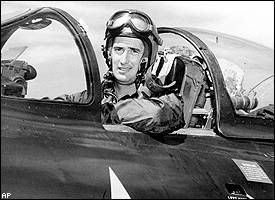
In addition to the baseball statistics, Williams was a two-time US veteran (World War II and Korean War) as a pilot. Missed a total of 801 career games (Almost 5 seasons) due to his two tours of duty. Had he played in those games, he would have potential played a total of 2,909 games. His projected numbers would have been:

- 2,332 Runs Batted In
- 2,583 Walks
- 657 Home Runs
- 3,383 Hits

So is there really a debate? I hope so. Let’s start a spirited, educated but civil debate. Please check out the following WebPages for more information on The Splendid Splinter:

Official Ted Williams Homepage
Baseball Reference: Ted Williams
NY Times Sports Article 8/26/2005
Hispanic Baseball Museum News Clips Page