Showing posts with label Philadelphia Athletics. Show all posts

Saturday, July 18, 2015

Ty Cobb Becomes The First Player to Reach 4,000 Hits July 18, 1927

On This Day in Baseball History July 18, 1927: Philadelphia Athletics outfielder Ty Cobb became the first Major League Baseball player to reach the 4,000 hit plateau against his former team the Detroit Tigers at the Tigers home Navin Field. He would hit his 4,000th hit against Tigers pitcher Sam Gibson in the top of the first inning.

Unlike the fanfare that reaching such a milestone would garner in today's Baseball world, Cobb reaching 4,000 barely garnered any press. The New York Times of July 19, 1927 not only doesn't mention Cobb reaching 4,000 hits, he isn't even mentioned in the two paragraph article describing the 5-3 loss by the Athletics. The blogpost No hoopla when Ty Cobb got his 4,000th hit by Richard Bak from the Detroit Athletic Company dated November 18, 2013 mentions some of the Detroit press from that day's baseball action:
As Harry Salsinger wrote in the next day’s Detroit News, “Cobb hit a line drive into right field and [Harry] Heilmann, trying for a one-handed catch, got his glove on the ball but it bounced out and gave Cobb a scratch two-bagger.” Harry Bullion of the Detroit Free Press described Cobb’s hit as “a lucky double [that] slid off Heilmann’s gloved hand and helped in the making of two runs.” The 2-0 lead didn’t last long as Detroit countered with three runs in the bottom of the first off Lefty Grove.
Significantly, the game was not held up to acknowledge the historic base hit and Cobb didn’t ask for the ball. In fact, Cobb’s accomplishment was scarcely acknowledged in the next day’s papers. One reason is that little emphasis was put on such arcane records then. Another is that it was considered just another ho-hum day at the office for the 40-year-old Cobb, a hitting machine who seemed likely to go on forever. Who was to say that he wouldn’t reach 5,000 hits someday? The same attitude prevailed at the end of the summer when Babe Ruth clouted his 60th home run, breaking his own record. Like 4,000 hits, 60 home runs made for a nice round number, but many observers figured the Yankees’ slugger might one day hit 65 or 70, so why get too excited?
The Free Press ran a column of notes with the headline: “Bengals In Third Place; Ty Cobb Gets 4,000th Hit.” Bullion wrote: “When Cobb made his fluke double in the first inning, it was his 4,000th major league safety. He’s so far ahead of all records of other batsmen that he will never be beaten or tied.”
Trying not to be defeated in trying to find something on Cobb's 4,000th, I decided to look into a trusted resource that I have used before when posting about Cobb.

I pulled my worn copy of Ty Cobb: My Life in Baseball with Al Stump off my Baseball book shelf and to my dismay, I found NOTHING about the day Cobb delivered his 4,000th hit. The only mention of his accomplishments during the 1927 season for the A's is on page 257:
My personal performance in 1927 was satisfactory: a matter of 175 hits in 134 games, 104 runs scored and another 93 driven in for an average of .357. At forty-one, I could still leg it a bit, if 22 stolen bases was any evidence.
Cobb would become the charter member of the 4,000 hit club that day and finish his career with 4,191 hits. On page 146, Cobb would claim that out of the 4,191 hits he collected over his 24-year career, 72-plus percent of them were singles. He had 3,054 singles out of his total of 4,191 hits for an accurate 72.9 percent.

There is only one other member of the 4,000 hit club and that is the man who would eventually pass Ty Cobb as Baseball's All-time hit king: Pete Rose. Rose would reach 4,000 hits on April 13, 1984 and would pass Cobb on September 11, 1985 with his 4,192nd hit. Rose would finish his career with 4,256 hits.

So much for trying to find something Cobb may have said concerning the day he hit his 4,000th hit. Oh well. Though the article doesn't mention the accomplishment here is the boxscore for the Philadelphia Athletics vs. The Detroit Tigers on July 18, 1927 from the July 19, 1927 edition of the New York Times:


Will we ever see another player reach 4,000 hits? I always thought that Derek Jeter had a chance before he broke his ankle in the postseason against the Detroit Tigers in 2013. He would finish his career in 2014 with 3,465 hits. Anyone want to take a guess on who, if anyone, can reach 4,000 hits in today's game?

Until Then Keep Playing Ball,
Baseball Sisco
#baseballsisco
#baseballsiscokidstyle

Sunday, May 24, 2015

Two Major Leaguers KIA during World War II

Since it is Memorial Day Weekend here in the United States, what better way to commemorate the effort given by our troops than to shed light on the two Major Leaguers who made the ultimate sacrifice during World War II.

From the moment when Japan attacked the United States at Pearl Harbor on that fateful "Day That Will Live in Infamy", December 7, 1941, superstar, reserve player and minor leaguer alike served the nation's armed forces during World War II. It is estimated that over 500-major leaguers and many more minor leaguers served during World War II. While only 2 major leaguers lost their lives in the conflict, there were an estimated 139 minor leaguers that lost their lives in World War Two. Gary Bedingfield's wonderful and informative website Baseball in Wartime and his book Baseball's Dead of World War II: A Roster of Professional Players Who Died in Service are two amazing resources to look up who those players were. On to honoring the two major leaguers who were killed in action during World War II.

- Elmer Gedeon
Gedeon was born in Cleveland, Ohio on April 15, 1917 and was the nephew of former big leaguer Joe Gedeon. Gedeon was a three sport star at the University of Michigan and made the majors with the Washington Senators in 1939. His stint with the Senators was not very memorable since he appeared in only five games with the Nats. In those five games, Gedeon batted .200 with 3 hits in 15 at-bats with an RBI and a run scored. He would be sent down to Charlotte of the Piedmont League for the 1940 season, and was recalled to Washington at the end of the season but didn't play in a game. Gedeon would never play in the majors again.

Gedeon received his draft notice in January 1941, and would later be transferred to the the Army Air Force in October, 1941. It was here where Gedeon would shine and meet his final fate. According to the biography on Elmer Gedeon on the aforementioned Baseball in Wartime website:
Flight training was always a hazardous time and almost claimed the 25-year-old's life on August 9, 1942. Gedeon was the navigator in a North American B-25 Mitchell medium-sized bomber that struggled on take-off from Raleigh Airport, North Carolina. The plane clipped pine trees at the end of the runway and plunged into a swamp before bursting into flames. Despite suffering three broken ribs, Gedeon managed to free himself and crawl from the wreckage, then realized crewmate Corporal John Rarrat was still inside. Gedeon returned to the burning plane without a moment's hesitation and pulled Rarrat to safety. Corporal Ros Ware died in the crash, Rarrat succumbed to his injuries at Rex Hospital in Raleigh, and the five other crew members all suffered serious burns and broken limbs. Gedeon was hospitalized for 12 weeks. In addition to broken ribs he suffered severe burns to his back, face, hands and legs, some of which needed skin grafts.
Gedeon would be promoted to the rank of First Lieutenant and was awarded the Soldiers' Medal for his heroics (Gedeon would later be promoted to his highest rank of Captain).

According to pilot's superstition, Gedeon was quoted as saying "I had my accident. It’s going to be good flying from now on,". Unfortunately for Gedeon it was not to be so. Again referring to the aformentioned Elmer Gedeon biography on the Baseball in Wartime website:
With his duties as operations officer, Gedeon was not a regular flyer but on the afternoon of April 20, 1944, just five days after celebrating his 27th birthday, he piloted a B-26B, one of 30 Marauders that left Boreham Field that afternoon to bomb a German VI site being constructed at Bois d'Esquerdes, France. It was the group's 13th mission.
It was nearly 7:30 P.M. when the group approached the target area and encountered blinding searchlights and intense, accurate, heavy anti-aircraft fire. The sky was suddenly full of puffs of black explosions that were silhouetted against the searchlights. These explosions generated hundreds of pieces of jagged steel that could easily set oxygen and gas tanks blazing, or rip through the wings of a plane and just as easily through the bodies of the men inside. Lining up to make the bombing run the flak grew heavier, thicker and more deadly, causing planes to bounce around from nearby bursts.
Gedeon's bomber dropped its bombs and had just passed over the target. “We got caught in searchlights and took a direct hit under the cockpit,” recalled co-pilot James Taaffe. “I watched Gedeon lean forward against the controls as the plane went into a nose dive and the cockpit filled with flames. He must have been thinking, 'Oh, no. Not again.'” [9] Taaffe, with his clothing on fire, desperately struggled to open the pilot's and co-pilot's top hatches. He looked back and saw no movement from Gedeon as he scrambled to safety through the hatch. Descending through the night sky he watched the flame-engulfed airplane spiral out of control and explode on impact with the ground, carrying Gedeon and five others to their death. The other crew members were Second Lieutenant Jack March, Staff Sergeant Joseph Kobret, Sergeant John Felker, Sergeant Ira Thomas and Private Charles Atkinson.[10]
Gedeon was reported missing in action - his fate unknown, because Taaffe had been taken prisoner by German soldiers and was being held at Stalagluft 3. It was not until May 1945 that Elmer's father, Andrew A. Gedeon, received word from his son's commanding officer that the graves of the missing airmen had been located in a small British army cemetery in St. Pol, France. Elmer Gedeon's body was later returned to the United States and rests at Arlington National Cemetery in Virginia.
For Further Reading:
Elmer J Gedeon from the American Air Museum in Britain website
- Elmer J. Gedeon's statistics from Baseball Reference.com

- Harry O'Neill
Harry Mink O’Neill was born in Philadelphia on May 8, 1917 and as Gedeon was, O'Neill was a standout athlete in college. O'Neill attended Gettysburg College in Gettysburg, Pennsylvania and was a three-sport star. After graduating college, O'Neill signed with Connie Mack’s Philadelphia Athletics on June 5, 1939. He would be the third string catcher for the Athletics in 1939 making only one appearance in that season. According to the article Harry O'Neill by Gary Bedingfield, Frank Fitzpatrick, and Bill Nowlin from the SABR Baseball Biography Project:
O’Neill made his only major-league appearance on July 23, 1939, as a late-inning defensive replacement for Frankie Hayes against the Tigers. It was a blowout of a ballgame, with the Tigers leading 9-1 after three innings and 15-3 through seven. Hayes was 0-for-4 in the game, and finally Athletics manager Earle Mack – who had taken over from his father, Connie Mack, in late June when Connie became ill – decided to give Hayes the rest of the day off and put in O’Neill behind the plate. O’Neill never got a time at bat, and was not involved in any fielding plays. He caught the fifth of Philadelphia’s five pitchers, Chubby Dean.
O'Neill would finish his major league career with a .000 batting average and played part of the 1940 season at for the Harrisburg team of the Class B Interstate League.

In September 1942, O'Neill would enlisted with the Marines Corps and was sent to the Marine Officers' Training School at Quantico, Virginia where he would graduate with the rank of Second Lieutenant. O'Neill would join the 4th Marine Division at Camp Pendelton, California. O'Neill would rise to the rank of first lieutenant and would be shipped out to the Pacific theater with the 4th Marine Division in January 1944. According to the Harry O'Neill biography page on the Baseball in Wartime website:
With the division's 25th Weapons Company, O'Neill made major amphibious assaults at Kwajalein later that month, then at Saipan in June. On June 16, 1944, he suffered a shell-fragment wound to the right arm on Saipan, and was sent back to a hospital ship to recover. He returned to active duty on July 22, 1944, and participated in the assault on Tinian. On February 19, 1945, the division landed at Iwo Jima and moved inland, over extremely difficult terrain. After an intense Allied artillery bombardment of enemy positions on March 5,1945, elements of the 3rd, 4th, and 5th Marine Divisions attacked on the morning of March 6. Fighting was heavy throughout the day with the enemy offering stiff resistance and subjecting the Marines to continuous small arms and mortar fire. By 5:30 P.M. on March 6, the Marines had made small local gains, but First Lieutenant O'Neill was dead. He had been killed by a sniper. O'Neill was one of 92 officers of the 4th Marine Division who lost their lives on Iwo Jima.
O'Neill was originally buried at Iwo Jima with 7,000+ Marines. His remains would later be interred at Arlington Cemetary in Drexel, Pennsylvania in July 1947.

For Further Reading:
Iowa Jima: Red Blood on Black Sand from the Fighting Fourth of World War II's website
- Harry M. O'Neill Class of 1939 Induction Class of 1980 of the Gettysburg College Hall of Athletic Honors page
- Harry O'Neill's statistics page from Baseball Reference.com

I would recommend that you read the much more in-depth articles on Elmer Gedeon and Harry O'Neill on the Baseball in Wartime website and the Harry O'Neill article by Gary Bedingfield, Frank Fitzpatrick, and Bill Nowlin from the SABR Baseball Biography Project. You will not be disappointed.

If you happen to be at a ballgame this weekend, give a tip of your hats and honor Elmer J. Gedeon and Harry O'Neill with a moment of silence and thanks for their ultimate sacrifice in helping us enjoy the game that they both spent time playing. Rest in Peace Captain Elmer J. Gedeon and First Lieutenant Harry M. O'Neill. Thank you for your sacrifice. You'll never be forgotten.

Until Then Keep Playing Ball,
Baseball Sisco
#baseballsisco
#baseballsiscokidstyle

Saturday, May 16, 2015

First American League Night Game May 16, 1939

On This Day in Baseball History May 16, 1939: The first American League night game took place at Philadelphia's Shibe Park when Connie Mack's Philadelphia Athletics hosted the Cleveland Indians in front of 15,109 fans.

The game would go into the 10th inning tied 3-3 until the Indians broke the game open with five runs in the top of the 10th. The Tribe would win the game by a score of 8-3.

The Athletics would become only the third MLB franchise to host a game under the lights after the Cincinnati Reds who were the first on May 24, 1935 and the Brooklyn Dodgers on June 15, 1938, which is significant in Baseball history as being the night when Cincinnati Reds pitcher Johnny Vandermeer threw his second consecutive no-hitter.

It is believed that the first professional Baseball game under the light took place on May 2, 1930, when the Des Moines, Iowa, team hosted Wichita for a Western League game. Many minor league teams would use lights to play night games five years before the majors in an attempt to stay viable during the Great Depression.

Here is the box score to the May 16, 1939 night game between the Cleveland Indians and the Philadelphia Athletics:

It really is amazing to think of a time where Baseball games were played primarily during the daytime. Aside from the Cubs who still play the majority of their home games during the day, we take it for granted today that the majority of the games are played under the lights. And with the profit margins leaning higher during night games, I don't see MLB teams playing less games at night and more during the day, especially during the week.

Until Then Keep Playing Ball,
Baseball Sisco
#baseballsisco
#baseballsiscokidstyle

Friday, May 1, 2015

Jimmie Foxx Debuts May 1, 1925

On This Day in Baseball History May 1, 1925: At the age of 17, Future Hall of Famer Jimmie Foxx makes his debut for the Philadelphia Athletics. In the game against the Washington Senators at Griffith Stadium, Foxx pinch-hits for pitcher Lefty Grove and has a hit in his first major league at-bat.

Foxx would only appear in 10-games in the 1925 season and play parts of the 1926 and 1927 seasons before becoming a regular player and feared slugger for the A's and the Boston Red Sox.

Here is the boxscore for Jimmie Foxx's debut from the May 2, 1925 edition of the New York Times.


Until Then Keep Playing Ball,
Baseball Sisco
#baseballsisco
#baseballsiscokidstyle

For Further Reading:
- The Boxscore for the May 1, 1925 matchup of the Philadelphia Athletics and the Washington Senators
- Click here for Jimmie Foxx's career statistics from Baseball Reference
- Jimmie Foxx by John Bennett from the SABR Baseball Biography Project
- Jimmie Foxx page from the National Baseball Hall of Fame website

Sunday, September 28, 2014

Ted Williams Finishes With a .406 Batting Average September 28, 1941

On this day in Baseball History September 28, 1941: Entering the last day of the 1941 season, Ted Williams led the league with a .39955 batting average. Sitting out the doubleheader to end the season against the Philadelphia Athletics would have given Williams a .400 average. Instead of being given the achievement, Williams decided to play both games going 4 for 5 in the first game and 2 for 3 in the second game finishing the season with a .4057 batting average rounded up to .406. In doing so, Williams became the first Major League to hit .400 or more since Bill Terry of the New York Giants hit .401 in 1930. Williams became the first American League player to hit .400 or more since Harry Heilman did so in 1923.

The article Star Gets 6 Hits As Red Sox Split from the September 29, 1941 edition of the New York Times states:
Williams made his thirty-seventh home run and three singles in five chances in the opener, and a double and a single in three attempts in the second encounter.

For the season he batted in 120 runs, scored 135 and walked 151 times. He struck out twenty-six times. Williams is the sixth American Leaguer to bat .400. Nap Lajoie, Ty Cobb, George Sisler, Joe Jackson and Heilman were the others. Jackson hit .408 for Cleveland in 1911, but lost the batting title to Cobb, who finished with .420.
Here are the boxscores for the two games played by the Boston Red Sox against the Philadelphia Athletics on September 28, 1941:


What did Ted Williams think about his chase for .400? On pages 85 and 89-90 of the book My Turn At Bat: The Story of my Life by Ted Williams with John Underwood, Williams describes what he felt that fateful day:
It came to the last day of the season, and by now I was down to .39955, which according to the way they do it, rounds out to an even .400. We had a doubleheader left at Philadelphia. I'd slumped as the weather got cooler, from a high of .436 in June, down to .402 in late August, then up again to .413 in September. In the last ten days of the season my average dropped almost a point a day. Now it was barely .400. The night before the game Cronin offered to take me out of the lineup to preserve the .400. They used to do that. Foxx lost a batting championship to Buddy Myer one year when he sat out the last game and Myer got two hits.

I told Cronin I didn't want that. If I couldn't hit .400 all the way I didn't deserve it. It sure as hell meant something to me then

Now it was the last day of the 1941 season, and it turned up cold and miserable in Philadelphia. It had rained on Saturday and the game had been rescheduled as part of a Sunday doubleheader. They still had 10,000 people in Shibe Park, I suppose a lot of them just curious to see if The Kid really could hit .400. I have to say that I felt good despite the cold. And I know just about everybody in the park was for me. As I came to bat for the first time that day, the Philadelphia catcher, Frankie Hayes, said, "Ted, Mr. Mack told us if we let up on you he'll run us out of baseball. I wish you all the luck in the world, but we're not giving you a damn thing."

Bill McGowan was the plate umpire, and I'll never forget it. Just as I stepped in, he called time and slowly walked around the plate, bent over and began dusting it off. Without looking up, he said, "To hit .400 a batter has got to be loose. He has got to be loose."

I guess I couldn't have been much looser. First time up I singled off Dick Fowler, a liner between first and second. Then I hit a home run, then I hit two more singles off Porter Vaughn, a left-hander who was new to me, and in the second game I hit one off the loudspeaker horn in right field for a double. For the day I would up six for eight. I don't remember celebrating that night, but I probably went out and had a chocolate milk shake. During the winter Connie Mack had to replace the horn.
The last player to come close to the .400 plateau was Tony Gwynn of the San Diego Padres. Gwynn hit .3938 during the strike shortened 1994 season. The last player to come close during a full season was George Brett of the Kansas City Royals. Brett hit .3898 during the 1980 season.

Williams narrowly missed winning the American League Triple Crown (2nd in RBI to Joe DiMaggio's 125 RBI) and would follow his 1941 campaign with the American Triple-Crown in the 1942 season. He would be the runner up in the American League MVP race to Joe DiMaggio and Joe Gordon of the Yankees. Williams would join the war effort, losing three full seasons before returning to play in the 1946 season where he continued with his hitting finally winning the American League MVP award. Williams was truly an amazing player and I wish that I had the opportunity to have watched him play in person.

Getting four hits out of every ten at-bats over the course of an entire season is a daunting task. Hitting .400 for the season, let alone reaching Williams' .406 seems to be one of those records that will probably not get broken in this era of free swinging hitters, batters who don't choke up and defend the plate with two strikes and high strikeout totals. Will we ever see .400 or more in our lifetime? I wouldn't bet on it but with the game of baseball, you just never can tell.

Until Then Keep Playing Ball,
Baseball Sisco
#baseballsisco
#baseballsiscokidstyle

For Further Reading:
- Click here to access Ted Williams' career statistics from Baseball Reference.com
- Click here to access the article What Do You Think of Ted Williams Now? by Richard Ben Cramer from Esquire Magazine dated January 8, 2013 originally published in the June 1986 issue of Esquire

Wednesday, September 17, 2014

A Quartet of Hall of Famers Debut on September 17th Part I

On this day in Baseball History September 17: A number of future Hall of Famers made their Major League debuts on September 17th. Here we go

Eddie Collins September 17, 1906

Playing as "Sullivan", Collins made his debut at Shortstop for the Philadelphia Athletics against the Chicago White Sox in Chicago. Why did he play under an alias? The article Eddie Collins by Paul Mittermeyer from the SABR Baseball Biography Project sheds some light:
In the summer of 1906, Eddie played for a succession of semipro clubs--Plattsburgh, Rutland, and Rockville--before his professional career was discovered, thus invalidating his senior year eligibility at Columbia. The summer was not to be a total loss, however. While honeymooning, Andy Coakley, pitcher with the Philadelphia A's, happened to see Collins playing for Rutland. Coakley sent word of the youngster to Connie Mack, who dispatched backup catcher Jimmy Byrnes to develop an in-depth scouting report. When Byrnes confirmed the pitcher's observations, Mack signed Collins to a 1907 contract, but not before Collins obtained a written promise that Mack would not send him to the minor leagues without his consent. John McGraw, manager of the New York Giants, had been aware of the budding prospect but declined to offer him a trial. 

At Connie Mack's suggestion, Collins made his major league debut under the alias of Eddie T. Sullivan on September 17, 1906, at Chicago's South Side Park. He played that first game at shortstop behind Rube Waddell, who completely subdued Eddie in batting practice. Nonetheless, "Sullivan" managed to reach Chicago's Big Ed Walsh for a bunt single in his first-ever at-bat. Six fielding chances were executed flawlessly that day, though Eddie's tenure at short was not to last. 

Collins was back in class at Columbia shortly after the Mackmen completed their Western tour, having played six games with the Athletics. 
Here is the boxscore for the September 17, 1906 game between the Philadelphia Athletics vs. the Chicago White Sox from the September 18, 1906 edition of the New York Times:


Collins would graduate from Columbia University and play for a total of twenty-five seasons with the Philadelphia Athletics and the Chicago White Sox retiring in 1930. Collins would be inducted into the National Baseball Hall of Fame in 1939 with 77.7% of the vote (213/274 ballots).

- Click here to access Eddie Collins' career statistics from Baseball Reference.com
- Click here to access the Eddie Collins page from the National Baseball Hall of Fame

Stan Musial September 17, 1941

The player that one day would be knows as "The Man" made his professional debut in Right-field with the St. Louis Cardinals on September 17, 1941 against the Boston Braves in the second game of a doubleheader at Sportsman's Park in St. Louis. The article Stan Musial by Jan Finkel from the SABR Baseball Biography Project describes the effect Musial's debut had on the Cardinals:
Clearly ready for the big leagues, he made his debut with the Cardinals on September 17, getting his first hit, a double, as St. Louis swept a doubleheader from Boston, 6-1 and 3-2. In 12 games he hit .426, nailed his first home run, a two-run shot off Pittsburgh's Rip Sewell at Forbes Field in the second game of a doubleheader on September 23, and as a bonus struck out just once in 47 at-bats. In spite of Musial's contributions, the Cardinals came up 2.5 games short of the pennant-winning Dodgers in a wild finish to a close race.

Given Musial's performance, it is difficult to see why the Cardinals waited until mid-September to bring him up. Talking to Donald Honig for Baseball When the Grass Was Real, Johnny Mize provided a cynical explanation for the delay:

"In '41 [Enos] Slaughter collided with Terry Moore, and Slaughter broke his shoulder. Here we're fighting the Dodgers for a pennant. [Branch] Rickey said we didn't have anybody in the minor leagues to help us. Then in September he brings up Musial. Why didn't he bring Musial up earlier? That's what all the players wanted to know. We might have gone ahead and won the pennant. I'll tell you what the talk used to be about Rickey: Stay in the pennant race until the last week of the season, and then get beat. I heard some talk to the effect that that was what he preferred. That way he drew the crowds all year, and then later on the players couldn't come in for the big raise for winning the pennant and maybe the World Series. I don't know if it's true or not, but that was the talk."
Here is the boxscore for the second game of the September 17, 1941 doubleheader between the Boston Braves and the St. Louis Cardinals from the September 18, 1941 edition of the New York Times:


Musial never looked back and put in a 22-year career with the St. Louis Cardinals. Stan Musial would retire after the 1963 season and would be inducted into the National Baseball Hall of Fame in 1969 with 93.2% of the vote (317/340 ballots).

- Click here to access Stan Musial's career statistics from Baseball Reference.com
- Click here to access the Stan Musial page from the National Baseball Hall of Fame

My next post will focus on the other two future Hall of Famers that would make their debut on September 17th.

Until Then Keep Playing Ball,
Baseball Sisco
#baseballsisco
#baseballsiscokidstyle

Tuesday, October 16, 2007

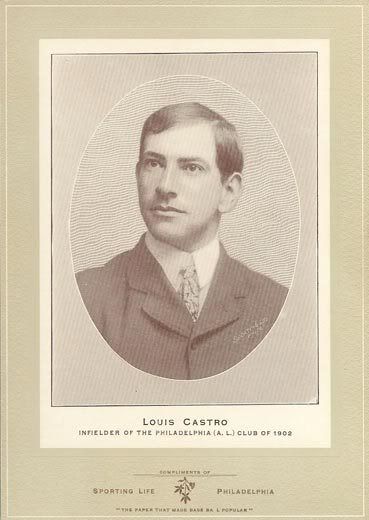
Luis Castro as the 1st Latino Major Leaguer?

It's funny how things work out. In my last post I list the pioneers of Latino baseball players. Since the last post, there has been some activity and debate on various websites on whether Luis Castro was the 1st Latino Major Leaguer. The debate is not on whether he played in the Major Leagues. That much is sure, it's whether he was born in Colombia, Panama or the United States that the issue gets confusing. To further muddle the debate, if Castro was not the 1st Latino Major League then who was, and under what criteria should the decision be made. First let me describe who Luis Castro was.

Irregardless of where he was born, it is known that he was born in 1876 (Some dates place it at November 24th). Similar to Esteban Bellan (who was profiled in my last post), Castro played his initial baseball at school while attending Manhattan College in New York City. Some dates place him there starting in 1891 and 1894, but it is known that he played for the Manhattan College team for three years. From there, his baseball experience is within various leagues. In 1898, he played for Utica, 1900 he played for Atlantic City and in 1901, he played in the Connecticut State League. How he came to be discovered by the Philadelphia Athletics for the 1902 season is not known but he did play for the Athletics in the 1902 season.

Due to a contract dispute between The Athletics and their second basemen Nap LaJoie, the second basemen position became available. The manager of the Athletics, Connie Mack, chose Luis Castro to be his second basemen. Here are his statistics for 1902:

Year
G
AB
R
H
2B
3B
HR
RBI
SB
BB
SO
AVG
1902
42
143
18
35
8
8
1
15
2
4
0
.245

Castro was let go after the 1902 season and played Minor League baseball among various leagues for about 17 years. What he did after baseball is not known but it is known that he lived with his wife in Flushing, NY and died in New York City on September 24, 1941. Pretty straightforward or so it seems.

The debate starts at this point. As per the 1910 census, Luis Castro is listed as being born in Colombia but this changes with the 1930 census where his birthplace is listed as New York City. Why the change? Speculation lies in that he was afraid of being deported. Also, since it is believed that he was in financial straits in his later years, in order to get benefits he may have needed to be a citizen of the United States. Who truly knows. The following piece of information may shed some new light where he was truly born. Based on the research of Nick Martinez, a ship's log of the SS Colon which left Colombia in 1885, a man named Nestor Castro and his eight year old child Luis (who was born in Colombia) were on the ship coming to New York City for business. Instead they stayed in the United States to make a new life for themselves.

So was he the 1st Latino Major Leaguer? If he was born in Colombia, then absolutely. If he was born in NYC, then I guess not if you subscribe to the idea that a person born in a non Latino country to a Latino parent(s)is not Latino. Though my position lies somewhere between both points of view. I believe that at least for the 1st Latino Major Leaguer he should have been at least born in Latin America. For later players, I think that if at least one of your parents were Latino, then you are Latino. Some authors have different views which can be seen in the following links:

Ian Herbert Smithsonian Magazine 9/1/2007
Peter Bjarkman's blog post 9/25/2007
Louis Castro website by Nick Martinez
Jesse Sanchez article on MLB.com 4/23/2007

So let me be devil's advocate for a second. If Castro wasn't the 1st, then who was. I personally think that Esteban Bellan should be listed as the 1st since he played in the Major League of his time (National Association) and whether the MLB, Elias Sports Bureau or any other agency doesn't recognizes it shouldn't change the fact that Bellan played Professional baseball before any other Latin ballplayer. But if we do go with the theory that the National Association wasn't a major league then who should it be. I just found about a baseball player called Charles "Chick" Pedroes who in 1902 played 2 games for the Chicago Orphans who was born in Havana but came to Chicago at the age of 2 years old. So where does he stand. I believe that this issue will only be further developed though research and I hope to be able to bring you some of that research in the near future.

Thanks,
FHJ