Showing posts with label Willie Mays. Show all posts

Thursday, April 30, 2015

Willie Mays Hits Four Round-Trippers In One Game April 30, 1961

On This Day in Baseball History April 30, 1961: Facing the Milwaukee Braves for the third consecutive game and looking down the barrel of an 0-7 slump, San Francisco Giants outfielder Willie Mays broke out of his slump with force. Mays became the ninth player (at the time) to hit four homeruns in one game. In clubbing the Braves with four homeruns, Mays drove in eight runs while homering in the first and third off Lew Burdett, in the sixth off of Seth Morehead and in the eighth inning off of Don McMahon. The opportunity to hit a fifth homerun in the game was oh so close for Mays but he would be stranded on the on-deck circle as the last out of the ninth of at 14-4 game was made by Jim Davenport.

In the article Mays, 0 for 7 Against Braves, Feared Slump Would Continue from the New York Times dated May 1, 1961 was quoted as saying the following of his achievement:
"I don't know what happened to me," he said afterwards. "When the game started, I didn't feel I would come out of my slump. But on my first time at-bat, I was seeing the ball better. No, I didn't use a different bat." 
"When you hit two homers in a game that's something you don't expect anymore," Mays said. "Hitting four is hard to believe!" 
He admitted that he "might have pressed" if he had gotten another time at bat in the ninth, knowing that he could break the record 
No player has ever hit five homeruns in a game. Here is the list of the players (and dates) that hit four homers in a game before and after Willie Mays did it on April 30, 1961
  1. Bobby Lowe (05-30-1894)
  2. Ed Delahanty HOF (07-13-1896)
  3. Lou Gehrig HOF (06-03-1932)
  4. Chuck Klein HOF (07-10-1936)
  5. Pat Seerey (07-18-1948)
  6. Gil Hodges (08-31-1950)
  7. Joe Adcock (07-31-1954)
  8. Rocky Colavito (06-10-1959)
  9. Willie Mays HOF (04-30-1961)
  10. Mike Schmidt HOF (04-17-1976)
  11. Bob Horner (07-06-1986)
  12. Mark Whiten (09-07-1993)
  13. Mike Cameron (05-02-2002)
  14. Shawn Green (05-23-2002)
  15. Carlos Delgado (09-25-2003)
  16. Josh Hamilton (05-08-2012)
The article #TBT: Mays hits 4 home runs in one game by Chris Haft of MLB.com has a series of anecdotes from some of Mays' teammates at the time including Willie McCovey and Orlando Cepeda about the four home run game.

Here is the boxscore for the April 30, 1961 game between the San Francisco Giants and the Milwaukee Braves from the New York Times dated May 1, 1961.


With the current power outage in MLB post-PED's, who do you think will be the next player to hit four homeruns in a game. Mike Trout? Nelson Cruz? Giancarlo Santon? We'll have to see if, and when, that happens.

Until Then Keep Playing Ball,
Baseball Sisco
#baseballsisco
#baseballsiscokidstyle

For Further Reading:
- The Boxscore for the April 30, 1961 matchup between the San Francisco Giants and the Milwaukee Braves from Baseball Reference

Monday, September 29, 2014

Willie Mays Makes The Catch During Game One of the World Series September 29, 1954

On this day in Baseball History September 29, 1954: With Game One of the 1954 World Series underway at the Polo Grounds, the stage was set for one of the most dramatic catches in Baseball History. The Cleveland Indians were coming off of an impressive 1954 campaign where they compiled a 111-43 record. Their opponents were the New York Giants who won the National League pennant with a 97-57 record. Indians first-baseman Vic Wertz was virtually the offense for the Indians finishing the game 4-for-5, for half of the Indians hits for the day, with a double and a triple that drove in the two runs scored by the Indians.

It was the top of the eighth inning in front of 52,751 spectators when Vic Wertz made his way up to the plate with two runners on against Giants reliever Don Liddle. To get an idea of how amazing this play way, I'll let the writing of John Drebinger in his article Giants Win in 10th From Indians 5-2, On Rhodes' Home Run from the September 30, 1954 edition of the New York Times tell the tale:
Wertz connected for another tremendous drive that went down the center of the field 450 feet, only to have Willie Mays make one of his amazing catches. 
Traveling on the wings of the wind, Willie caught the ball directly in front of the green boarding facing the right-center bleachers  and with his back still to the diamond
Here is how the newspaper captured the catch in four images:

To see the play unfold in real time, check out the following video:


The Giants would hold off the Indians and win the game on a three-run walkoff home run by Pinch hitter James "Dusty" Rhodes off of twenty-three game winner Bob Lemon. The Giants would ride the momentum of this victory and sweep the Cleveland Indians 4-0 to win their last World Series in the city of New York.

Though many of today's fans will think this catch to be passé and ordinary (read the comments after the video on the YouTube page for more proof of this), this catch came at the hands of a 21-year old rookie who on the biggest sports stage of them all caught the ball with his back to the field, running full speed ahead and arcing his head back to see the ball and then fired the ball in keeping the two runs on base from scoring. I know haters are going to hate but damn.

What did Willie Mays think of this play? The interview of Willie Mays from the Academy of Achievement website has Mays telling us in his own words about this play:
I think the key to that particular play was the throw. I knew I had the ball all the time. In my mind, because I was so cocky at that particular time when I was young, whatever went in the air I felt that I could catch. That's how sure I would be about myself. When the ball went up I had no idea that I wasn't going to catch the ball. As I'm running -- I'm running backwards and I'm saying to myself, "How am I going to get this ball back into the infield?" I got halfway out. As I'm catching the ball I said, "I know how I'm going to do it." I said, "You stop..." -- I'm visualizing this as I'm running. It's hard to tell people that -- what I'm doing as I'm running. I know people say, "You can't do all that and catch a ball." I said, "Well, that's what I was doing. Okay?" I was running, I was running. I'm saying to myself, "How am I going to get this ball back in the infield? "So now as I catch the ball -- if you watch the film close -- I catch the ball, I stop immediately, I make a U-turn. Now if I catch the ball and run and turn around -- Larry Doby which is on second, Al Rosen on first -- Larry can score from second. Because Larry told me -- I didn't see this, Larry had told me many times -- "I was just about home when you caught the ball, I had to go back to second and tag up and then go to third." So he would have scored very easily. So I said, well -- as I'm running, I've got to stop and make a complete turn. You watch the film and you'll see what I'm talking about. I stopped very quickly, made a U-turn, and when I threw the ball I'm facing the wall when the ball is already in the infield. So when you talk about the catch, more things went into the play than the catch. The throw was the most important thing because only one guy advanced, and that was Larry, from second to third. Al was still on first. And that was the key. To me it was the whole World Series.
Want to see a different view of the catch to see how hard it must have been for Mays? The article Photo of Day II: An uncommon angle on 'The Catch' by Willie Mays by Dayn Perry of the CBSSports Eye on Baseball page dated January 10, 2014 shows us the following view:


Folks, this is not an ordinary catch. That's all I have to say.

Until Then Keep Playing Ball,
Baseball Sisco
#baseballsisco
#baseballsiscokidstyle

For Further Reading:
- Click here to access the 1954 Cleveland Indians page from Baseball Reference.com
- Click here to access the 1954 New York Giants page from Baseball Reference.com


Monday, September 22, 2014

Andre Dawson Steals His 300th Base September 22, 1990

On this day in Baseball History September 22, 1990: Andre Dawson of the Chicago Cubs steals his 300th base off of Ron Darling and Mackey Sasser of the New York Mets. The 300th stolen base is significant since it allowed Dawson to join Willie Mays as the only players to have hit 300 home runs, 300 stolen bases and 2000 hits.

Dawson hit his 300th home run against Ron Darling of the New York Mets on April 23, 1989 and gets his 2,000th hit against pitcher Jim Clancy of the Houston Astros at the Astrodome August 18, 1989.

Dawson would retire at the end of the 1996 season. He would be inducted into the National Baseball Hall of Fame in 2010 with 78% of the vote (420/539 ballots).

Since Dawson joined Mays on the 300 Hit, 300 Stolen Base, and 2000 hit club, a number of other players have joined them. Who are they? I'll keep that one in the bag for a future post.

Until Then Keep Playing Ball,
Baseball Sisco
#baseballsisco
#baseballsiscokidstyle

For Further Reading:
- Click here to access Andre Dawson's career statistics from Baseball Reference.com
- Click here to access the article '89 brought milestones, playoffs for Dawson by Carrie Muskat from MLB.com dated June 21, 2010
- Click here to access the article 1990: Andre Dawson of the CUBS stole his 300th base in an... from the Chicago Tribune dated September 22, 2004
- Click here to access the post Andre Dawson by Dan D'Addona for the SABR Baseball Biography Project
- Click here to access the blogpage Hawk 4 The Hall

Saturday, September 13, 2014

Willie Mays Reaches The 500 Home Run Plateau September 13, 1965

On this day in Baseball History September 13, 1965: Willie Mays of the San Francisco Giants hits his 500th career home run making him the fifth player to reach the 500 home run plateau. Mays led the fourth inning against Houston Astros starter Don Nottebart with a drive into the center-field stands at the Houston Astrodome. At this time in Baseball History, the 500 home run club was a small one made up of the following members:
  1. Babe Ruth August 11, 1929
  2. Jimmie Foxx September 24, 1940
  3. Mel Ott August 1, 1945
  4. Ted Williams June 17, 1960
Mays would become the first African-American and first former Negro Leaguer to reach the 500 home run plateau. Here is the boxscore for September 13, 1965 match up between the San Francisco Giants and the Houston Astros:


Mays would finish the 1965 season with a league leading 52 home runs and would pass Mel Ott on both the All-Time Home Run list and the National League home run list on May 4, 1966. Mays would remain the National League All-Time hit list until he was passed by Hank Aaron on June 10, 1972.

Mays would retire after the 1973 season with the New York Mets and would be inducted into the National Baseball Hall of Fame in 1979 with 94.7% of the vote (409/432 ballots).

Mays truly was one of the best in the game. A player truly worth of the five-tool label. Players come and go, but there will only ever be one Willie Mays.

Until Then Keep Playing Ball,
Baseball Sisco
#baseballsisco
#baseballsiscokidstyle

For Further Reading:
- Click here to access Willie Mays' career statistics from Baseball Reference.com

Wednesday, September 10, 2014

Mickey Mantle Hit The Ball OUT of Tiger Stadium September 10, 1960

From The Cards
That Never Were
On this day in Baseball History September 10, 1960: At Briggs Stadium (later known as Tiger Stadium) in Detroit, Mickey Mantle of the New York Yankees strides to the plate with two men on base and two outs against Detroit starter Paul Foytack in the seventh inning. Mantle being a switch hitter took his place in the left-hand hitter box.

Yankees announcer Phil Rizzuto described Mantle's swing as "putting good wood on the ball" as Mantle swung at the 2-0 offering by Foytack and put the ball over the right field roof of Briggs Stadium. Let me repeat that, he hit the ball OVER the roof of Briggs Stadium. The ball landed at a lumberyard across the street. Though not measured at the time, a measurement "after the fact" estimated that the ball traveled a distance of 643 feet. The article Mickey Mantle's 10 Longest Home Runs by Lewis Early from The Mick.com describes the story in detail about Mantle's homer and the measurement:
Detroit's Tiger Stadium (the name was changed from Briggs Stadium) was a favorite Mantle hunting ground for legendary home run blasts. On September 10, 1960, with two out and two on in the seventh, Mickey worked the count to 2-0. Righty Paul Foytack fired a fastball right into the Mick's killing zone and he jumped on it. He crushed a spectacular drive that easily cleared the right-field roof (something Mickey had done several times by this point in his career), crossed Trumbull Avenue and landed at the base of a shed in the Brooks lumberyard across from the ballpark.

For spectators that day it was another of many tape measure homers Mantle hit during his career. For the Yankees the win - coupled with a Baltimore Orioles loss - put them back in first place in a tight pennant race. This overshadowed the magnitude of Mickey's blast in the stories that appeared in newspapers the next day. That plus the fact that spectacular Mantle home runs were becoming somewhat commonplace. So much so that Yankees' PR director Bob Fishel (Red Patterson's successor), who had many other duties, couldn't keep up with every tape measure blast Mantle hit. For that matter, Fishel wasn't with the Yankees in Detroit on that trip, so there was no one to emphasize to the press what Mickey had accomplished, and the Tigers certainly had no motivation to point it out.

But this one turns into quite a story a quarter of a century later. As told by Mark Gallagher in his excellent book, Explosion!, Dr. Paul Susman, a true Mantle fan, was convinced that this home run was special. As part of Dr. Susman's research for Gallagher's book, he went to Detroit to see if he could get the necessary information to calculate the exact distance the ball traveled.

It turns out that the story of Mickey's historic drive was well known at Brooks Lumber. Paul Borders, a Brooks employee, saw exactly where the ball landed. Susman and fellow researcher Robert Schiewe calculated the distance through Schiewe's use of the Pythagorean Theorem. The result was a prodigious 643 feet. This is the longest home run to have actually been measured from the point it was hit to the point at which it landed. Although it was measured after the fact, the point of impact was well-known and we believe this distance to be completely reliable. This is no computer estimate. This is the distance the ball traveled in the air from home plate to the place where it landed. The Guinness Book of Sports Records notes it as the longest home run in a major league game to be measured "after the fact." It is the longest home run ever hit in a major league game where it was possible to get the exact measurement. Considered along with the Bovard Field homer, it demonstrates that Mickey's unheard of home run distances are no flukes.
Now as the article Tigers beaten 5-1 by John Drebinger in the New York Times of September 11, 1960 states:
In one of Mantle's two previous clouts over this same roof, Foytack was also the victim. That occurred on June 18, 1956. Mantle's second one was hit off of Jim Bunning on Sept. 17, 1958.

Prior to that, only one homer cleared that Detroit rampart and this took place more than twenty-one years ago. (Ted) Williams did it on May 4, 1939.
Here is the box score for the September 10, 1960 game between the New York Yankees and the Detroit Tigers from the September 11, 1960 New York Times:


Mantle would go on to hit a total of 536 homers over an 18-year career. In doing so, Mantle sits at the top of the list of the most home runs by a switch-hitter in the history of the game (Eddie Murray is second with 504 homers). Mantle would retire in 1968 and would be inducted to the National Baseball Hall of Fame in 1974 with 88.2% of the vote (322/365 ballots).

Ok, let me rant for a minute. How the hell does Mickey Mantle not get at least 90% of the vote for induction. We're talking about Mickey "F'n" Mantle here. You ever get into a discussion with a person who believes that the Hall of Fame should have less members and their criteria is "If you have to think about someone being a Hall of Famer then they shouldn't be in"? If I'm going by that, the Mick is a no-brainer. You don't have to think if the Mick was a Hall of Famer. He was. HE IS!!! Bar none. His getting 88.2% of the vote is downright embarrassing. Mays got 94.6% of the vote (409/432 ballots) and in my mind, I think Mays and Mantle goes hand-in-hand. I know the Yankees dominated during Mantle's time with the era, so the Yankees hate must have been really strong. LOL. Getting off the soapbox now.


Many people wonder if we'll ever see a player like Mickey Mantle. Switch-hitting aside, I think Mike Trout is as close as we'll get this generation to a player of Mantle's caliber. Now only time will tell if Trout will continue on the pace he's playing at to make this a fair comparison.

Until Then Keep Playing Ball,
Baseball Sisco
#baseballsisco
#baseballsiscokidstyle

For Further Reading:
- Click here to access Mickey Mantle's career statistics from Baseball Reference.com
- Click here to access the article Mickey Mantle's 10 Longest Home Runs by Lewis Early from The Mick.com
- Click here to access Distance of Longest Batted Baseball from The Physics Factbook Edited by Glenn Elert -- Written by his students from the Physics Factbook website

Saturday, September 6, 2014

Eddie Murray Hits His 500th Home Run September 6, 1996

On this day in Baseball History September 6, 1996: Eddie Murray of the Baltimore Orioles hits home run number 500 against Detroit Tigers starter Felipe Lira over the right-field wall at Orioles Park at Camden Yards, Baltimore. In doing so, Murray became the 15th player to reach the 500 home run plateau and joined Hank Aaron and Willie Mays as the only players to get 3,000 hits (Murray got his 3,000th hit on June 30, 1995) and 500 home runs. Rafael Palmeiro would later join them on this list. Murray is the only switch hitter in the 3000/500 club. Here is the boxscore for the September 6, 1996 game between the Detroit Tigers and Baltimore Orioles.


Here is the 500 home run club at the time Murray hit his 500th:

  1. Babe Ruth August 11, 1929
  2. Jimmie Foxx September 24, 1940
  3. Mel Ott August 1, 1945
  4. Ted Williams June 17, 1960
  5. Willie Mays September 13, 1965
  6. Mickey Mantle May 14, 1967
  7. Eddie Mathews July 14, 1967
  8. Hank Aaron July 14, 1968
  9. Ernie Banks May 12, 1970
  10. Harmon Killebrew August 10, 1971
  11. Frank Robinson September 13, 1971
  12. Willie McCovey June 30, 1978
  13. Reggie Jackson September 17, 1984
  14. Mike Schmidt April 18, 1987
  15. Eddie Murray September 6, 1996
Murray would retire in 1997 with 3,255 hits and 504 home runs. His 504 homers was second best for a switch-hitter, Mickey Mantle is at the top of the switch-hitter home run list with 536 homers. Murray would be inducted into the National Baseball Hall of Fame in in 2003 with 85.3% of the vote (423/496 ballots).

Murray's milestone came a year to the day of Cal Ripken's 2,131st consecutive game played, passing Lou Gehrig as MLB's Iron Man. 

Until Then Keep Playing Ball,
Baseball Sisco
#baseballsisco
#baseballsiscokidstyle

For Further Reading
- Click here to access Eddie Murray's career statistics from Baseball Reference.com
- Click here to access the article Murray Collects 500th Hr, But Orioles Fall In 12 Innings by Stephen Nidetz from the Chicago Tribune website dated September 07, 1996
- Click Here to access the article Homeric Odyssey: Eddie Murray’s biggest ball has gone from milestone to afterthought by Dave McKenna from the Washington City Paper website dated January 26, 2007


Monday, July 14, 2014

Mathews and Aaron hit the 500 HR Plateau on the Same Day One Year Apart

On this day in Baseball history July 14, a year apart (1967 and 1968), against the same opponents, former teammates Eddie Mathews and Hank Aaron hit their 500th homeruns against the San Francisco Giants.


On July 14, 1967, as a member of the Houston Astros Mathews hit his 500th homerun against future Hall of Famer Juan Marichal at the Houston Astrodome. Mathews became the seventh player to reach the 500 homerun plateau, doing so two months after Mickey Mantle of the New York Yankees hit his 500th.


On July 14, 1968, the 500th homerun plateau was once again reached against the San Francisco Giants. This time it was Hank Aaron who hit his 500th against Mike McCormick at Atlanta-Fulton County Stadium. Aaron became the eight player to reach the 500 homerun plateau.

At the time of Aaron's reaching 500 homeruns, here is how the list looked like (with date of reaching the 500 homerun plateau):

  1. Babe Ruth August 11, 1929
  2. Jimmie Foxx September 24, 1940
  3. Mel Ott August 1, 1945
  4. Ted Williams June 17, 1960
  5. Willie Mays September 13, 1965
  6. Mickey Mantle May 14, 1967
  7. Eddie Mathews July 14, 1967
  8. Hank Aaron July 14, 1968

Aaron and Mathews would combine for a total of 863 homeruns as teammates from 1953-1965. An amazing accomplishment by teammates who often are overlooked when talking about the best one-two combinations in a major league lineup.

Until Then Keep Playing Ball,
Baseball Sisco
#baseballsisco
#baseballsiscokidstyle

For Further Reading:
- Click here for the box score from July 14, 1967 between the San Francisco Giants and the Houston Astros from BaseballAlmanac.com
- Click here for the box score from July 14, 1968 bewteen the San Francisco Giants and the Atlanta Braves from BaseballAlmanac.com


Thursday, July 21, 2011

Pumpsie Green and July 21, 1959

It was on today's date in 1959 that the Boston Red Sox brought up a switch hitting infield utility player of the name of Elijah Jerry "Pumpsie" Green. Why is the promotion of a switch hitting utility player during 1959 something of importance? With the promotion of Green to the Major Leagues, all 16 teams of Major League Baseball had now been integrated. Starting with the signing of Jackie Robinson with the Brooklyn Dodgers on August 28, 1945 (and his becoming the first black player to cross the color barrier on April 15, 1947) it took twelve years for all 16 teams to have at least one black player. Now I say black rather than African American since if you look at the list of the first players to integrate the 16 teams, not all of them were African American:

Brooklyn Dodgers – Jackie Robinson (1947)
Cleveland Indians – Larry Doby (1947)
St. Louis Browns – Hank Thompson (1947)
New York Giants – Hank Thompson (1949)
Boston Braves – Sam Jethroe (1950)
Chicago White Sox – Minnie Minoso (1951)
Philadelphia Athletics – Bob Trice (1953)
Chicago Cubs – Ernie Banks (1953)
Pittsburgh Pirates – Curt Roberts (1954)
St. Louis Cardinals – Tom Alston (1954)
Cincinnati Reds – Nino Escalera (1954)
Washington Senators – Carlos Paula (1954)
New York Yankees – Elston Howard (1955)
Philadelphia Phillies – John Kennedy (1957)
Detroit Tigers – Ozzie Virgil (1958)
Boston Red Sox – Pumpsie Green (1959)


Four of them were from Latin America (If you want to know more about these players, you can click here: Black Latino Pioneers from my Latinoball blog page). Back to Green.

Green's first appearance came as a pinch runner against the Chicago White Sox on July 21, 2011. His role would normally be that of a defensive infield replacement and pinch runner for the four years (1959-1962) he played with the Red Sox. Green would play his last season with the New York Mets in 1963.

Green's best season was in 1961 when in 88 games he batted .260 with 57 hits (12 2B, 3 3B, 6 HR) and 27 RBI in 219 at-bats. Green walked 42 times while striking out 32 times and stealing 4 out of 6 bases. 

The promotion of Green in 1959 casts a negative light on the Red Sox not due to Green himself, but that it took so long for the team to integrate. This could have been avoided on two earlier occasions if the airs of racial intolerance had not permeated the Boston Red Sox. The first time was in April of 1945 when under pressure of the removal of their Sunday day permit allowing the team to play Baseball by local City Councilor Isadore Muchnick, the Red Sox held a tryout for three African American players. One was Marvin Williams. The second was Sam Jethroe, and the third was Jackie Robinson.

The other occasion was in 1949 when Red Sox scouts refuse to waste their time waiting for rain to stop falling so they could scout a young black player named Willie Mays. The thought of Willie Mays and Ted Williams patrolling the same outfield is mind boggling. So instead of Boston being the first team to integrate their racial stubbornness caused them to be the last team to integrate. And the rest is history.

For a more in depth look at the racial climate in Boston in relation to the Red Sox I recommend that you check out Howard Bryant's book called Shut Out: A History of Race and Baseball in Boston

In a weird twist of fate for Pumpsie Green, following a series of losses to the New York Yankees at Yankee Stadium, Green and fellow teammate Gene Conley got off of the team bus while sitting in a traffic jam in the Bronx. They went to a bar to use the restroom and after a few drinks, they exited the bar and noticed the bus was gone. Green rejoined the team the next day. Conley went missing for a total three days spending his time at Toots Shor and at the Waldorf Astoria He would be spotted at Idlewild Airport (now known as JFK International Airport) trying to board a flight for Israel without any passports or luggage of any kind. Why? That question has never been answered.

FH

For Further Reading
- Click Here for Pumpsie Green's career statistics from Baseball Reference.com
- Click Here for the article The Boston Red Sox and Racism dated October 11, 2002 from the NPR.org website
- Click Here to access the article Red Sox Give Jackie Robinson Tryout at Fenway Park in 1945, Two Years Before He Breaks MLB Color Barrier dated June 26, 2011 from NESN.com
- Click Here to access Dan Shaughnessy's article Conley's stories fit to print dated December 15, 2004 from the Boston Globe website

Friday, May 6, 2011

Happy 80th Birthday Willie Mays

If ever there was a reason to use a time machine to go back in time is to watch Baseball players from prior eras in person and in glorious color. Granted, we have news reels and newspaper clippings to refer back to the exploits of many former players. But nothing comes close to saying that I saw so and so hit that massive homerun, steal that pivotal base, throw that no-hitter or make that amazing catch. Speaking of amazing catches, today is the Birthday of arguably the best Baseball player there has ever been. Willie Howard Mays, Jr was born on May 6, 1931 in the town of Westfield, Alabama. From his teenage years, the exploits of Mays' speed and baserunning were known throughout the Negro Leagues. Mays played with the Birmingham Black Barons of the Negro American League while he was still a high school student in 1948. After signing with the New York Giants in 1950, Mays played minor league ball with class B Trenton, New Jersey and the AAA Minneapolis Miners of the American Association. Nays made his big league debut for the New York Giants on May 24, 1951 against the Philadephia Phillies. After a slow start and some self doubt, Mays' career picked up and he never looked back.

Playing in the same Golden Era of New York City Baseball as the Brooklyn Dodgers and New York Yankees, the New York Giants made the World Series in 1951 and 1954 winning the 1954 series against the heavily favored 111-43 Cleveland Indians. In arguably the most famous catch in a World Series game, Mays made an unbelievable over the head catch to rob Vic Werth of an extra base-hit and keeping the two runners on base from scoring keeping the game tied. The Giants would eventually win Game 1 and sweep the Indians to win the 1954 World Series. Mays would never play in the World Series again. Until the Giants moved to San Francisco, the New York Baseball seen was dominated by the trio of great outfielders of Mays, Mickey Mantle of the New York Yankees and Duke Snider of the Brooklyn Dodgers.


Mays would play for the Giants until 1972 when he returned to New York City playing for the New York Mets for one season before retiring at the end of the 1973 season. His final career line is a so:

.302 Batting average with 660 HRs and 1903 RBI. Mays had 3208 hits (523 2B/140 3B/660 HR) with 338 stolen bases (in 441 attempts), 1526 strikeouts with 1464 walks. His career OPS was .941 (.384 OBP%/.557 SLG%). Mays was also a defensive marvel finishing with a .981 fielding percentage making only 141 errors in 7095 career putouts in the outfield. Mays won the Rookie of the Year award in 1951, won two National League MVP awards (1954, 1965) finishing in the top ten in MVP voting 12 times. Mays was a 20-time All-Star and won 12 consecutive Gold Glove awards. Willie Mays was inducted into the National Baseball Hall of Fame at Cooperstown in his first year of eligibility in 1979 with 94.7 percent of the vote (409 of 432 votes).

As hard as it is to me to believe that he would not get the other remaining 23 votes, Mays was only the 14th person at that time to be elected to the Hall of Fame in his 1st year of eligibility. I would just like to thank Wille Mays for all he has done for the game of Baseball and for the generations of Baseball fans who grew up reading and watching footage of his exploits. I wish I was able to see him play live but at least I can say that I had the privilege of seeing Mays in any way shape or form. Maybe I'll get lucky and someone will invent that time machine so I can sit down in the Polo Grounds and watch the marvel that is Willie Mays. Thank you and Happy Birthday

FH

For Further Reading:
- Click Here to access Willie Mays' career statistics from Baseball Reference.com
- Click Here to access Willie Mays' page from the National Baseball Hall of Fame website
- Click Here for a blogpost that I wrote on April 30, 2007 on Willie Mays and Roberto Clemente and the 1954 Puerto Rican Winter League season that they played together in the outfield from my Latinoball blogpage

Sunday, February 27, 2011

Edward Donald "The Duke" Snider 1926-2011

During the summer of 2007, I visited the exhibit The Glory Days: New York Baseball 1947-1957 located at the Museum of the City of New York. In it I saw first hand the effect that players such as Mickey Mantle, Willie Mays and Duke Snider had on their fans and the city of New York. Listening the song Talkin' Baseball by Terry Cashman also brings back memories of a baseball past that I can only see through newspaper articles and news footage.


So when I heard that one of the famed trio of the Golden Age of New York City centerfielders and member of the famed Boys of Summer, Duke Snider passed away at the age of 84, well I felt that had to write something.

Duke Snider was born Edwin Donald Snider September 19, 1926 in the city of Los Angeles California, growing up in the South Central area of the city. Snider was signed by the Brooklyn Dodgers straight out of Compton High School, where Snider was an athletic standout in the sports of baseball, basketball and football. After serving a tour of duty in the Navy from 1944-1946, Snider began his major league career.

Snider debuted with the Dodgers on April 17, 1947 joining a talented team made up with such outstanding players like Jackie Robinson, Pee Wee Reese, Gil Hodges and Carl Furillo. This era is considered to be the Golden Age of New York Baseball. The page for the Museum of the City of New York's exhibit The Glory Days: New York Baseball 1947-1957 describes it as so:

The decade between 1947 and 1957 was the golden age of baseball in New York City. With three major league teams—the Yankees, the Brooklyn Dodgers, and the New York Giants—at least one of whom played in the World Series every year except 1948; two National League teams in an intense rivalry each season; and seven landmark subway series, New York was the undisputed baseball capital of the nation.

From 1947, until they left Brooklyn in 1957, the Dodgers won six National League pennants (1947, 1949, 1952, 1953, 1955, 1956) and winning their only World Series in Brooklyn in 1955. The man known as the "Duke of Flatbush" was a main component of these teams. Snider was a seven time All Star and finished in the top ten of MVP voting six times. Snider continued playing with the Dodgers as they moved to his home town in 1958. He has the distinction of being the last player to get a base-hit at Ebbets Field and the first player to get a hit at Dodger Stadium.

Snider helped the Dodgers win their second World Series in 1959 against the Chicago White Sox. Snider's contract was sold to the New York Mets in 1963 and after a brief return to New York City, Snider's contract was sold to the San Francisco Giants in 1964. Snider would retire in the same year after the Giants released him. Snider would be elected into the Baseball Hall of Fame in Cooperstown in 1980, joining fellow New York Centerfield Greats Willie Mays (1979) and Mickey Mantle (1974).

Former Los Angeles Times staff writer Mike Kupper describes Snider's career as so:

Snider hit 40 or more homers in five consecutive seasons and during the 1950s led all major leaguers in home runs, 326; runs batted in, 1,031; runs scored, 970; and slugging percentage, .569. He finished his career with a lifetime batting average of .295 and 407 home runs, 389 of them as a Dodger, still the team record. He is the only player to have twice hit four homers in the World Series, matching his 1952 feat in '55, the year the Dodgers won the Series and he was named major league player of the year by Sporting News.

Snider remained in baseball as a broadcaster for the San Diego Padres (1969-1971), Montreal Expos (1971, 1973-1986) and the Los Angeles Dodgers (1991), as well as, being a hitting coach for the Montreal Expos (1973-1974).

Having been child in New York City during the 1970's, I would hear the stories about New York's Golden Era of Baseball on baseball telecasts and be envious that I was born too early to have experienced it. Going to the areas of Flatbush and Harlem where the former Ebbets Field and Polo Grounds existed I find it hard to believe that there were major league stadiums erected there once upon a time ago. Another component of the magical era has gone to rest. The Duke has gone to the big ballpark in the sky, joining the Mick in a fabled homerun contest. May the Duke of Flatbush rest in peace.

FH.

For Further Reading:
- Click Here for the Duke Snider obituary written by Mike Kupper from the Los Angeles Times website dated February 27, 2011
- Click Here for the Duke Snider obituary written by Richard Goldstein from the New York Times dated February 27, 2011
- Click Here to access the Duke Snider page from the Baseball Hall of Fame at Cooperstown's webpage
- Click Here to access the transcript of Duke Snider's induction speech given at the Baseball Hall of Fame at Cooperstown on August 3, 1980
- Click Here to access the virtual exhibit of The Glory Days: New York Baseball 1947-1957 provided by the Museum of the City of New York

Monday, April 30, 2007

Willie Mays and Roberto Clemente 1954

Imagine sitting in a stadium during a warm sunny day. The game is to start within a few minutes and the home team is taking their places in the field. As you scan the players on the field you recognize two players in particular. In center field you notice the “Say Hey” kid himself Hall of Famer Willie Mays. Next to him in right field is his fellow Hall of Famer, Roberto Clemente. Sounds unreal? Think of it as something that you could only do in a game like Strat-O-Matic or by flipping baseball cards? Well, it really happened. When you ask? Read on and find out.

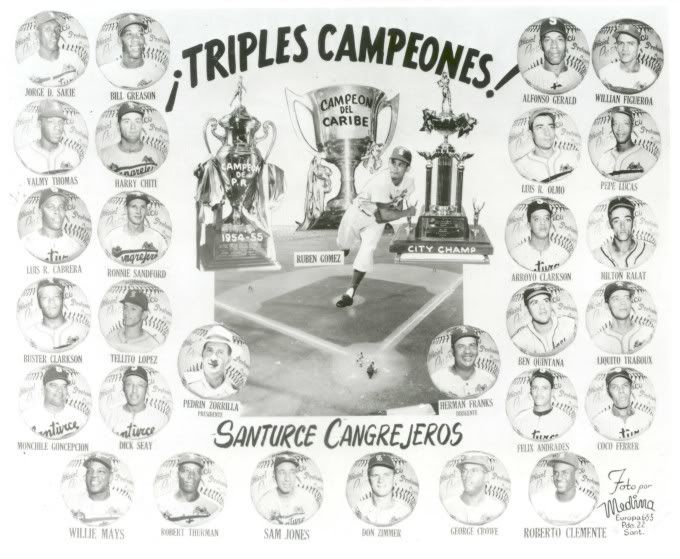
The year is 1954 and the location is Puerto Rico. Playing in the Puerto Rican Winter league on the team known as the Santurce Cangrejeros. Now the 1954 season in the United States was punctuated by the arrival on the national scene of a young 23-year-old named Willie Mays. This was seen specifically with arguably with the over the head catch by Mays off of a blast of the Cleveland Indians’ hitter Vic Wertz during Game 1 of The World Series. In contrast, Roberto Clemente had come off of a frustrating rookie season with the Montreal Royals, which was an affiliate of the Brooklyn Dodgers. It was frustrating in that The Dodgers were trying to hide him from all of the other scouts and wanted him to get proper seasoning by playing a number of years in the minors. So his playing time was limited. In the end, their hesitance to play him worked against him as the Pittsburgh Pirates took Clemente with the 1st pick of the Rule V draft in the Winter of 1955. But let’s get back to Puerto Rico in late 1954.

So again, you’re sitting in this stadium watching two of the most exciting ballplayers to ever grace the diamond in any stadium and they are playing on not only the same field but on the same team! Now you may ask, how does this happen. The economic reality of the game in those years was much different than today. Where today’s player makes at least six figures at a minimum, players in the 1950’s didn’t make much money. So when the opportunity to play baseball year round in an ideal setting like the Caribbean came along the ballplayers took it. In addition to making more money, players who were either Black or Latino found that the exclusionary racial environment they faced on a daily basis in the United States was virtually non existent in the Caribbean. They were able to dine and go where they wanted and were treated with respect.

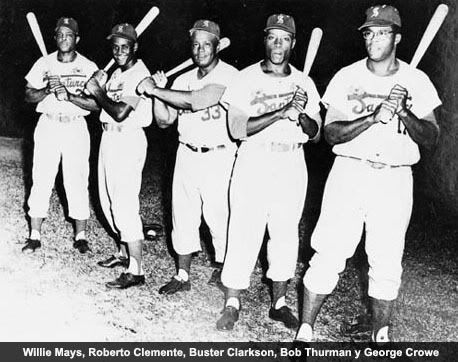
So, once again, you’re sitting in the stadium and have the luxury of knowing what kind of players Mays and Clemente would become. It’s easy for us to know how the players would develop, but in reality so did the Puerto Rican fans. Mays was already known and Clemente had been playing for the Santurce team from the age of 19 and he was known from his High School days as being an amazing player. So, though the Santurce team won their league and advanced to the Caribbean Series, Mays and Clemente were not the only ones who contributed. The vaunted lineup was also made up of sluggers Buster Clarkson, Bob Thurman, and George Crowe. Together with Mays and Clemente, they were known as El Escuadrón del Pánico (The Panic Squad). Also on the team was Puerto Rican legend Luis Rodriguez Olmo and a young shortstop named Don Zimmer.


Playing against the Legendary Almendares of Cuba, Carta Vieja of Panama and the home team Magallanes of Venezuela, The Puerto Rican team was able to win the round robin tournament by going undefeated (5-0). Mays ended the tournament with 2 homers and 9 RBI’s. Clemente also had one homer. Surprisingly, the MVP of the tournament was the unlikely hero, Don Zimmer, who hit 3 homers to take the honors.

There are many players that I personally could say that I wish I had the privilege to see in person. Though I could see footage of Mays and Clemente nothing could compare with seeing these Hall of Fame ballplayers in person. I can see in my head images of Mays making amazing catches with the ease that only he could. I also imaging Clemente running full speed to make an amazing basket catch then firing the ball to any base (And most times successfully) throwing runners out on the fly. I hope that as baseball fans you can imagine what I can and then some. Enjoy.