Showing posts with label Baseball Sisco. Show all posts

Saturday, April 7, 2018

So Far Shohei Ohtani Is The Real Deal April 7, 2018

The Angels' two-way star Shohei Ohtani is making the Angels look good so far. Now granted its only one week into the 2018 season, but Ohtani's performance is making the Angels decision to sign him look like a wise one. 

Aside from his victory in his pitching debut against the Oakland A's, in four starts as a DH, Ohtani has batted 7 for 18 with a .389 batting average with three homers and seven RBIs. Ohtani has homered in three consecutive days to boot. 

Its amazing to see how ingrained certain roles in Baseball are. The game hasn't seen a two-way player since the great Babe Ruth and with Ohtani's performance, the comparisons with Ruth continue. For example, According to the article Ohtani homers in third straight, helps Halos rally by Maria Guardado from MLB.com, Ohtani is the first American League player to homer in three straight games in the same season since he started a game since Babe Ruth did so in 1930.

And according to the article Ohtani joins exclusive company with 3rd HR in first four games by Yardbarker, Ohtani is also the sixth rookie to his three homeruns in his first four games joining Mike Jacobs, Trent Oeltjen, Yoenis Cespedes, Trey Mancini and Trevor Story. 

Ohtani has quickly made himself a fan favorite in Orange County. His second start comes against the Oakland A's, who defeated on he pitched six innings allowing seven hits (one homer) with six strikeouts and one walk. Let's see if he can continue making the Angels brass look good.

Until Then Keep Playing Ball,
Baseball Sisco
#BaseballSisco
#BaseballSiscoKidStyle


For Further Reading:

Friday, April 6, 2018

Adrián Beltré Makes History...Again April 6, 2018

Texas Rangers 3B Adrián Beltré made history once again during yesterday's game against the Oakland A's. With his 2 for 3 performance, Beltré passed Hall of Famer Rod Carew with his career hit number 3,054. In doing so, Beltré became the player born in Latin America with most career hits. Beltré was born in the Dominican Republic while Carew was born in Panama. But Beltré's history making didn't end there. 


With his second hit of the game, Beltré tied another Hall of Famer on the All-Time Hits list. This time, he stood side by side with Rickey Henderson. Both players are on the list with 3,055 hits. Hall of Famer Craig Biggio sits just ahead with 3,060 hits. Now here is where the fun really begins.

In front of Biggio is Seattle Mariners outfielder (and future Hall of Famer) Ichiro Suziki. Ichiro currently has 3, 082 hits and is the player who has most career hits that was born in a foreign country. Plus add to the 3,000 hit mix is Los Angeles Angeles (I almost typed California and Anaheim before finally typing Los Angeles, LOL) 1B/DH Albert Pujols. Pujols, who like Ichiro and Beltré is a future Hall of Famer, currently sits at 2,975 career hits. 


It is also conceivable that a 200 hit season puts Beltré at 14th on the list just past Hall of Famer Cal Ripken, who sits at 3,184 hits. The 2018 season is shaping up nicely as a race within the 3,000 hit club.

After Pujols, where do we sit in terms of current players on the cusp of the 3,000 club. You have Detroit Tigers 1B Miguel Cabrera with 2,643 hits and Seattle Mariners 2B Robinson Cano with 2,386 hits. After that, it'll be a while before we have a discussion about who might be next to reach the 3,000 hit club.

Until Then Keep Playing Ball,
Baseball Sisco
#BaseballSisco
#BaseballSiscoKidStyle

For Further Reading:

Monday, May 23, 2016

Random Thoughts on an Article From May 24, 1991

Sometimes you come across an article in an old newspaper that catches your eye. The article It's a Thrill Every Minute With Sax at Third Base by Michael Martinez of the New York Times dated May 24, 1991 did just that with me. The New York Yankees of the early 1990′s were a horrible bunch and the 1991 Yankees were no exception finishing the season with a 71-91 record. A couple of things in this article stood out to me.

First is the list of players that played the hot corner for the Yankees after they traded Graig Nettles in 1984. Looking at the list to the right, in eight seasons, they had 29 different players at third base, including Dave Winfield. What the hell was Lou Piniella thinking putting Dave Winfield at third for two games in 1986. Even I, as a lifelong Yankees have no idea who Mike O'Berry, Jeff Moronko and Leo Hernandez are, let alone when they played third for the Yankees. But I digress.

The list shows how truly valuable a player the caliber of Graig Nettles was to the Yankees from the mid 1970′s to 1984. It also makes you wonder why Graig Nettles isn’t in the Hall of Fame. He was arguably the best defensive third baseman since Brooks Robinson and though he wasn’t the kind of hitter that Mike Schmidt and George Brett were, he wasn’t too shabby either. I guess people can point to his .248 batting average as to a reason why he wasn’t inducted to the Hall but I challenge anyone to point to a better third baseman than Nettles after Robinson, Schmidt and Brett. And if you say Buddy Bell, I’d take a one armed Nettles over Bell anyday.


The second thing that I noted was the subject of the article: Steve Sax. Even today, I wonder what the hell happened to Steve Sax. That guy was money with the Los Angeles Dodgers. Sax was the 1982 NL Rookie of the Year and played in 150 games or more in five out of his eight seasons with L.A. He was durable as well for the Yankees. In his three seasons with the Yankees, he only missed 15 games in three seasons. But for whatever reasons, he just seemed to stop being able to field the ball at second base.

While not a Gold Glove winner for the Dodgers, thanks to Ryan Sandberg who owned all the N.L. Gold Glove awards from 1983-1991, Sax was a solid second baseman. Solid enough that the Yankees let long time Yankee Willie Randolph leave via free agency. Ironically, Randolph would replace his replacement on the Yankees in Los Angeles. Offensively he was everything the Yankees expected to get, but Sax just seemed to forget how to play second base. I wouldn't quite say he had the "yips" but he had so many troubles that the Yankees brought up Pat Kelly from AAA in 1991 to play second and moved Sax to third.

Sax would be sent to the Chicago White Sox in the offseason for Domingo Jean, Melido Perez and Bob Wickman. He would never regain his stride having retired after the strike season of 1994.

I know New York is a tough place to play, especially while wearing the Yankees pinstripes. But here is an example of how one player could overcome the madness in the Bronx to arguably become a Hall of Famer and a player who showed tons of potential upon his arrival to the Bronx, just became a shell of the player we was.

Until Then Keep Playing Ball,
Baseball Sisco
#baseballsisco
#baseballsiscokidstyle

For Further Reading:

Friday, October 2, 2015

The Last Weekend of the 2015 Regular Season

I know there are many Baseball fans that are against the Wild Card but year in and year out there are meaningful games being played heading into the last series of the MLB season and as a fan you can't ask for anything more than that.

The Los Angeles Angels are hanging on to their Wild Card hopes heading into a weekend series against the American League West leaders Texas Rangers. While the Rangers have clinched a postseason spot, they have yet to clinch the division. The Houston Astros are only three games back of the Rangers and a sweep by the Angels along with a sweep by the Astros of the Arizona Diamondbacks guarantees us a 163rd game of the season between the Rangers and Astros to decide who gets the AL West and the second Wild Card spot.

Not to be forgotten, the Minnesota Twins are also one game behind the Astros for second the AL Wild Card slot. Tied with the Angels, if the Twins sweep the Kansas City Royals and the Astros/Angels stumble the Twins could feasibly win the second Wild Card spot.

Over in the National League, both the Los Angeles Dodgers and the New York Mets are playing meaningful games to decide who gets the home field advantage in the first round of the playoffs. The Dodgers and Mets play division rivals in the San Diego Padres and Washington Nationals respectively and both teams need to win the next three games to ensure they don't have to be the first team to travel cross country in the best of five National League Divisional Series matchup. If both teams end up tied, The Mets would gain the home field advantage in the NLDS matchup with the Dodgers virtue of their head-to-head record during the season.

While the Chicago Cubs and Pittsburgh Pirates have clinched the two NL Wild Card spot, both teams play to decide who gets the home field advantage in the one-game playoff. The Pirates end the season at home against the Cincinnati Reds while the Cubs finish on the road against the Milwaukee Braves. The Pirates hold a two game lead over the Cubs. If the Pirates and Cubs finish the season tied with the same record, the Cubs would host the wild card game because they won the season series against the Pirates 11-8.

So here we go folks. Meaningful games are to be played in the first weekend of October. Enjoy the ride into the postseason.

Until Then Keep Playing Ball,
Baseball Sisco
#baseballsisco
#baseballsiscokidstyle

Friday, July 31, 2015

First Reigning Cy Young Award Winner Traded At The Deadline July 31, 1989

On This Day in Baseball History July 31, 1989: Minnesota Twins ace and reigning American League Cy Young Award winner Frank Viola was traded to the New York Mets for Rick Aguilera, Tim Drummond, Kevin Tapani, David West and Jack Savage.

While the trading of ace pitchers during the in-season trading period isn't rare, this transaction between the Twins and Mets marked the first time that a reigning Cy Young Winner was traded the following season after winning the award. Since the 1989 trading deadline deal that sent Viola to the Mets, only two reigning Cy Young Award winners have been traded the following season after winning the award.

In 2007, C.C. Sabathia was the American League Cy Young Award winner with the Cleveland Indians. He would be traded to the Milwaukee Brewers during the 2008 season for Rob Bryson , Zach Jackson, Matt LaPorta and Michael Brantley where he would go 11-2 with a 1.65 ERA down the stretch helping to catapult the Brewers into the postseason.

In 2008, as with C.C. Sabathia, Cliff Lee was the American League Cy Young Award winner with the Cleveland Indians and he would be traded by the deadline with Ben Francisco during the 2009 season to the Philadelphia Phillies for Jason Knapp, Carlos Carrasco, Jason Donald and Lou Marson. Lee would go 7-4 with a 3.39 ERA as the Phillies would lose to the New York Yankees in their bid to repeat as World Series Champions.

As for Frank Viola? His trade to his hometown team didn't prove to be as successful as he would have wanted. Viola went 5-5 with a 3.38 ERA down the stretch for the Mets in 1989. He would finish third in the 1990 NL Cy Young race by posting a 20-12 record with a 2.67 ERA. Though Viola was an All-Star for the Mets the following season, Viola would finish with a disappointing 13-15 record. Viola would become a free agent at the end of the season and sign with the Boston Red Sox for the 1992 season.

The Twins on the other hand would fare better in the deal. Both Rick Aguilera and Kevin Tapani were pivotal players in the Twins' march to becoming World Series Champions in 1991. Aguilera would save 42 games for Tom Kelly's Twins while Tapani would go 16-9 with a 2.99 ERA.


With the trading deadline looming, I don't think we'll see reigning Cy Young Award winners Corey Kluber or Clayton Kershaw being moved from their respective teams. But as we've seen in recent days, big name pitchers like Johnny Cueto, Cole Hamels and David Price can be moved for the right price. Any guesses on who else gets traded by the deadline?

Until Then Keep Playing Ball,
Baseball Sisco
#baseballsisco
#baseballsiscokidstyle


For Further Reading:
- Click Here to access Frank Viola's career statistics from Baseball Reference.com
- Click Here to access Rick Aguilera's career statistics from Baseball Reference.com
- Click Here to access Kevin Tapani's career statistics from Baseball Reference.com
- From Left Field: Only 3 Teams Have Traded A Reigning Cy Young Winner by Jim Mancari from the Mets Merized Online blogpage dated November 15, 2012

Saturday, July 25, 2015

My First Memories of the 2015 Hall of Fame Class

Looking at the 2015 National Baseball Hall of Fame class of Craig Biggio, Randy Johnson, Pedro Martinez and John Smoltz, I started to think about when I first remember seeing each player.

Photo: Julio Cortez, Associated Press
As I have mentioned before on this blog, I grew up as a kid in an era where we didn't have 24-hour/7-day a week sports networks, up to the minute news updates through the internet and apps. The majority of my Baseball information came the old fashioned way via baseball cards, newspapers, the local televised ballgames and the weekly games of the week. So after establishing that I am one of the last of the dinosaurs ;) here are my recollections of the first time I saw the Hall of Fame class of 2015.

Craig Biggio

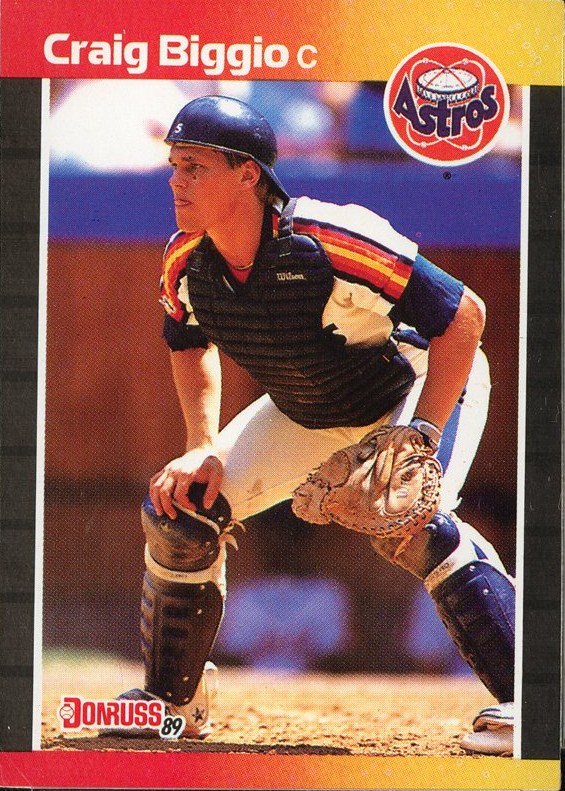
I remember Craig Biggio coming up as a catcher for the Houston Astros. Watching a game that contained the Astros would require me to watch a New York Mets telecast on WWOR-9. I honestly believe that the first time I remember Biggio was from his Baseball Card. One such card was the 1989 Donruss #561 card of Craig Biggio at the plate in his catching gear.

Biggio made his debut for the Astros in 1988 and for three season he would share duties at catcher, various outfield positions and second base. He was such a versatile athlete that he played 161 games at second base during the 1992 season and the rest as we know today is history

- Click Here for Craig Biggio's career statistics from BaseballReference.com
- Craig Biggio: From Kings Park to Cooperstown by Steven Marcus from Newsday.com dated July 24, 2015

Randy Johnson

My first recollection of Randy Johnson is in the powder blue uniforms that the Montreal Expos used to wear. Now those uniforms were truly unique and add to the mix that Randy Johnson was 6'10" and as wild as Major League's Rick Vaughn. But when I really got to know Randy Johnson was when he was traded to the Seattle Mariners in 1989. Not so much for because he was traded but because of who he was traded for.

I used to play Micro League Baseball religiously on my old Commodore 64-C (see, I am one of the last dinosaurs) and Mark Langston was always money for me in that game. I used to update the lineups every couple days a week and when the trade happened, I remember wonder who this Randy Johnson was. I remember seeing footage of his being wild either on This Week in Baseball or on the George Michael Sports Machine.

Luckily for Johnson, he would learn to utilize his size and velocity to become the Hall of Fame pitcher he is today.

- Click Here for Randy Johnson's career statistics from BaseballReference.com
- Cooperstown-bound Randy Johnson recalls the moment everything changed for him by Daniel Brown from the San Jose Mercury dated July 24, 2015

Pedro Martinez

My first memory of Pedro Martinez wasn't so much about Pedro himself but about the hype of his being the little brother of Dodgers prospect Ramon Martinez. Ramon Martinez was supposed to be the next great Los Angeles Dodgers pitcher when he came up in 1988. Ramon posted a 20-6 season in 1990 with a 2.92 ERA and 12 complete games which earned him a spot on the All-Star team and was the runner up for the 1990 NL Cy Young Award behind Doug Drabek of the Pittsburgh Pirates.

While Ramon was establishing himself as a mainstay of the Dodgers rotation, Pedro made his debut September 24, 1992. Luckily for Pedro, he wouldn't get much of a chance with the Dodgers. Pedro would be traded to the Montreal Expos for outfielder Delino DeShields after the 1993 season. It was in Montreal that Pedro would develop and shine. The 1997 trade to Boston only cemented the legendary status that Pedro Martinez would earn on his way to Cooperstown.

- Click Here for Pedro Martinez's career statistics from BaseballReference.com
- What made Pedro Martinez so great by Peter Abraham from the Boston Globe dated July 23, 2015

John Smoltz

I'm sure that I had heard of John Smoltz before the moment that I am going to mention. But if I hadn't, that Game 7 performance of the 1991 World Series against Jack Morris of the Minnesota Twins is a good place to start. Smoltz was part of an amazing starting rotation the Atlanta Braves that included Hall of Famers Greg Maddux and Tom Glavine. Also anchoring the rotation was veteran Charlie Liebrandt and prospect Steve Avery. But it was Smoltz performance that stood out to me in that classic World Series.

Smoltz matched goose-eggs on the scoreboard with Jack Morris through seven innings. And though Morris will always be remembered for arguably the second best World Series performance of 10-shutout innings, it was at this point that John Smoltz stands out in my memory.

Smoltz would not only be an outstanding starter, but also an amazing closer putting him in the same league as Denniz Eckersley as having succeeded not only as a starter but as a closer. And as Eck, Smoltz became a Hall of Famer.

- Click Here for John Smoltz's career statistics from BaseballReference.com
- Unparalleled John Smoltz a worthy Hall of Fame recipient Bby Ivan the Great from the Talking Chop blogpage on SBNation.com dated on Jul 24, 2015

What were your first recollections about the 2015 Hall of Fame class. Make sure to let me know in the comments box. I'd like to hear when it was that you discovered these future Hall of Famers.

Until Then Keep Playing Ball,
Baseball Sisco
#baseballsisco
#baseballsiscokidstyle

Sunday, July 19, 2015

Juan Marichal Debuts With a Complete Game 1-Hitter on July 19, 1960

On This Day in History July 19, 1960: 21-year old rookie Juan Marichal of the Dominican Republic makes his major league debut for the San Francisco Giants and does so in an impressive fashion. Facing the Philadelphia Phillies at home at Candlestick Park, Marichal was throwing a no-hitter until the Phillies sent up pinch hitter Clay Dalrymple with two outs in the eighth inning.

Dalrymple ruined the young pitcher's bid for a no-no in his debut with a solid single to center field on the first pitch Marichal delivered to the plate. Had Marichal been able to no-hit the Phillies, he would have been the second pitcher to throw a no-hitter in his debut after Charles Leander "Bumpus" Jones (January 1, 1870 – June 25, 1938) did so for the Cincinnati Reds on October 15, 1892 ***Bobo Holloman and Ted Breitenstein of the St. Louis Browns also threw no-hitters in their first major league starts but each had appeared in relief before making their first start.

Marichal would complete his game with a 1-hit, 12-strikeout, and 1-walk gem as the Giants beat the Phillies 2-0. Here is the boxscore of that game from the July 20, 1960 edition of the New York Times:


Marichal would become the first Dominican enshrined in Cooperstown in 1983. Marichal did it with style, flair and a bulldog determination. Pitchers today can take notes on how Marichal was able to succeed in an era where he was often overshadowed by such names as Koufax, Gibson, Drysdale and Ford. Luckily for us, we have similar pitchers in today's game in the form of Scherzer, Kershaw, Hernandez and Grienke.

Until Then Keep Playing Ball,
Baseball Sisco
#baseballsisco
#baseballsiscokidstyle

For Further Reading:

Saturday, July 18, 2015

Ty Cobb Becomes The First Player to Reach 4,000 Hits July 18, 1927

On This Day in Baseball History July 18, 1927: Philadelphia Athletics outfielder Ty Cobb became the first Major League Baseball player to reach the 4,000 hit plateau against his former team the Detroit Tigers at the Tigers home Navin Field. He would hit his 4,000th hit against Tigers pitcher Sam Gibson in the top of the first inning.

Unlike the fanfare that reaching such a milestone would garner in today's Baseball world, Cobb reaching 4,000 barely garnered any press. The New York Times of July 19, 1927 not only doesn't mention Cobb reaching 4,000 hits, he isn't even mentioned in the two paragraph article describing the 5-3 loss by the Athletics. The blogpost No hoopla when Ty Cobb got his 4,000th hit by Richard Bak from the Detroit Athletic Company dated November 18, 2013 mentions some of the Detroit press from that day's baseball action:
As Harry Salsinger wrote in the next day’s Detroit News, “Cobb hit a line drive into right field and [Harry] Heilmann, trying for a one-handed catch, got his glove on the ball but it bounced out and gave Cobb a scratch two-bagger.” Harry Bullion of the Detroit Free Press described Cobb’s hit as “a lucky double [that] slid off Heilmann’s gloved hand and helped in the making of two runs.” The 2-0 lead didn’t last long as Detroit countered with three runs in the bottom of the first off Lefty Grove.
Significantly, the game was not held up to acknowledge the historic base hit and Cobb didn’t ask for the ball. In fact, Cobb’s accomplishment was scarcely acknowledged in the next day’s papers. One reason is that little emphasis was put on such arcane records then. Another is that it was considered just another ho-hum day at the office for the 40-year-old Cobb, a hitting machine who seemed likely to go on forever. Who was to say that he wouldn’t reach 5,000 hits someday? The same attitude prevailed at the end of the summer when Babe Ruth clouted his 60th home run, breaking his own record. Like 4,000 hits, 60 home runs made for a nice round number, but many observers figured the Yankees’ slugger might one day hit 65 or 70, so why get too excited?
The Free Press ran a column of notes with the headline: “Bengals In Third Place; Ty Cobb Gets 4,000th Hit.” Bullion wrote: “When Cobb made his fluke double in the first inning, it was his 4,000th major league safety. He’s so far ahead of all records of other batsmen that he will never be beaten or tied.”
Trying not to be defeated in trying to find something on Cobb's 4,000th, I decided to look into a trusted resource that I have used before when posting about Cobb.

I pulled my worn copy of Ty Cobb: My Life in Baseball with Al Stump off my Baseball book shelf and to my dismay, I found NOTHING about the day Cobb delivered his 4,000th hit. The only mention of his accomplishments during the 1927 season for the A's is on page 257:
My personal performance in 1927 was satisfactory: a matter of 175 hits in 134 games, 104 runs scored and another 93 driven in for an average of .357. At forty-one, I could still leg it a bit, if 22 stolen bases was any evidence.
Cobb would become the charter member of the 4,000 hit club that day and finish his career with 4,191 hits. On page 146, Cobb would claim that out of the 4,191 hits he collected over his 24-year career, 72-plus percent of them were singles. He had 3,054 singles out of his total of 4,191 hits for an accurate 72.9 percent.

There is only one other member of the 4,000 hit club and that is the man who would eventually pass Ty Cobb as Baseball's All-time hit king: Pete Rose. Rose would reach 4,000 hits on April 13, 1984 and would pass Cobb on September 11, 1985 with his 4,192nd hit. Rose would finish his career with 4,256 hits.

So much for trying to find something Cobb may have said concerning the day he hit his 4,000th hit. Oh well. Though the article doesn't mention the accomplishment here is the boxscore for the Philadelphia Athletics vs. The Detroit Tigers on July 18, 1927 from the July 19, 1927 edition of the New York Times:


Will we ever see another player reach 4,000 hits? I always thought that Derek Jeter had a chance before he broke his ankle in the postseason against the Detroit Tigers in 2013. He would finish his career in 2014 with 3,465 hits. Anyone want to take a guess on who, if anyone, can reach 4,000 hits in today's game?

Until Then Keep Playing Ball,
Baseball Sisco
#baseballsisco
#baseballsiscokidstyle

Friday, July 17, 2015

Ty Cobb Passes Away on July 17, 1961

On This Day in Baseball History July 17, 1961: One of professional Baseball's best, most intense and controversial players Tyrus Raymond Cobb passed away at the age of 74 in Atlanta, Georgia.

The man simply known as Ty amassed an amazing number of accomplishments in his 24-year Baseball career. At the time of his retirement after the 1928 season, Cobb finished with a still league high .366 career batting average, 4,189 hits (724 2B/295 3B/117 HR) and 1933 RBI. Cobb had a career slash line of .366/.433/.512 with an OPS of .945. What was most impressive about Cobb's accomplishments is that he led the league in batting 12-times with a never a batting average under .324 and hit over .400 three times.

Cobb would gain 98.2% of the vote in the inaugural National Baseball Hall of Fame Class of 1936. In doing so, he was the top vote-getter in a class that included such players as Babe Ruth, Honus Wagner, Christy Mathewson and Walter Johnson.

Cobb would pass away of complications from diabetes and chronic heart disease at Emory University Hospital.

The following opinion piece was printed in the July 18, 1961 New York Times and I believe epitomizes who Ty Cobb the Baseball player was in conjunction with two of his contemporaries: Christy Mathewson and Babe Ruth:
Baseball as well as all sport has lost one of its great figures in the death of Tyrus Raymond Cobb. As with two of his outstanding contemporaries, the late Christy Mathewson and Babe Ruth, his was a name which became synonymous with America's national pastime. Curiously, each of these three was cast in his own mold.
The handsome Matty was the ideal American boy, the type that every mother hopes her son some day would emulate. The flamboyant Babe the uninhibited child of nature whose amazing exploits on the field, mixed with his engaging frankness and wayward habits, endeared himself to the public and made him the greatest attraction the game had ever known.
And Cobb, the Georgia Peach, epitomized the flaming spirit of youth. In Ty the will to win was ever uppermost. He set more records in baseball than any man who ever lived. But the setting of records, as such, meant very little to him. 
They were merely the accumulation of statistics compiled as he drove himself from day to day to live by the only code he knew. That was to play every afternoon a little harder and a little better than he had the day before. Victory was his only goal and to gain it he spared neither himself nor his adversaries. He knew no excuse for defeat. 
Some players are once in a generation. Some are once in a lifetime. Cobb was unique. There will only be one Ty Cobb.

Until Then Keep Playing Ball,
Baseball Sisco
#baseballsisco
#baseballsiscokidstyle

For Further Reading:

Here are a series of articles printed in the July 18, 1961 edition of the New York Times reflecting back on the legacy of Ty Cobb

- Ty Cobb, Baseball Great, Dies
Cobb, Hailed as Greatest Player in History, Mourned by Baseball World
- Sports of The Times: The Cobb We Knew by John Drebinger
Ty Cobb

Wednesday, June 3, 2015

Casey at the Bat Published June 3, 1888

On This Day in Baseball History June 3, 1888: The poem Casey at the Bat by Ernest Lawrence Thayer is published in the San Francisco Daily Examiner. Here is the text to the eternal Baseball poem that every Baseball fan can relate to:
Casey at the Bat 
By Ernest Lawrence Thayer
The outlook wasn’t brilliant for the Mudville nine that day:
The score stood four to two, with but one inning more to play,
And then when Cooney died at first, and Barrows did the same,
A pall-like silence fell upon the patrons of the game.
A straggling few got up to go in deep despair. The rest
Clung to the hope which springs eternal in the human breast;
They thought, “If only Casey could but get a whack at that—
We’d put up even money now, with Casey at the bat.”
But Flynn preceded Casey, as did also Jimmy Blake,
And the former was a hoodoo, while the latter was a cake;
So upon that stricken multitude grim melancholy sat,
For there seemed but little chance of Casey getting to the bat.
But Flynn let drive a single, to the wonderment of all,
And Blake, the much despisèd, tore the cover off the ball;
And when the dust had lifted, and men saw what had occurred,
There was Jimmy safe at second and Flynn a-hugging third.
Then from five thousand throats and more there rose a lusty yell;
It rumbled through the valley, it rattled in the dell;
It pounded on the mountain and recoiled upon the flat,
For Casey, mighty Casey, was advancing to the bat.
There was ease in Casey’s manner as he stepped into his place;
There was pride in Casey’s bearing and a smile lit Casey’s face.
And when, responding to the cheers, he lightly doffed his hat,
No stranger in the crowd could doubt ‘twas Casey at the bat.
Ten thousand eyes were on him as he rubbed his hands with dirt;
Five thousand tongues applauded when he wiped them on his shirt;
Then while the writhing pitcher ground the ball into his hip,
Defiance flashed in Casey’s eye, a sneer curled Casey’s lip.
And now the leather-covered sphere came hurtling through the air,
And Casey stood a-watching it in haughty grandeur there.
Close by the sturdy batsman the ball unheeded sped—
“That ain’t my style," said Casey. “Strike one!” the umpire said.
From the benches, black with people, there went up a muffled roar,
Like the beating of the storm-waves on a stern and distant shore;
“Kill him! Kill the umpire!” shouted someone on the stand;
And it’s likely they’d have killed him had not Casey raised his hand.
With a smile of Christian charity great Casey’s visage shone;
He stilled the rising tumult; he bade the game go on;
He signaled to the pitcher, and once more the dun sphere flew;
But Casey still ignored it and the umpire said, “Strike two!”
“Fraud!” cried the maddened thousands, and echo answered “Fraud!”
But one scornful look from Casey and the audience was awed.
They saw his face grow stern and cold, they saw his muscles strain,
And they knew that Casey wouldn’t let that ball go by again.
The sneer is gone from Casey’s lip, his teeth are clenched in hate,
He pounds with cruel violence his bat upon the plate;
And now the pitcher holds the ball, and now he lets it go,
And now the air is shattered by the force of Casey’s blow.
Oh, somewhere in this favoured land the sun is shining bright,
The band is playing somewhere, and somewhere hearts are light;
And somewhere men are laughing, and somewhere children shout,
But there is no joy in Mudville—mighty Casey has struck out.
Here is Walt Disney's 1946 animated version of Casey at the Bat:

Until Then Keep Playing Ball,
Baseball Sisco
#baseballsisco
#baseballsiscokidstyle
For Further Reading:
- Click here for an audio recording of De Wolf Hopper reciting Ernest Lawrence Thayer's Casey at the Bat recorded June 16, 1909 from the Library of Congress Website

Monday, June 1, 2015

Lou Gehrig Starts His Consecutive Games Streak June 1, 1925

On This Day in Baseball History June 1, 1925: The man who would be known as the Iron Horse, Lou Gehrig started his consecutive games streak by being inserted as a pinch hitter by New York Yankees manager Miller Huggins for shortstop Paul "Pee Wee" Wanninger in a 5-3 loss to the Washington Senators. Similar to how Cal Ripken Jr made an inauspicious start to his streak, Gehrig would bat for Wanninger in the eight inning against future Hall of Fame pitcher Walter Johnson and deliver a soft flyball out to left field.

Up to that point in his first two seasons with the Yankees, Gehrig was nothing more than a pinch hitter and defensive replacement. Gehrig only appeared in 23 games during the 1923 and 1924 seasons combined. Circumstances beyond his control would lead to Gehrig's baseball immortality being cemented. Many people believe that the streak started the next day on June 2, 1925 when as per legend, Wally Pipp asked to take a day off. Gehrig stepped in for Pipp at first and didn't give the bag up until the day that he took himself out of the lineup thirteen years later on May 2, 1939. Just as Steve Buscemi says as Nucky Thompson in the pilot episode of Boardwalk Empire: Never let the truth get in the way of a good story, the story of Gehrig's rise and Pipp's fall makes for a good story but its not entirely true.

Jonathan Eig in his book Luckiest Man: The Life and Death of Lou Gehrig describes the events that went into Gehrig becoming an everyday player for the Yankees:
Huggins was frustrated. The season was only two months old, yet his team seemed to be giving up. Players had been missing curfew, practicing halfheartedly, mouthing off in the dugout, and drinking too much. Pipp wasn't giving him problems off the field, but on the field the first baseman was a disaster. Huggins had already dropped Pipp from the fourth spot in the batting order to the sixth, and Pipp had not responded. He was batting .244 with only three home runs and twenty-three runs batted in. During the last three weeks of May, his batting average was an anemic .181. After the loss to Walter Johnson, Huggins decided to try a new lineup. Maybe the veterans would respond to the threat of losing their jobs. He benched not only Pipp but also catcher Wally Schang and second baseman Aaron Ward. (Page 65)
After starting at first for ten seasons for the Yankees, Pipp suffered a head injury during batting practice a month later which resulted in a fractured skull that limited his playing time during the remainder of the 1925 season. Pipp's contract would be sold to the Cinicnnati Reds for the 1926 season and would retire after the 1928 season.

Gehrig as we know became a cornerstone for the New York Yankees become a Hall of Famer as part of a formidable one-two punch with not only Babe Ruth but also Joe DiMaggio. It would seem that the illness that bears his name was the only thing that could stop the Iron Horse.

Here is the boxscore from the June 2, 1925 edition of the New York Times for the June 1, 1925 game between the Washington Senators and New York Yankees at Yankee Stadium:


Until Then Keep Playing Ball,
Baseball Sisco
#baseballsisco
#baseballsiscokidstyle

For Further Reading:
- Click Here for Lou Gehrig's career statistics from Baseball Reference.com
- Click Here for Wally Pipp's career statistics from Baseball Reference.com
- Click Here for the boxscore for the June 1, 1925 game between the Washington Senators vs The New York Yankees from Baseball Reference.com
- Wally Pipp: A son's tale about the start of Gehrig's consecutive games streak by Chris Anderson
from the Sarasota Herald Tribune dated April 22, 2009

Saturday, May 30, 2015

Cal Ripken Jr Starts His Iron Man Streak May 30, 1982

On This Day in History May 30, 1982: Baltimore Orioles rookie third baseman Cal Ripken Jr., took the field in front of 21,632 fans at Memorial Stadium in Baltimore against the Toronto Blue Jays, for the first of what would become his record setting 2,632 games played in a row. Ripken would go 0-2 with a walk and a strikeout. Not a very auspicious start to his "Iron Man" streak.

Ripken would continue to make history in 1982 when Orioles manager Earl Weaver moved him from third base to shortstop. In doing so, the position of shortstop would forever be changed form a "good glove, no hit" position to a position where both defense and offense became the norm. Ripken would go on to win the 1982 American League Rookie of the Year Award with a slashline of .264/.317/.475 with 28 homeruns and 93 RBI.

Ripken would reach the mark of 2131 consecutive games played set by the Iron Horse Lou Gehrig in 1939 on September 6, 1995 in front of the hometown crowd at Orioles Park at Camden Yards. Ripken's streak would come to an end when he voluntarily took himself out of the lineup on September 19, 1998.

Ripken would retire at the end of the 2001 season and to no one's surprise, was inducted to the National Baseball Hall of Fame in 2007 garnering 98.53% of the vote (537/545 ballots) for third best all-time after Tom Seaver (98.84%) and Nolan Ryan (98.79%).

Though in theory players today are bigger, faster and stronger than players of yesteryear, I don't see anyone being durable enough to play in enough consecutive games to reach the lofty goal of 2,632 games. What do you think folks. Anyone want to take a stab at a guess?

Until Then Keep Playing Ball,
Baseball Sisco
#baseballsisco
#baseballsiscokidstyle

For Further Reading:
- Cal Ripken Jr's career statistics from Baseball Reference.com
- The Boxscore from the Toronto Blue Jays vs. Baltimore Orioles game from May 30, 1982 courtesy of Baseball Reference.com
Ripken breaks record for consecutive games played from History.com
Streak Scene 2,131: Ripken Passes Gehrig from the Baltimore Sun Archives website
It's Over: Ripken Sits Out After 2,632 Games by Richard Justice of the Washington Post dated September 21, 1998
Calling his own number, Ripken ends the streak by Roch Kubatko of the Baltimore Sun dated September 27, 1998
Baseball Hall of Fame BBWAA Voting Percentages from Baseball Almanac.com

Sunday, May 24, 2015

Two Major Leaguers KIA during World War II

Since it is Memorial Day Weekend here in the United States, what better way to commemorate the effort given by our troops than to shed light on the two Major Leaguers who made the ultimate sacrifice during World War II.

From the moment when Japan attacked the United States at Pearl Harbor on that fateful "Day That Will Live in Infamy", December 7, 1941, superstar, reserve player and minor leaguer alike served the nation's armed forces during World War II. It is estimated that over 500-major leaguers and many more minor leaguers served during World War II. While only 2 major leaguers lost their lives in the conflict, there were an estimated 139 minor leaguers that lost their lives in World War Two. Gary Bedingfield's wonderful and informative website Baseball in Wartime and his book Baseball's Dead of World War II: A Roster of Professional Players Who Died in Service are two amazing resources to look up who those players were. On to honoring the two major leaguers who were killed in action during World War II.

- Elmer Gedeon
Gedeon was born in Cleveland, Ohio on April 15, 1917 and was the nephew of former big leaguer Joe Gedeon. Gedeon was a three sport star at the University of Michigan and made the majors with the Washington Senators in 1939. His stint with the Senators was not very memorable since he appeared in only five games with the Nats. In those five games, Gedeon batted .200 with 3 hits in 15 at-bats with an RBI and a run scored. He would be sent down to Charlotte of the Piedmont League for the 1940 season, and was recalled to Washington at the end of the season but didn't play in a game. Gedeon would never play in the majors again.

Gedeon received his draft notice in January 1941, and would later be transferred to the the Army Air Force in October, 1941. It was here where Gedeon would shine and meet his final fate. According to the biography on Elmer Gedeon on the aforementioned Baseball in Wartime website:
Flight training was always a hazardous time and almost claimed the 25-year-old's life on August 9, 1942. Gedeon was the navigator in a North American B-25 Mitchell medium-sized bomber that struggled on take-off from Raleigh Airport, North Carolina. The plane clipped pine trees at the end of the runway and plunged into a swamp before bursting into flames. Despite suffering three broken ribs, Gedeon managed to free himself and crawl from the wreckage, then realized crewmate Corporal John Rarrat was still inside. Gedeon returned to the burning plane without a moment's hesitation and pulled Rarrat to safety. Corporal Ros Ware died in the crash, Rarrat succumbed to his injuries at Rex Hospital in Raleigh, and the five other crew members all suffered serious burns and broken limbs. Gedeon was hospitalized for 12 weeks. In addition to broken ribs he suffered severe burns to his back, face, hands and legs, some of which needed skin grafts.
Gedeon would be promoted to the rank of First Lieutenant and was awarded the Soldiers' Medal for his heroics (Gedeon would later be promoted to his highest rank of Captain).

According to pilot's superstition, Gedeon was quoted as saying "I had my accident. It’s going to be good flying from now on,". Unfortunately for Gedeon it was not to be so. Again referring to the aformentioned Elmer Gedeon biography on the Baseball in Wartime website:
With his duties as operations officer, Gedeon was not a regular flyer but on the afternoon of April 20, 1944, just five days after celebrating his 27th birthday, he piloted a B-26B, one of 30 Marauders that left Boreham Field that afternoon to bomb a German VI site being constructed at Bois d'Esquerdes, France. It was the group's 13th mission.
It was nearly 7:30 P.M. when the group approached the target area and encountered blinding searchlights and intense, accurate, heavy anti-aircraft fire. The sky was suddenly full of puffs of black explosions that were silhouetted against the searchlights. These explosions generated hundreds of pieces of jagged steel that could easily set oxygen and gas tanks blazing, or rip through the wings of a plane and just as easily through the bodies of the men inside. Lining up to make the bombing run the flak grew heavier, thicker and more deadly, causing planes to bounce around from nearby bursts.
Gedeon's bomber dropped its bombs and had just passed over the target. “We got caught in searchlights and took a direct hit under the cockpit,” recalled co-pilot James Taaffe. “I watched Gedeon lean forward against the controls as the plane went into a nose dive and the cockpit filled with flames. He must have been thinking, 'Oh, no. Not again.'” [9] Taaffe, with his clothing on fire, desperately struggled to open the pilot's and co-pilot's top hatches. He looked back and saw no movement from Gedeon as he scrambled to safety through the hatch. Descending through the night sky he watched the flame-engulfed airplane spiral out of control and explode on impact with the ground, carrying Gedeon and five others to their death. The other crew members were Second Lieutenant Jack March, Staff Sergeant Joseph Kobret, Sergeant John Felker, Sergeant Ira Thomas and Private Charles Atkinson.[10]
Gedeon was reported missing in action - his fate unknown, because Taaffe had been taken prisoner by German soldiers and was being held at Stalagluft 3. It was not until May 1945 that Elmer's father, Andrew A. Gedeon, received word from his son's commanding officer that the graves of the missing airmen had been located in a small British army cemetery in St. Pol, France. Elmer Gedeon's body was later returned to the United States and rests at Arlington National Cemetery in Virginia.
For Further Reading:
Elmer J Gedeon from the American Air Museum in Britain website
- Elmer J. Gedeon's statistics from Baseball Reference.com

- Harry O'Neill
Harry Mink O’Neill was born in Philadelphia on May 8, 1917 and as Gedeon was, O'Neill was a standout athlete in college. O'Neill attended Gettysburg College in Gettysburg, Pennsylvania and was a three-sport star. After graduating college, O'Neill signed with Connie Mack’s Philadelphia Athletics on June 5, 1939. He would be the third string catcher for the Athletics in 1939 making only one appearance in that season. According to the article Harry O'Neill by Gary Bedingfield, Frank Fitzpatrick, and Bill Nowlin from the SABR Baseball Biography Project:
O’Neill made his only major-league appearance on July 23, 1939, as a late-inning defensive replacement for Frankie Hayes against the Tigers. It was a blowout of a ballgame, with the Tigers leading 9-1 after three innings and 15-3 through seven. Hayes was 0-for-4 in the game, and finally Athletics manager Earle Mack – who had taken over from his father, Connie Mack, in late June when Connie became ill – decided to give Hayes the rest of the day off and put in O’Neill behind the plate. O’Neill never got a time at bat, and was not involved in any fielding plays. He caught the fifth of Philadelphia’s five pitchers, Chubby Dean.
O'Neill would finish his major league career with a .000 batting average and played part of the 1940 season at for the Harrisburg team of the Class B Interstate League.

In September 1942, O'Neill would enlisted with the Marines Corps and was sent to the Marine Officers' Training School at Quantico, Virginia where he would graduate with the rank of Second Lieutenant. O'Neill would join the 4th Marine Division at Camp Pendelton, California. O'Neill would rise to the rank of first lieutenant and would be shipped out to the Pacific theater with the 4th Marine Division in January 1944. According to the Harry O'Neill biography page on the Baseball in Wartime website:
With the division's 25th Weapons Company, O'Neill made major amphibious assaults at Kwajalein later that month, then at Saipan in June. On June 16, 1944, he suffered a shell-fragment wound to the right arm on Saipan, and was sent back to a hospital ship to recover. He returned to active duty on July 22, 1944, and participated in the assault on Tinian. On February 19, 1945, the division landed at Iwo Jima and moved inland, over extremely difficult terrain. After an intense Allied artillery bombardment of enemy positions on March 5,1945, elements of the 3rd, 4th, and 5th Marine Divisions attacked on the morning of March 6. Fighting was heavy throughout the day with the enemy offering stiff resistance and subjecting the Marines to continuous small arms and mortar fire. By 5:30 P.M. on March 6, the Marines had made small local gains, but First Lieutenant O'Neill was dead. He had been killed by a sniper. O'Neill was one of 92 officers of the 4th Marine Division who lost their lives on Iwo Jima.
O'Neill was originally buried at Iwo Jima with 7,000+ Marines. His remains would later be interred at Arlington Cemetary in Drexel, Pennsylvania in July 1947.

For Further Reading:
Iowa Jima: Red Blood on Black Sand from the Fighting Fourth of World War II's website
- Harry M. O'Neill Class of 1939 Induction Class of 1980 of the Gettysburg College Hall of Athletic Honors page
- Harry O'Neill's statistics page from Baseball Reference.com

I would recommend that you read the much more in-depth articles on Elmer Gedeon and Harry O'Neill on the Baseball in Wartime website and the Harry O'Neill article by Gary Bedingfield, Frank Fitzpatrick, and Bill Nowlin from the SABR Baseball Biography Project. You will not be disappointed.

If you happen to be at a ballgame this weekend, give a tip of your hats and honor Elmer J. Gedeon and Harry O'Neill with a moment of silence and thanks for their ultimate sacrifice in helping us enjoy the game that they both spent time playing. Rest in Peace Captain Elmer J. Gedeon and First Lieutenant Harry M. O'Neill. Thank you for your sacrifice. You'll never be forgotten.

Until Then Keep Playing Ball,
Baseball Sisco
#baseballsisco
#baseballsiscokidstyle

Saturday, May 16, 2015

First American League Night Game May 16, 1939

On This Day in Baseball History May 16, 1939: The first American League night game took place at Philadelphia's Shibe Park when Connie Mack's Philadelphia Athletics hosted the Cleveland Indians in front of 15,109 fans.

The game would go into the 10th inning tied 3-3 until the Indians broke the game open with five runs in the top of the 10th. The Tribe would win the game by a score of 8-3.

The Athletics would become only the third MLB franchise to host a game under the lights after the Cincinnati Reds who were the first on May 24, 1935 and the Brooklyn Dodgers on June 15, 1938, which is significant in Baseball history as being the night when Cincinnati Reds pitcher Johnny Vandermeer threw his second consecutive no-hitter.

It is believed that the first professional Baseball game under the light took place on May 2, 1930, when the Des Moines, Iowa, team hosted Wichita for a Western League game. Many minor league teams would use lights to play night games five years before the majors in an attempt to stay viable during the Great Depression.

Here is the box score to the May 16, 1939 night game between the Cleveland Indians and the Philadelphia Athletics:

It really is amazing to think of a time where Baseball games were played primarily during the daytime. Aside from the Cubs who still play the majority of their home games during the day, we take it for granted today that the majority of the games are played under the lights. And with the profit margins leaning higher during night games, I don't see MLB teams playing less games at night and more during the day, especially during the week.

Until Then Keep Playing Ball,
Baseball Sisco
#baseballsisco
#baseballsiscokidstyle