Showing posts with label Esteban Bellan. Show all posts

Tuesday, October 16, 2007

Luis Castro as the 1st Latino Major Leaguer?

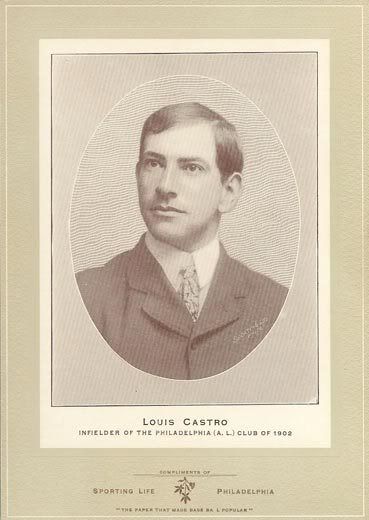
It's funny how things work out. In my last post I list the pioneers of Latino baseball players. Since the last post, there has been some activity and debate on various websites on whether Luis Castro was the 1st Latino Major Leaguer. The debate is not on whether he played in the Major Leagues. That much is sure, it's whether he was born in Colombia, Panama or the United States that the issue gets confusing. To further muddle the debate, if Castro was not the 1st Latino Major League then who was, and under what criteria should the decision be made. First let me describe who Luis Castro was.

Irregardless of where he was born, it is known that he was born in 1876 (Some dates place it at November 24th). Similar to Esteban Bellan (who was profiled in my last post), Castro played his initial baseball at school while attending Manhattan College in New York City. Some dates place him there starting in 1891 and 1894, but it is known that he played for the Manhattan College team for three years. From there, his baseball experience is within various leagues. In 1898, he played for Utica, 1900 he played for Atlantic City and in 1901, he played in the Connecticut State League. How he came to be discovered by the Philadelphia Athletics for the 1902 season is not known but he did play for the Athletics in the 1902 season.

Due to a contract dispute between The Athletics and their second basemen Nap LaJoie, the second basemen position became available. The manager of the Athletics, Connie Mack, chose Luis Castro to be his second basemen. Here are his statistics for 1902:

Year
G
AB
R
H
2B
3B
HR
RBI
SB
BB
SO
AVG
1902
42
143
18
35
8
8
1
15
2
4
0
.245

Castro was let go after the 1902 season and played Minor League baseball among various leagues for about 17 years. What he did after baseball is not known but it is known that he lived with his wife in Flushing, NY and died in New York City on September 24, 1941. Pretty straightforward or so it seems.

The debate starts at this point. As per the 1910 census, Luis Castro is listed as being born in Colombia but this changes with the 1930 census where his birthplace is listed as New York City. Why the change? Speculation lies in that he was afraid of being deported. Also, since it is believed that he was in financial straits in his later years, in order to get benefits he may have needed to be a citizen of the United States. Who truly knows. The following piece of information may shed some new light where he was truly born. Based on the research of Nick Martinez, a ship's log of the SS Colon which left Colombia in 1885, a man named Nestor Castro and his eight year old child Luis (who was born in Colombia) were on the ship coming to New York City for business. Instead they stayed in the United States to make a new life for themselves.

So was he the 1st Latino Major Leaguer? If he was born in Colombia, then absolutely. If he was born in NYC, then I guess not if you subscribe to the idea that a person born in a non Latino country to a Latino parent(s)is not Latino. Though my position lies somewhere between both points of view. I believe that at least for the 1st Latino Major Leaguer he should have been at least born in Latin America. For later players, I think that if at least one of your parents were Latino, then you are Latino. Some authors have different views which can be seen in the following links:

Ian Herbert Smithsonian Magazine 9/1/2007
Peter Bjarkman's blog post 9/25/2007
Louis Castro website by Nick Martinez
Jesse Sanchez article on MLB.com 4/23/2007

So let me be devil's advocate for a second. If Castro wasn't the 1st, then who was. I personally think that Esteban Bellan should be listed as the 1st since he played in the Major League of his time (National Association) and whether the MLB, Elias Sports Bureau or any other agency doesn't recognizes it shouldn't change the fact that Bellan played Professional baseball before any other Latin ballplayer. But if we do go with the theory that the National Association wasn't a major league then who should it be. I just found about a baseball player called Charles "Chick" Pedroes who in 1902 played 2 games for the Chicago Orphans who was born in Havana but came to Chicago at the age of 2 years old. So where does he stand. I believe that this issue will only be further developed though research and I hope to be able to bring you some of that research in the near future.

Thanks,
FHJ

Monday, August 13, 2007

1st Latino Pioneers

Latinos have been a part of professional baseball for over a century. Playing throughout the many varied leagues in the United States, Latinos have played an important role in not only advancing the game in The United States but also in their homelands. Here is the list of the 1st Latino ballplayers from Latin America. Though the list is not in order of appearance for each individual Latino, it is broken down by the 1st player from each represented country to play in the Major Leagues.

Colombia: Luis Castro 1902 Philadelphia Athletics
Cuba: Armando Marsans/Rafael Almeida 1911 Cincinnati Reds
Mexico: Baldomero “Mel” Almada 1933 Boston Red Sox
Venezuela: Alejandro Carrasquel 1939 Washington Senators
Puerto Rico: Hiram Bithorn 1942 Chicago Cubs
Panama: Humberto Robinson 1955 Milwaukee Braves
Dominican Republic: Osvaldo Virgil Sr. 1956 New York Giants
Nicaragua: Dennis Martinez 1976 Baltimore Orioles
Honduras: Gerald Young 1987 Houston Astros


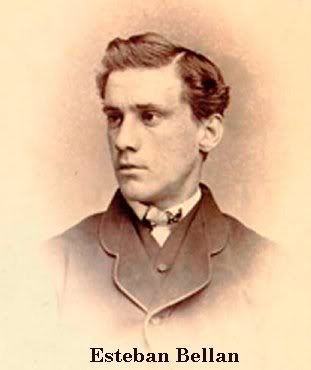
Now, technically the 1st Latino to play professional baseball in the United States was Esteban Enrique Bellan (1850-8/8/1932) of Cuba. Also known as Steve Bellan, he played his college baseball at The University of Fordham during the years of 1863-1868 on the Fordham Rose Hill Baseball Club. The Fordham Baseball Club had the distinction of being the first school to play in the first ever nine-man team college baseball game in the United States against St. Francis Xavier College on November 3, 1859.

Professionally, Bellan played for the Unions of Morrisania, an upstate New York team. In 1869 Bellan joined the Troy Haymakers for whom he played third base until 1872. In 1871 the Haymakers joined the National Association of Professional Baseball Players (NAPBBP) also known as the National Association. Eventually a number of its teams became the National League on February 2, 1876.

After his time with the Haymakers, Bellan played a year with the New York Mutuals and then returned to Cuba. On December 27, 1874 Bellan played in the first organized baseball game in Cuba. From 1878-1886 he served as both a player and manager for the recently founded Havana baseball team. He led Havana to multiple Cuban baseball championships (1878-79, 1879-1880, and 1882-1883).

Why is Bellan not recognized as the 1st Latino to play in MLB?
Though the National Association is commonly considered the first professional baseball league, its status as the first Major league disputed. By the official history of Major League Baseball, the National Association is not recognized as one of the recognized historical major leagues and MLB does not recognize the compiled statistics from that league. So, based on that reasoning, Bellan is not considered to be the 1st Latino to play in MLB.

In future posts, I will attempt to highlight each of the 1st Latino Baseball players. If you have any questions and/or comments, please feel free to post and comment. Any and all information helps to round out my blog.

Thank You.
FHJ

Monday, June 11, 2007

Minor League Baseball and Latin America Part 1

Though baseball has always been known as America’s Pastime, it’s connection with the small island nation of Cuba has been so since the late 19th century. As early as the late 1860’s, the role of baseball on the Spanish controlled nation was one of rebellion against the status quo. Where sports such as Bullfighting and Polo were deemed as diversions for the elite, baseball was embraced by the college youth as a mode of resistance against the Imperialist Spanish.

The first Cuban to play professional baseball in the United States was Esteban Bellan, who played for the National Association from the years of 1871-1873. By the early 20th century, two Cubans played for the Cincinnati Reds in 1911: Armando Marsans and Rafael Almeida. What was important to note was that while the “Gentlemen’s Agreement” that kept blacks from playing in the professional baseball leagues was in place, light skinned Cubans were allowed to play. This would prove to be important to future relations between the Major Leagues and Cuba. Also equally important was the man who managed the Cincinnati Reds: Clark Griffith. Griffith, who as the owner of The Washington Senators would employ more Cuban players than the rest of the Major League teams combined.

For many years there were exhibition matched between the Major League teams and the Cuban teams. Very often, the Cuban teams were successful against their American opponents. The relationship between the league and the island expanded within the 30’s and the 50’s with various teams holding Spring Training in Cuba. Most notable was the New York Giants (1937) and The Brooklyn Dodgers (1941, 1942, 1947) who attempted to evade the racial climate of the time with their rookie prospect Jackie Robinson. It wasn’t until 1929 that the idea for bringing professional baseball to Cuba really became a serious option.

With the eventual expansion of the Class B Southeastern League of six to eight teams in the fall of 1929, Havana was chosen to be one of the potential expansion cities. In addition to Havana, Miami was to join the cities of Jacksonville (FL), Tampa (FL), Pensacola (FL), Montgomery (AL), Selma (AL), and Columbus (GA) within the expanded Southeastern League. Though the National Association approved the expansion into Miami and Havana, the National Board of Arbitration refused to make the players fly if they did not want to. Unlike today where travel to and from the above listed cities would be easy via airplane, in 1929, commercial air travel was basically in its beginning stages. Other options would be introduced to facilitate travel to Havana but internal problems within the league would place Havana’s bid in jeopardy.

From the time of the expansion vote in December to the league meeting in February 1930, Miami’s bid was rescinded and St. Petersburg would join the league with Havana. Without having the port of Miami, which is of close distance to Havana, to fly from would cause logistical problems with travel. It was believed that the P&O Steamship Company could be used with their Tampa-Havana route to transport the players and equipment. By March of 1930, the St. Petersburg bid was also rescinded leaving the Havana franchise in jeopardy. Though the league spoke of adding Havana for the 1931 season, the Great Depression hit the league hard causing it to go out of business half way though the 1932 season.

Though the first attempt to add a franchise in Havana was unsuccessful, there would be other attempts where success would be attained. Out next blog post will highlight the Havana Cubans, who would be the First successful Minor League franchise in the Caribbean.