Showing posts with label Washington Senators. Show all posts

Sunday, July 19, 2015

Two Young Latino Pitchers Dominate the Opposition on July 19, 1960

On This Day in Baseball History July 19, 1960: A pair of young Latino pitchers throw complete game 1-hitters, both losing their no-hit bids in the eighth inning.

25-year old Cuban Pedro Ramos of the Washington Senators defeated the Detroit Tigers 5-0 at Detroit's Navin Field by hurling a 1-hit, 9-strikeout, 4-walk game that was disrupted by Rocky Colavito's eighth inning leadoff single that just got by Senators' shortstop Jose Valdivielso.

Ramos' gem was one of the only bright spots of the 1960 season for the Cuban hurler. Ramos was on track to lead the American League in losses for a third year in a row. Ramos would go 14-18 in 1958, 13-19 in 1959, 11-18 in 1960 and he would also add another consecutive league leading 11-20 record in 1961. Ramos would finish his 15-year career with a 117-160 record.

Here is the boxscore for Pedro Ramos' 1-hit complete game victory against the Detroit Tigers from the July 20, 1960 edition of the New York Times:


For Further Reading:

As I posted on my BaseballSisco blog, Juan Marichal made his career debut with a 1-hit, 12-strikeout, 1-walk complete game 2-0 gem against the Philadelphia Phillies at Candlestick Park. As with Pedro Ramos, Marichal would lose his no-hit bid in the eighth inning by allowing a single to Clay Dalrymple.

Marichal would fare considerably better in his career than Pedro Ramos did. Marichal would become one of the premier pitchers during the era of the Pitcher of the 1960's. Pitching against such stiff competition as Sandy Koufax, Don Drysdale, Bob Gibson and Warren Spahn, Marichal was able to finish with a 243-142 record over a 16-year career.

Marichal led the league in victories twice with a 25-8 record in 1963 and a 28-9 record in 1968. Marichal also put up seven straight sub 3.00 ERA seasons from 1963-1969 with a league and career best 2.10 ERA in 1969. Even more impressive was Marichal throwing 260+ innings in a season eight times with a league leading 321.1 in 1963 and a league leading and career high 325.2 in 1968. Marichal would finish the 1960's with 191 wins and 195 complete games.

Here is the boxscore of Marichal's 1-hit complete game victory against the Philadelphia Phillies from the July 20, 1960 edition of the New York Times:


For Further Reading:


Though both Latino hurlers had careers that went in different directions, they both share a moment in time when both threw 1-hit complete games on the same day.

Hasta la próxima, nunca dejaremos de jugar el Beisbol,
Baseball Sisco
#baseballsisco
#baseballsiscokidstyle


Sunday, May 24, 2015

Two Major Leaguers KIA during World War II

Since it is Memorial Day Weekend here in the United States, what better way to commemorate the effort given by our troops than to shed light on the two Major Leaguers who made the ultimate sacrifice during World War II.

From the moment when Japan attacked the United States at Pearl Harbor on that fateful "Day That Will Live in Infamy", December 7, 1941, superstar, reserve player and minor leaguer alike served the nation's armed forces during World War II. It is estimated that over 500-major leaguers and many more minor leaguers served during World War II. While only 2 major leaguers lost their lives in the conflict, there were an estimated 139 minor leaguers that lost their lives in World War Two. Gary Bedingfield's wonderful and informative website Baseball in Wartime and his book Baseball's Dead of World War II: A Roster of Professional Players Who Died in Service are two amazing resources to look up who those players were. On to honoring the two major leaguers who were killed in action during World War II.

- Elmer Gedeon
Gedeon was born in Cleveland, Ohio on April 15, 1917 and was the nephew of former big leaguer Joe Gedeon. Gedeon was a three sport star at the University of Michigan and made the majors with the Washington Senators in 1939. His stint with the Senators was not very memorable since he appeared in only five games with the Nats. In those five games, Gedeon batted .200 with 3 hits in 15 at-bats with an RBI and a run scored. He would be sent down to Charlotte of the Piedmont League for the 1940 season, and was recalled to Washington at the end of the season but didn't play in a game. Gedeon would never play in the majors again.

Gedeon received his draft notice in January 1941, and would later be transferred to the the Army Air Force in October, 1941. It was here where Gedeon would shine and meet his final fate. According to the biography on Elmer Gedeon on the aforementioned Baseball in Wartime website:
Flight training was always a hazardous time and almost claimed the 25-year-old's life on August 9, 1942. Gedeon was the navigator in a North American B-25 Mitchell medium-sized bomber that struggled on take-off from Raleigh Airport, North Carolina. The plane clipped pine trees at the end of the runway and plunged into a swamp before bursting into flames. Despite suffering three broken ribs, Gedeon managed to free himself and crawl from the wreckage, then realized crewmate Corporal John Rarrat was still inside. Gedeon returned to the burning plane without a moment's hesitation and pulled Rarrat to safety. Corporal Ros Ware died in the crash, Rarrat succumbed to his injuries at Rex Hospital in Raleigh, and the five other crew members all suffered serious burns and broken limbs. Gedeon was hospitalized for 12 weeks. In addition to broken ribs he suffered severe burns to his back, face, hands and legs, some of which needed skin grafts.
Gedeon would be promoted to the rank of First Lieutenant and was awarded the Soldiers' Medal for his heroics (Gedeon would later be promoted to his highest rank of Captain).

According to pilot's superstition, Gedeon was quoted as saying "I had my accident. It’s going to be good flying from now on,". Unfortunately for Gedeon it was not to be so. Again referring to the aformentioned Elmer Gedeon biography on the Baseball in Wartime website:
With his duties as operations officer, Gedeon was not a regular flyer but on the afternoon of April 20, 1944, just five days after celebrating his 27th birthday, he piloted a B-26B, one of 30 Marauders that left Boreham Field that afternoon to bomb a German VI site being constructed at Bois d'Esquerdes, France. It was the group's 13th mission.
It was nearly 7:30 P.M. when the group approached the target area and encountered blinding searchlights and intense, accurate, heavy anti-aircraft fire. The sky was suddenly full of puffs of black explosions that were silhouetted against the searchlights. These explosions generated hundreds of pieces of jagged steel that could easily set oxygen and gas tanks blazing, or rip through the wings of a plane and just as easily through the bodies of the men inside. Lining up to make the bombing run the flak grew heavier, thicker and more deadly, causing planes to bounce around from nearby bursts.
Gedeon's bomber dropped its bombs and had just passed over the target. “We got caught in searchlights and took a direct hit under the cockpit,” recalled co-pilot James Taaffe. “I watched Gedeon lean forward against the controls as the plane went into a nose dive and the cockpit filled with flames. He must have been thinking, 'Oh, no. Not again.'” [9] Taaffe, with his clothing on fire, desperately struggled to open the pilot's and co-pilot's top hatches. He looked back and saw no movement from Gedeon as he scrambled to safety through the hatch. Descending through the night sky he watched the flame-engulfed airplane spiral out of control and explode on impact with the ground, carrying Gedeon and five others to their death. The other crew members were Second Lieutenant Jack March, Staff Sergeant Joseph Kobret, Sergeant John Felker, Sergeant Ira Thomas and Private Charles Atkinson.[10]
Gedeon was reported missing in action - his fate unknown, because Taaffe had been taken prisoner by German soldiers and was being held at Stalagluft 3. It was not until May 1945 that Elmer's father, Andrew A. Gedeon, received word from his son's commanding officer that the graves of the missing airmen had been located in a small British army cemetery in St. Pol, France. Elmer Gedeon's body was later returned to the United States and rests at Arlington National Cemetery in Virginia.
For Further Reading:
Elmer J Gedeon from the American Air Museum in Britain website
- Elmer J. Gedeon's statistics from Baseball Reference.com

- Harry O'Neill
Harry Mink O’Neill was born in Philadelphia on May 8, 1917 and as Gedeon was, O'Neill was a standout athlete in college. O'Neill attended Gettysburg College in Gettysburg, Pennsylvania and was a three-sport star. After graduating college, O'Neill signed with Connie Mack’s Philadelphia Athletics on June 5, 1939. He would be the third string catcher for the Athletics in 1939 making only one appearance in that season. According to the article Harry O'Neill by Gary Bedingfield, Frank Fitzpatrick, and Bill Nowlin from the SABR Baseball Biography Project:
O’Neill made his only major-league appearance on July 23, 1939, as a late-inning defensive replacement for Frankie Hayes against the Tigers. It was a blowout of a ballgame, with the Tigers leading 9-1 after three innings and 15-3 through seven. Hayes was 0-for-4 in the game, and finally Athletics manager Earle Mack – who had taken over from his father, Connie Mack, in late June when Connie became ill – decided to give Hayes the rest of the day off and put in O’Neill behind the plate. O’Neill never got a time at bat, and was not involved in any fielding plays. He caught the fifth of Philadelphia’s five pitchers, Chubby Dean.
O'Neill would finish his major league career with a .000 batting average and played part of the 1940 season at for the Harrisburg team of the Class B Interstate League.

In September 1942, O'Neill would enlisted with the Marines Corps and was sent to the Marine Officers' Training School at Quantico, Virginia where he would graduate with the rank of Second Lieutenant. O'Neill would join the 4th Marine Division at Camp Pendelton, California. O'Neill would rise to the rank of first lieutenant and would be shipped out to the Pacific theater with the 4th Marine Division in January 1944. According to the Harry O'Neill biography page on the Baseball in Wartime website:
With the division's 25th Weapons Company, O'Neill made major amphibious assaults at Kwajalein later that month, then at Saipan in June. On June 16, 1944, he suffered a shell-fragment wound to the right arm on Saipan, and was sent back to a hospital ship to recover. He returned to active duty on July 22, 1944, and participated in the assault on Tinian. On February 19, 1945, the division landed at Iwo Jima and moved inland, over extremely difficult terrain. After an intense Allied artillery bombardment of enemy positions on March 5,1945, elements of the 3rd, 4th, and 5th Marine Divisions attacked on the morning of March 6. Fighting was heavy throughout the day with the enemy offering stiff resistance and subjecting the Marines to continuous small arms and mortar fire. By 5:30 P.M. on March 6, the Marines had made small local gains, but First Lieutenant O'Neill was dead. He had been killed by a sniper. O'Neill was one of 92 officers of the 4th Marine Division who lost their lives on Iwo Jima.
O'Neill was originally buried at Iwo Jima with 7,000+ Marines. His remains would later be interred at Arlington Cemetary in Drexel, Pennsylvania in July 1947.

For Further Reading:
Iowa Jima: Red Blood on Black Sand from the Fighting Fourth of World War II's website
- Harry M. O'Neill Class of 1939 Induction Class of 1980 of the Gettysburg College Hall of Athletic Honors page
- Harry O'Neill's statistics page from Baseball Reference.com

I would recommend that you read the much more in-depth articles on Elmer Gedeon and Harry O'Neill on the Baseball in Wartime website and the Harry O'Neill article by Gary Bedingfield, Frank Fitzpatrick, and Bill Nowlin from the SABR Baseball Biography Project. You will not be disappointed.

If you happen to be at a ballgame this weekend, give a tip of your hats and honor Elmer J. Gedeon and Harry O'Neill with a moment of silence and thanks for their ultimate sacrifice in helping us enjoy the game that they both spent time playing. Rest in Peace Captain Elmer J. Gedeon and First Lieutenant Harry M. O'Neill. Thank you for your sacrifice. You'll never be forgotten.

Until Then Keep Playing Ball,
Baseball Sisco
#baseballsisco
#baseballsiscokidstyle

Tuesday, August 26, 2014

Walter Johnson's 16-Game Win Streak Ends August 26, 1912

On this day in Baseball History August 26, 1912: Walter "Big Train" Johnson's 16-game win streak ends in a 3-2 loss against the St. Louis Browns under controversial circumstances. Before I go into the particulars of the controversy, I wanted to touch upon the win streak itself.

Johnson was aiming for the Major League record of 19-straight victories which is held by Rube Marquard of the New York Giants who established the record earlier in that 1912 season. Johnson would tie for the American League record with Smoky Joe Wood of the Boston Red Sox who also won 16-straight games in 1912. Two other American League pitchers would reach the 16-straight wins plateau set by Johnson and Wood in 1912. Lefty Grove of Philadelphia Athletics did so in 1931 and Schoolboy Rowe's 16-game accomplished the feat in 1934 for the Detroit Tigers. For an interesting breakdown on winning streaks from 1900-1977, I recommend you read the article Winning Streaks by Pitchers by Ronald G. Liebman from the SABR Journal Research Archive. Now for the controversy.

I was lucky enough to be able to access the box scores of both the New York Times via its TimesMachine feature and Washington Times 1902-1939 through the Chronicling America website of the Library of Congress. This game shows us how different the game of Baseball was back in 1912 compared to today.

The Washington Senators were facing the St. Louis Browns and starting pitcher Tom Hughes be responsible for two runners in top of the seventh when Johnson came in to relieve him. Here is how the article Nationals Break Even in Double Bill With Browns from the The Washington times., August 27, 1912, LAST EDITION, Page 10, Image 10:
The seventh saw the final tally counted for the Climbers, and a batting streak nipped bv Burt Shotton. With one down Ainsmith bounced one past Austin. Johnson walked. Milan, after fouling to the right field fence close to the chalkline, breezed. Foster's clean single scored Ainsmith and put Johnson on second. Then came Laporte's great drive and Shotton's greater catch.

Wallace walked In the fifth and Krichell scratched a safety to Foster, who lost the ball In the sun. Hamilton's sacrifice sent them up a cushion, and Wallace scored on Shotton's single to right Krichell came over on Compton's long hoist to Shanks.


Again Wallace and Krichell did the dirty work in the seventh, scoring the runs that won the game. Wallace singled and Krichell walked. Hamilton's bunt was a little pop to Hughes close to the line, and then came Walter Johnson into the battle with one gone and two on. Shotton never saw the ball and fanned weakly. A wild pitch had put Wallace on third, and Krichell on second and both rushed over when Compton burnt a safety to center, Williams was called out on strikes.


After that seventh the Browns could do nothing with Johnson. But they had done enough for they had put Johnson's great winning streak in danger, and It will take mature reflection on the part of the league boss, conferences with Umpires Evans and Egan and a persual of the official score to determine whether or not the defeat should be charged to Johnson or Hughes.
Now it seems with the score 3-2 in favor of the Senators with two runners on base which were the responsibility of Hughes when Johnson came in. Now here is where the game was different then from now.

Senators manager Clark Griffith is bringing in his ace to shutdown the game in the seventh inning. To put that in a modern context, that would be similar to Seattle Mariners manager Lloyd McClendon bringing in Felix Hernandez to hold a lead in the seventh inning. What I find amazing is that Johnson was to start the next game on the August 27 against the Browns. Though by today's rules, the runs that scored would be charged to Hughes and the loss given to him. But in Ban Johnson's American League of 1912 that was not to be so.

In the article Johnson Explains Strange Decision by "The Senator" from the The Washington times., August 28, 1912, LAST EDITION, Page 10, Image 10:
Ban Johnson, the boss of The American League, and interpreter of its rules, has at last explained his line of reasoning in charging Monday's defeat to Walter Johnson instead of to Tom Hughes.

"While he did not allow the two men, who scored and thereby assured St. Louis its victory, to become base runners at his expense, Johnson was, nevertheless, responsible for the fact that they did score," says the archon of the league.


"He allowed a hit and was guilty of a wild pitch. He had a chance to win the game by saving it. He failed. Therefore, he is entitled to shoulder the blame. I have announced officially that Johnson's winning record concludes with his sixteenth straight triumph."


"I believe in pitchers earning their records. Naturally, I would like to see Johnson or any other pitcher in my league honor it with a record, but he must earn it if he does. I will stand for no subterfuge."
And people complain about Bud Selig. Imagine a decision like this coming down today in the era of social media and instant news. To further add to the point, The Senator continues:
The painful thing about Ban Johnson's decision is that what he says goes. Johnson must rest with his sixteen straight games, even though Hughes is responsible for Monday's defeat in the minds of all fair-minded fans. He rules contrary to precedent of years in the National League, the parent body of the national game.

John A. Heydler, of this city, secretary of the National League and a recognized authority on the interpretation of baseball rules, says that it has been an invariable rule to charge such a defeat to the retiring pitcher. When it comes to an issue between Heydler and Johnson, few followers of baseball will lean toward the boss of the American League. They believe that Heydler knows more about the matter than does Johnson.


"My ruling In such cases has always been just opposite," said Heydler today. "I have always held that if a first pitcher leaves the game with a man on base one or more and a score is made by the men off the second pitcher it is charged against the first."


"That is my rule and always will be. I don't know of any exact precedent. If President Johnson says the record is broken it is broken. He is the one to decide in his league."
What did Walter Johnson think of the decision? The Senator continues:
Walter Johnson, who stood an excellent chance of bettering Rube Marquard's mark of nineteen straight victories, smiles and says nothing regarding the decision of Ban Johnson. Walter does not work for records particularly. He cares little whether or not he wins twenty in a row so long as he wins the twenty. That suits him. He refuses to discuss the decision, saying it has little interest for him.
Here is the box score for the controversial game:

 Published August 28, 1912 The WashingtonTimes 
In the end, Johnson would lose his next start the old fashioned way against the Browns. The New York Times listing for the game with box score describes the games activities. What I find interesting in this post (as you'll see down below) is that the post says that this loss broke Johnson's win streak, rather than the decision by Ban Johnson as I highlighted above from the Washington Times articles.


In the end, Johnson would finish the 1912 season with a 33-12 record with a 1.35 ERA. I could go into listing the incredible statistics that Johnson put up that season. I'll put it here as a picture courtesy of Baseball Reference.com. Just don't drool while you sit with you mouth open when looking over the stats ;)

Walter Johnson's Career Statistics from Baseball Reference.com


Will we ever see another stretch like Walter Johnson's in term of a consecutive game winning streak by a starter? Guess we'll have to wait and see if it ever happens.

Until Then Keep Playing Ball,
Baseball Sisco
#baseballsisco
#baseballsiscokidstyle

Wednesday, April 23, 2014

Conrado Marrero 1911-2014

The oldest living Major League, Conrado "Connie" Eugenio (Ramos) Marrero passed away on April 22, 2014, just two days shy of this 103rd Birthday. Born on April 25, 1911 in Sagua La Grande, Villa Clara, Cuba, Marrero would become one of the most successful Baseball players as an amateur in Cuba before reaching the majors at the almost ancient age (for a ballplayer to be a rookie in the pros) of 39.

Peter Bjarkman wrote an article on Marrero for the New York Times entitled Bridge to Cuba’s Baseball Past on August 13, 2011, a few months after Marrero's 100th birthday where Marrero states that his road to the pros started in the following manner:
In those days, the all-white Cuban amateur circuit was much more popular than the racially integrated professional winter league based in Havana. The amateurs played games only on weekends, and they received well-paying token employment from enterprises that sponsored their clubs.
Photo Credit Cuba Collectibles

“I earned great fame pitching for the Cienfuegos club, and they paid me good,” said Marrero, who was known in the United States as Connie. “With the national team in 1939, I was the first Cuban to beat the Americans in the amateur world series. I had no need to be with the pro clubs in Havana. I never wanted to sign a contract.

“But then on two occasions, they suspended me from the Amateur Athletic Union league. It was because I was playing in some exhibition games on the side, which was against the rules. I had won 123 and lost only 39 in seven seasons, but they threw me out. I didn’t have any choice, and then Reinaldo Cordeiro gave me a contract with the Chihuahua team in the Mexico League, and I went there in 1945 and won 28. That was how it started with the pros.”
As Bjarkman states, Marrero spent three seasons with the Havana Cubans of the Class B Florida International League, where he had 70 victories, a no-hitter and a sub-2.00 earned run average. On April 21, 1950, four days shy of his 39th birthday, Marrero would make his debut for the Washington Senators with 0.2-innings pitched against the New York Yankees in Old Yankees Stadium. Marrero would give up 1-hit to the three batters he faced. This is his career line for the five seasons he played for the Senators (Courtesy of Baseball Reference.com):

The Cold War era politics between the United States and the Fidel Castro led Cuba caused many a former major league to stay behind in Cuba when Castro closed the borders to the United States. This was no different for Marrero. In wouldn't be until 1999 when Marrero would be heard from again by Baseball Fans here in the United States.

During the first game of the 1999 exhibition series at Estadio Latinoamericano in Havana between the Baltimore Orioles and the Cuban National team on March 28, 1999, Marrero would steal the show with his throwing out of the first pitch. Richard Goldstein in his obituary for Marrero Connie Marrero, Popular Pitcher in Cuban Baseball, Dies at 102 describes the scene:
When the Baltimore Orioles played exhibitions against the Cuban national team in Havana in 1999, Marrero was selected to throw out the ceremonial first pitch. He was so enthusiastic that he could not stop. After he hurled several pitches, with the Orioles’ Brady Anderson standing at the plate, officials finally called a halt to his unofficial comeback.

At age 87, Marrero could be excused for imagining that he was back in his prime, when, in the words of Felipe Alou, the longtime major league player and manager, he confounded batters with “a windup that looked like a cross between a windmill gone berserk and a mallard duck trying to fly backwards.”


When Marrero put on his pitching performance against the Orioles, the sportscaster Bob Wolff, who had broadcast Senators games during Marrero’s time with them, remembered how “Connie was one of the Senators’ all-time popular players.”

“He was a wily, chunky guy, always with a cigar, even on the bench,” Wolff told The New York Times. “He could really make the ball do tricks. He was an excellent pitcher on a lousy team.”
Marrero would live out the rest of his life in Havana with his grandson. Now, as in June 1951, Life magazine dubbed Marrero “The Senators’ Slow-Ball Señor.”, the Slow-Ball Señor is throwing his trademark off-speed pitches in Baseball Heaven. En Paz Descanse Conrado.

Here is Conrado "Connie" Marrero celebrating his 102nd Birthday:


Hasta la próxima, no dejamos de jugar el Beisbol
Baseball Sisco
#baseballsisco

For Further Reading:
- Click Here to access the article A Cigar With the Oldest Living Former Major Leaguer by Tom Hawthorne from the Tyee.ca website dated March 4, 2011
- Click Here to access the article Going to bat for the Slow-Ball Señor by Tom Hawthorne from The Globe and Mail website dated April 26, 2011 and updated on September 10, 2012


Tuesday, March 25, 2014

Rudy Hernández The First Dominican Pitcher in MLB

I was always under the impression that the first Domican pitcher in the majors was the legendary Dominican Dandy, Hall of Famer Juan Marichal. That impression was wrong. In reading Beisbol Dominicano: Origines, Evoluciones y Heroes Edicion 2006 by Hector J. Cruz, I found out that there was a Dominican pitcher who made his debut 16 days before Marichal did for the San Francisco Giants on July 19, 1960. On July 3, 1960 Rudy Hernández made his debut in relief during the first game of a doubleheader for the Washington Senators against the Cleveland Indians.

Hernández was born on December 10, 1931 in the city of Santiago de Los Caballeros to a Dominican father and Puerto Rican mother. According to Cruz, the family would emigrate to New York City during the 1940's where Hernández would grow to the height of 6' 3" garnering the attention of many baseball teams including the hometown New York Giants. Hernández would sign a contract with the New York Giants before the beginning of the 1950 season. According to Malcolm Allen in his article on Rudy Hernández which was published in La Prensa del Beisbol Latino (a quarterly newsletter of the Society for American Baseball Research (SABR)), Hernández was signed as an outfielder with some power but could never get any higher than Class A ball. (AUTHOR'S NOTE: I tried to contact the author of the referenced article to find out exactly when it was published in La Prensa del Beisbol newsletter. Up to today's date he has yet to contact me. So I am going to use his article as a reference in a second hand nature from this post: RUDY HERNANDEZ of the Washington Senators – First Major League Baseball Pitcher Born in the Dominican Republic. If and when I do hear back from Mr. Allen, I'll rewrite the post).

After a suggestion (due to his powerful arm) by Philadelphia Phillies pitcher Steve Ridzik during the Puerto Rican Winter Ball season (possibly while both played together with los Cangrejeros de Santurce), Hernández would change positions and try his hand at pitching. According to Allen, Hernandez went 15-4 for the Class C Muskogee Giants in his first season as a pitcher but his career was derailed by a two year stint in the U.S. Military. He would return to the Giants minor leagues in 1956 and would stay there through the 1958 season. He would be either traded or sold to the Washington Senators of the American League (I'm unsure which type of transaction) before the start of the 1959 season.

Hernández would spend almost a year and a half in the Senators' minor league system before finally getting his big break at the age of 28 on July 3, 1960. In his first appearance in relief, Hernandez would face eleven batters over three innings pitched allowing one hit, one walk while striking out two batters. On July 9, 1960 against the Baltimore Orioles, Hernández became the first Dominican pitcher to record a win by hurling three shoutout innings in relief allowing one hit and one walk with three strikeouts. Over the course of the 1960 season, Hernández would make 21 appearances for the Senators (all in relief) and he would compile a 4-1 record with a 4.41 ERA in 34.1 innings pitched. He gave up 34 hits, 24 runs (17 earned) with 21 walks and 22 strikeouts for a WHIP of 1.587.

The next season marked the movement of the Washington Senators to Minneapolis becoming the Minnesota Twins. As a condition of allowing the Senators to leave Washington for Minnesota, a new team also called the Senators would replace the old Senators in the nation's capital. On December 14, 1960, Hernández would be put up in the 1961 expansion draft by the Twins and would be drafted by the new Washington Senators with the 56th pick. (AUTHOR'S NOTE: The second Washington Senators would play in Washington D.C. from 1961-1971 when the team was moved to Arlington, Texas becoming the Texas Rangers.)

In his last season in the majors, Hernández went 0-1 with a 3.00 ERA in 7 relief appearances. He had 9.0 innings pitched, gave up 8 hits, 5 runs (3 earned) with 3 walks and 4 strikeouts for a WHIP of 1.222. According to Cruz, Hernández would play for Las Aguilas Cibaeñas and Los Leones del Escogido of the Dominican League. He would later move to Puerto Rico and worked within the Department of Sports of the Puerto Rican government.

Though his time in the majors was brief and pales in comparison to Marichal's Hall of Fame career, we should never forget who was the first Dominican pitcher in the majors though to many he is just a footnote in Latino Baseball history.

On a side note, Hernández was the owner of a bar on the corner of San Jorge and Loiza streets in San Juan, Puerto Rico by the name of Rudy’s 10th Inning Lounge. In 1971, the officers of Temple Beth Shalom decided to purchase a permanent home for the congregation. One location shown by the real estate agents was the building where Hernández's bar was located. After two years of legal proceedings, the eviction of Hernandez was complete and the temple was built. For more informations, click on the following links: TBS'S (Temple Beth Shalom) Building Beginnings and Temple Beth Shalom origins.

Sisco Kid

For Further Reading
- Click here to access Rudy Hernández's career statistics from Baseball Reference.com

Wednesday, October 27, 2010

The 106th Fall Classic Begins Today

It would seem fitting that on the 50th anniversary of the Texas Rangers being admitted into the American League as the Washington Senators (After the previous version of the Senators moved to Minnesota after the 1960 season) to begin play in the 1961 season that the Rangers will play in their first ever World Series. After winning 3 American League West titles (1996, 1998, 1999) and suffering three straight defeats to the eventually World Series Champion New York Yankees in the postseason, the Rangers have finally found postseason success. In defeating the AL East Champion Tamnpa Bay Rays and the defending World Series Champion New York Yankees, the Rangers have set themselves up as the adversary to the San Francisco Giants, another transplanted franchise looking to bring the first ever World Series trophy to their "new" home.

The team formerly known as the New York Giants moved to the state of California (along with the Brooklyn Dodgers) at the end of the 1957 season and in a strange twist of fate traded places with their National League nemesis. Where the Giants found considerable success in New York with 17 National League pennants (1888, 1889, 1904, 1905, 1911, 1912, 1913, 1917, 1921, 1922, 1923, 1924, 1933, 1936, 1937, 1951, 1954) and 5 World Series titles (1905, 1921, 1922, 1933, 1954) compared to the Brooklyn Dodgers who won 12 National League pennants (1890, 1899, 1900, 1916, 1920, 1941, 1947, 1949, 1952, 1953, 1955 1956) and only 1 World Series title (1955), the success did not follow the Giants to San Francisco. While the Dodgers have thrived in Los Angeles with 9 National League pennants (1959, 1963, 1965, 1966, 1974, 1977, 1978, 1981, 1988) and 5 World Series titles (1959, 1963, 1965, 1981, 1988) the Giants have only one 4 National League pennants (1962, 1989, 2002, 2010) and have yet to win their first California World Series title. Lincecum, Wilson, Bochy and company hope to change that by next week.

The mighty bats and legend inspired pitching of the Texas Rangers meet the savvy arms and timely bats of the San Francisco Giants. History will be made with the World Series trophy being delivered to a city that has never had a World Series Champion. Who will win? Stay tuned to Fox and find out. Unless you live in a Cablevision are LIKE I DO where you will miss the game due to the bullshit between Cablevision and Fox. Luckily for me, I'll be at work for the next games 2-5 so I'll be able to watch those games.

Good luck and may the team that wants it the most win.

FH

Sunday, June 24, 2007

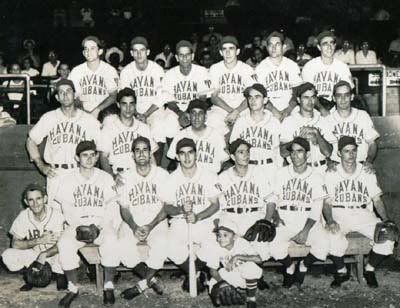
The Havana Cubans 1946-1953

The next stage of Minor League baseball in Cuba was made up in two parts. From 1946-1954 the Havana Cubans were a part of the Florida International League (FIL). The team was put together by famed Washington Senators scout Joe Cambria who was known as the main finder of Cuban baseball players for the major leagues. Originally a Class C league, the league moved up to Class B in 1947. The league was made up of teams that played in Miami, Miami Beach, Tampa, West Palm Beach and Key West. The team was an affiliate of the Washington Senators and was made up of the following future major leaguers: like Conrado “Connie” Marrero, Julio Moreno, Miguel “Mike” Fornieles and Sandalio “Sandy” Consuegra.

Success came quickly for the Havana Cubans in its early years. For its first five years in the league (1946-1950), Havana won titles in each compiling a combined 474-249 record. As quickly as success came, rougher times lay ahead. In the final three years of the Havana Cubans, the team fared no better than fourth place (1953) though they were managed by Cuban legends Adolfo Luque (1951) and Armando Marsans (1953). The best of the Havana Cuban teams was the 1947 team.

The 1947 Havana Cubans led the league with a 105-45 record and defeated the Miami Sun Sox in a five game series and defeated the Tampa Smokers four games to one to win the Championship banner of the FIL. Though the Cubans led the league with a .268 team batting average, their strength was with their pitching. Led by future major league Conrado “Connie” Marrero, won the pitching Triple Crown with a 25-6 record, a 1.66 ERA and 251 strikeouts with only 46 walks in 271 IP.

By 1954, team owner Bobby Maduro (who we’ll hear more about in the next post) decided to change the name of the team from the Cubans to the Sugar Kings and moved the team from the Florida International League to the AAA International League. The Florida International League eventually folded with the exit of its Havana franchise. All of the other franchises, except for Miami, joined the Class D Florida State League. Miami became Miami Marlins of the International League in 1956.

For our next post, I’ll be highlighting the Havana Sugar Kings of the International League. I’ll try to highlight how outside factors led to the demise of not only the Sugar Kings but of professional baseball on the island of Cuba.