Showing posts with label Jackie Robinson. Show all posts

Sunday, April 15, 2018

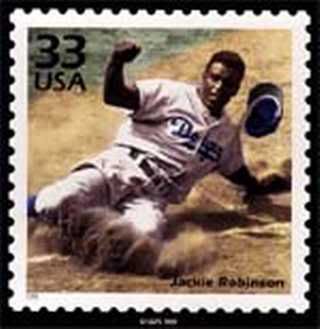
Jackie Robinson Was NOT The First Black to Play in MLB April 15, 2018

I've noticed on many a post on various social media outlets that we celebrate Jackie Robinson Day because Jackie Robinson was the first black player in MLB.  Now, before I get jumped on for my statement, its true. Jackie Robinson was NOT the first black player in MLB. And nothing of what I will say is disparaging what Jackie went through and what Jackie did in 1947 and the years after. I'll go into what Jackie Robinson WAS the first to do in the next paragraph or two.

Now, the honor and distinction of who was the first black player in MLB depends on whom you talk to. Many Baseball experts and historians give that honor to Moses "Fleetwood" Walker. Walker was a catcher who played for the Toledo Blue Stockings of the American Association during the 1884 season. Walker played for a total of 42 games that season. Another name that comes up is William Edward White who was known as Bill White. White played for the Providence Grays of the National League for just one single game, getting a hit and scoring a run. Other names that come up are Bud Fowler, Frank Grant and Sol White. But generally, Moses Walker is deemed to be the first black player in MLB before the enactment of the so called "Gentlemen's Agreement." Before I go into Jackie Robinson, I wanted to shed some light on what the "Gentleman's Agreement" entailed.

To put it simply, the "Gentlemen's Agreement" barred black and colored players from playing in organized baseball that was affiliated with the National Association of Professional Baseball Leagues. This included teams on the Major, Minor and even the independent level. This opened the door for the rise of the Negro Leagues and the integration of many an international league throughout Latin America. This is where Jackie Robinson comes in.

Jackie was the first black player to break the color line created by the "Gentleman's Agreement." By his taking the field on April 15, 1947 and being subjected to the vitriol and hatred by many a fan and fellow ballplayer, Jackie broke down the ignorant color line that kept black players from playing in the Majors since the 1880s. To say he was the first ever is inaccurate. But the first since the segregation of the Majors? That is correct. There is a difference. Just wanted to clarify what the difference was.

Thank you Jackie Robinson for your courage, poise, bravery and strength during those trying days when you helped to bring about change within an unjust and ignorant system. Thank you to Moses "Fleetwood" Walker, William Edward White, Frank Grant, Bud Fowler, Sol White and any other black pioneers lost to time.

For Further Reading:

Friday, April 17, 2015

Hank Greenberg and Jackie Robinson

One of the many stories and anecdotes that stand out concerning Jackie Robinson and his first year in the majors is his meeting the soon to be retired former Detroit Tiger (and at the time Pittsburgh Pirate) Hank Greenberg.

When the Brooklyn Dodgers traveled to Forbes Field for the first time during Robinson's rookie season in May 1947, there were many in both the stands and the opposing dugout who went after Jackie with racial slurs and epithets. Greenberg, who was Jewish and raised in the Bronx, knew first hand how cruel and hateful people could be in terms of their words and actions.

Greenberg came up to the Majors in the 1930's where anti-Semitic slurs could by regularly heard throughout the league by both fans and opposing players. Not only was verbal abuse the norm but physical abuse was often employed as a method to both intimidate and humiliate. Jackie Robinson was continually thrown at by opposing pitchers in his rookie season. During the 1930's, Jewish players (including Hank Greenberg) were the ones being thrown at and beaned. To give you an example of the world that Jewish ballplayers (in general) and Hank Greenberg specifically played in, the book The Baseball Talmud by Howard Megdal states:
But measuring Greenberg has to move beyond simply baseball. For instance, through all of the Jackie Robinson festivities, a secondary point has frequently been made that, while the struggle to integrate baseball was unimaginably difficult, Brooklyn was the perfect place, politically and culturally, for such an endeavor to take place. By contrast, the world, and in particular, the major league city that Hank Greenberg called home when he got to the big leagues, was arguably the toughest time and place a Jew could have gone to establish himself in the public eye. Greenberg got to Detroit to stay in 1933—the year Adolf Hitler took over in Germany. Detroit’s most famous citizen, in fact the city’s raison d’ĂȘtre, was Henry Ford. Ford published a newspaper that unceasingly railed against Jews, and a collection of the newspaper’s columns was published in book form as The International Jew—the World’s Foremost Problem. Reportedly, Hitler was one of his readers and admirers. Ford went on to blame “international Jewish bankers” for World War II after receiving the highest award a foreigner could receive from Hitler’s government. (At least Ford was nice enough to suffer a heart attack when shown films of the Nazi concentration camps, according to a collaborator of his—I suppose it was the least he could do.)
Along with Ford’s presence shadowing Greenberg’s city was the leading voice of reactionary public Catholicism in the 1930s, the Reverend Charles Coughlin, whose weekly radio sermons were estimated to reach more than 40 million people at their peak. Coughlin pinned the Russian Revolution and the Great Depression on the Jewish people from his pulpit in Royal Oak, Michigan, just outside Detroit. Into this situation, and a city ravaged by the Depression and looking for scapegoats, stepped Greenberg. One can only imagine the degree of difficulty...Greenberg, for his career, was the symbol of the Jewish people and all that it entailed.
Reading about what Robinson had to go through in terms of the abuse in his brief time in the majors and handling the abuse in the manner that he did, stood out to Greenberg. According to the book HANK GREENBERG The Story of My Life Edited and with an Introduction by Ira Berkow:
Early in the season, Jimmy Powers in the New York Daily News quoted Greenberg on Robinson: “The more they ride him the more they will spur him on. It threw me a lot when I first came up. I know how he feels. . . . They will keep needling Jackie, and he will react by forcing himself to play over his head. I’ll be awfully surprised if I hear that Robinson fails to hit and hold his job.”
The Brooklyn Dodgers would travel to Forbes Field in Pittsburgh for a three game series from May 15-May 17. It would be during this series that Greenberg and Robinson would meet and give Greenberg a front row seat of the abuse hurled at Robinson. Once again, according to the above quoted Greenberg's autobiography:
Jackie came into Pittsburgh on a Friday afternoon, and the place was jammed. We were in last place and the Dodgers were in first. Our Southern ballplayers, a bunch of bench jockeys, kept yelling at Jackie, “Hey, coal mine, hey coal mine, hey you black coal mine, we’re going to get you! You ain’t gonna play no baseball!” Jackie paid them no mind. He got on the bases and started dancing. It was beautiful to watch. I couldn’t help but admire him. Anyway, we were in last place and these guys were calling a guy on a first- place team names. “We’ll get you next time at bat, you dumb black son of a bitch. We’re going to get you!”

Jackie turned his head. He was like a prince. He kept his chin up and kept playing as hard as he could. He was something to admire that afternoon.

I got to thinking, here were our guys, a bunch of ignorant, stupid Southerners who couldn’t speak properly, who hadn’t graduated from school, and all they could do was make jokes about Jackie. They couldn’t recognize that they had a special person in front of them, a gem. They just kept ragging him and calling him names.

In a way, it was sad that he was so educated because, had he been just an ordinary bumpkin, it might have been easier for him. But the fact that he was a college man, from UCLA, and a football star, a baseball star, and a basketball star made it difficult for him to accept a role of a subhuman being in a world where he felt he was an equal. In every park that he played that spring he was on exhibition. He was the one the fans came out to see, this first black ballplayer in the Major Leagues.
It's not totally clear to me in which game during the series that the collision between Greenberg and Robinson occurred at first base. The article HANK GREENBERG A HERO TO DODGERS’ NEGRO STAR from the New York Times dated May 18, 1947 stated the following concerning the discussion between Greenberg and Robinson:
Jackie Robinson, first Negro player in the Major Leagues, has picked a diamond hero— rival first baseman Hank Greenberg of the Pittsburgh Pirates.

Here’s why:

Robinson and Greenberg collided in a play at first base during the current Dodger- Pirate series. The next time Jackie came down to the sack, Hank said,

"I forgot to ask you if you were hurt in that play."
Assured that Robinson was unharmed, Greenberg said:

"Stick in there. You’re doing fine. Keep your chin up."
This encouragement from an established star heartened Robinson, who has been the subject of reported anti- racial treatment elsewhere and admits he has undergone ‘jockeying— some of it pretty severe."

“Class tells. It sticks out all over Mr. Greenberg,"Robinson declared.
Greenberg's autobiography delves further into the conversation between the two future Hall of Famers:
I said to Robinson at first base, “Don’t pay any attention to these Southern jockeys. They aren’t worth anything as far as you’re concerned.”

He thanked me and I said, “Would you like to go to dinner?”

He said, “I’d love to go to dinner, but I shouldn’t because it’ll put you on the spot.”

That was our conversation, and we always were friends after that, even though he was in the National League and I went back to the American League as a club executive after that season.
Greenberg further elaborates on his observations concerning the behavior towards Robinson compared to his own experiences:
Jackie had it tough, tougher than any ballplayer who ever lived. I happened to be a Jew, one of the few in baseball, but I was white, and I didn’t have horns like some had thought I did. Jo- Jo White had said to me, “I thought all you Jews had horns on your head.” But I identified with Jackie Robinson. I had feelings for him because they had treated me the same way. Not as bad, but they made remarks about my being a sheenie and a Jew all the time.
Upon Robinson's retirement from the game after the 1957 season, there were many former and current players who wished Robinson well wishes. One of these was Hank Greenberg. According to the book Jackie Robinson: A Biography by Arnold Rampersad:
Hank Greenberg, writing to praise "your long and illustrious career" and the "exemplary manner in which you have conducted yourself--both on and off the field," called Robinson "a credit to baseball and inspiration" to youngsters "who will attempt to emulate your example."
Both baseball legends would once again be tied historically in 1970, when both Greenberg and a Robinson testified in Federal Court against Baseball's Reserve Clause in the Flood v. Kuhn (407 U.S. 258) aka Curt Flood case.

Jackie Robinson would pass away on October 24, 1972 with Greenberg attending Robinson's funeral. Greenberg himself would pass away on September 4, 1986.

It really is surreal to think that players such as Hank Greenberg and Jackie Robinson had to deal with such blatant racism no more than 70-years ago. That such behavior was deemed to be a part of everyday life. That it was acceptable to treat a person in such a manner because of the color of their skin or due to the religion that they choose to practice.

It really is heartening that a player such as Hank Greenberg, who himself was an object of the hatred and ignorance of others chose to support Jackie Robinson. It would have been easier for Greenberg to just forget his own experiences rather than take the positive step forward to lend support and encouragement to Robinson. Thankfully, Greenberg exhibited the qualities of the decent man that he was in reference to Jackie Robinson and it needs to be a story that is told more than just once a year.

Until Then Keep Playing Ball,
Baseball Sisco
#baseballsisco
#baseballsiscokidstyle

Monday, July 8, 2013

The Most Steals of Home Plate

Getty Images
I came across an answer to the question of Who is the all-time leader of steals of home plate when reading The Baseball Fan's Bucket List: 162 Things You Must Do, See, Get, and Experience Before You Die by Robert and Jenna Santelli. Now whenever I think of stealing home I think of Jackie Robinson stealing home during Game One of the 1955 World Series and catcher Yogi Berra jumping up in protest when the umpire called Robinson safe. Now unfortunately the statistic of steals of home is not an official statistic but I decided I look online to see what I could find.

The Baseball Fan's bucket list states that Ty Cobb is the all-time leader with 50. Baseball Almanac has Ty Cobb in the lead with 54 stolen bases of home. Here is the list as compiled by Baseball Almanac (for players with 10 or more stolen bases of home plate):

Stealing Home Plate Ten Times in a Career
Ty Cobb (1905-1928) 54
Max Carey (1910-1925) 33
George Burns (1911-1925) or (1914-1929) 28
Honus Wagner (1897-1917) 27
Sherry Magee (1904-1919) 23
Frank Schulte (1914-1918) 23
Johnny Evers (1902-1929) 21
George Sisler (1915-1930) 20
Frankie Frisch (1919-1937) 19
Jackie Robinson (1947-1956) 19
Jim Sheckard (1897-1913) 18
Tris Speaker (1907-1928) 18
Joe Tinker (1902-1916) 18
Rod Carew (1967-1985) 17
Eddie Collins (1906-1930) 17
Larry Doyle (1907-1912) 17
Tommy Leach (1898-1918) 16
Ben Chapman (1933-1946) 15
Fred Clarke (1894-1915) 15
Lou Gehrig (1923-1939) 15
Bobby Byrne (1907-1917) 14
Fritz Maisel (1913-1918) 14
Fred Merkle (1907-1926) 14
Vic Saier (1911-1929) 14
Heinie Zimmerman (1907-1919) 13
Donie Bush (1908-1923) 12
Sam Rice (1915-1934) 12
Shano Collins (1910-1925) 11
Harry Hooper (1909-1925) 11
George Moriarty (1903-1916) 11
Braggo Roth (1914-1921) 11
Buck Herzog (1908-1920) 11
Jimmy Johnston (1911-1926) 10
Rabbit Maranville (1912-1935) 10
Paul Molitor (1978-1998) 10
Babe Ruth (1914-1935) 10
Billy Werber (1930-1942) 10
Ross Youngs (1917-1926) 10

****AUTHOR'S NOTE There are two different sets of years listed for George Burns since there were two players named George Burns who played during virtually the same time. Both had a high number of stolen bases so I couldn't discern which George Burns was the one on this list. 

I added the years the players played to add perspective to the list. Out of the 38 players on the list, 32 of the players made their debut in the Dead Ball Era. Baseball Reference describes the Dead Ball Era as:
While the exact period that should be described as the Deadball Era is arguable, it is generally recognized to have stretched from the founding of the American League in 1901 to the elimination of the spitball in 1920. The Deadball Era marked the end of the sport's rapid development in the 19th Century and the beginning of relative stability in the rules and structure of the Major League game.
What I find curious is that among the speedsters like Rabbit Maranville, Honus Wagner and Ty Cobb, there is Babe Ruth with 10 steals of home. I guess Tommy Lee Jones as Ty Cobb in the Cobb movie was right about Ruth: He could run okay for a fat man. =)

The remaining six players are broken down as such: Three debuted between 1920 and 1935, one in 1947 (Robinson) and two after 1965 (Carew and Molitor). Only four of the top ten in career stolen bases are on this list (Cobb, Collins, Carey and Wagner). So what does this show?

I believe that it shows that stealing home was a part of an aggressive strategy employed by managers and base-runners in an era where there wasn't a reliance on the long ball to score runs. With the rise of the long ball and the gaining popularity such Baseball philosophies as Moneyball (stolen bases are not deemed favorable in the Sabermetric principles concerning Baseball statistics and productivity) the tendency to try to steal home (and to a lesser degree all bases) has diminished in the last decades. But are these the only reasons why the stealing home has virtually disappeared? I kept looking and found another reason why.

I found an article by Dave Anderson of the New York Times entitled Why Nobody Steals Home Anymore which was published on April 16, 1989. Now given that the article is almost 25 years old, I find that it is still relevant with the game today. One statement from Whitey Herzog in the article stood out to me:
'The game has changed,'' said Whitey Herzog, the Cardinals' manager. ''You don't see big windups anymore.''
Anderson further adds:
With a base-stealing threat on third, pitchers seldom use a big rocking-chair windup as they often did years ago. Instead, they usually check the runner in coming to a stretch or a semistretch position that not only holds the runner closer to the bag but also takes less time.
This makes total sense to me. Aside from Dontrelle Willis, I can't say that I've seen a pitcher recently who utilizes a big windup a-la Juan Marichal and Bob Feller. With windups becoming shorter and more compact and with pitchers even using the stretch more and more, the opportunities to steal home have shrunk. To think about it, the last steal of home I remember was Jacoby Ellsbury stealing home on Andy Pettitte of the New York Yankees in 2009.

Though there seems to be a renaissance in base stealing throughout the majors. Cincinnati Reds prospect Billy Hamilton stole a total of 155 bases during the 2012 season evoking memories of the last stolen base glory era of Rickey Henderson, Tim Raines, Willie Wilson and Vince Coleman. I believe that with the concerted effort of MLB to curtail the use of PED's in the sport and the subequent diminishing of power numbers to the Pre-Steroid Era levels, teams are trying to find ways to score runs via small ball techniques. While I believe that stolen bases in general will continue to rise league-wise. it remains to be seen whether or not a return to stealing home becomes the norm or stays a rarity.

Sisco Kid

On a final note, I leave you with footage of the above referenced stolen base of home by Jackie Robinson in the 1955 World Series. Enjoy.

Tuesday, April 16, 2013

Jackie Robinson Day April 15


I originally wrote this post for my NYCHistory blog page entitled Jackie Robinson Day April 15 on April 15, 2009. Since today is once again April 15th, I decided to re-post this in honor of Jackie Robinson:

April 15 is known to many people as the day that the TaxMan gets his due. But for baseball people, April 15th has a different significance. On April 15th, 1947, a young 28-year-old man took the field at Ebbets Field for the Brooklyn Dodgers in a game against the Boston Braves. While playing first base, he had no hits in three at bats. Though this description is somewhat ordinary, the player was anything but. For the first time since the late 1800’s, a black man was allowed to play professional baseball within the ranks of Major League Baseball. That man was Jack Roosevelt "Jackie" Robinson (January 13, 1919-October 24, 1972).
"It kills me to lose. If I'm a troublemaker, and I don't think that my temper makes me one, then it's because I can't stand losing. That's the way I am about winning, all I ever wanted to do was finish first." Jackie Robinson
Robinson brought an energy and excitement to both the field of play that was only seen on the fields that the Negro Leagues baseball was played on. His determination on the field translated to a form of baseball that emphasized speed and aggressive base running that many of the fans of Major League baseball had not seen. Where Robinson was aggressive on the field he was patient with the abuse that was hurled towards him from not only fans but from fellow players who often insulted him and threatened to not take the field if Robinson played in the game.
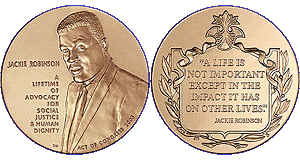
"A life is not important except in the impact it has on other lives."Jackie Robinson
The significance of Robinson’s playing for the Dodgers was not only felt within the baseball ranks. In terms of society, Robinson would become one of the icons of the growing civil rights movement. As Buck O'Neill says in the documentary Pride and Preserverance: The Story of the Negro Leagues:
"Jackie Robinson, that was the beginning of the civil rights movement. That was before Brown vs. The Board of Education. That was before Sister Rosa Parks said 'I'm not going to move to the back of the bus today'. Martin Luther King was a sophomore at Spellman at the time. That's what got the ball moving."
Robinson’s playing of professional baseball, gave many young black men and women a positive role model. If Jackie could do it, why couldn’t they do it.
"The right of every American to first-class citizenship is the most important issue of our time." Jackie Robinson
His later life was devoted to the enhancement and advancement of the civil rights movement not only for African American but for all Americans.

"With all major league players, coaches and umpires wearing Jackie's No. 42, we hope to demonstrate the magnitude of his impact on the game of baseball, Major League Baseball will never forget the contributions that Jackie made both on and off the field" Commissioner of Major League Baseball Allen H. “Bud” Selig
"The way I figured it, I was even with baseball and baseball with me. The game had done much for me, and I had done much for it." Jackie Robinson
Today, every Major League player will wear number 42 as their uniform number in honor of the breaking of the color barrier by Robinson 62 years ago.
"When Jack stepped foot on the field on April 15, 1947, and broke the color barrier in baseball, he became a catalyst for social change in America," Rachel Robinson
That he did Mrs. Robinson, and thank you for all that your husband and family have done. The world would not be the same without it.

Here are some links to check out about Jackie Robinson:
- The Official Jackie Robinson Page
- Time Magazine 100 Most Important People of the 20th Century Listing for Jackie Robinson
- U.S. Library of Congress Baseball and Jackie Robinson Page
- Afro-Am Listing for Jackie Robinson
- The National Baseball Hall of Fame and Museum listing for Jackie Robinson
- The Jackie Robinson Foundation

Thursday, July 21, 2011

Pumpsie Green and July 21, 1959

It was on today's date in 1959 that the Boston Red Sox brought up a switch hitting infield utility player of the name of Elijah Jerry "Pumpsie" Green. Why is the promotion of a switch hitting utility player during 1959 something of importance? With the promotion of Green to the Major Leagues, all 16 teams of Major League Baseball had now been integrated. Starting with the signing of Jackie Robinson with the Brooklyn Dodgers on August 28, 1945 (and his becoming the first black player to cross the color barrier on April 15, 1947) it took twelve years for all 16 teams to have at least one black player. Now I say black rather than African American since if you look at the list of the first players to integrate the 16 teams, not all of them were African American:

Brooklyn Dodgers – Jackie Robinson (1947)
Cleveland Indians – Larry Doby (1947)
St. Louis Browns – Hank Thompson (1947)
New York Giants – Hank Thompson (1949)
Boston Braves – Sam Jethroe (1950)
Chicago White Sox – Minnie Minoso (1951)
Philadelphia Athletics – Bob Trice (1953)
Chicago Cubs – Ernie Banks (1953)
Pittsburgh Pirates – Curt Roberts (1954)
St. Louis Cardinals – Tom Alston (1954)
Cincinnati Reds – Nino Escalera (1954)
Washington Senators – Carlos Paula (1954)
New York Yankees – Elston Howard (1955)
Philadelphia Phillies – John Kennedy (1957)
Detroit Tigers – Ozzie Virgil (1958)
Boston Red Sox – Pumpsie Green (1959)


Four of them were from Latin America (If you want to know more about these players, you can click here: Black Latino Pioneers from my Latinoball blog page). Back to Green.

Green's first appearance came as a pinch runner against the Chicago White Sox on July 21, 2011. His role would normally be that of a defensive infield replacement and pinch runner for the four years (1959-1962) he played with the Red Sox. Green would play his last season with the New York Mets in 1963.

Green's best season was in 1961 when in 88 games he batted .260 with 57 hits (12 2B, 3 3B, 6 HR) and 27 RBI in 219 at-bats. Green walked 42 times while striking out 32 times and stealing 4 out of 6 bases. 

The promotion of Green in 1959 casts a negative light on the Red Sox not due to Green himself, but that it took so long for the team to integrate. This could have been avoided on two earlier occasions if the airs of racial intolerance had not permeated the Boston Red Sox. The first time was in April of 1945 when under pressure of the removal of their Sunday day permit allowing the team to play Baseball by local City Councilor Isadore Muchnick, the Red Sox held a tryout for three African American players. One was Marvin Williams. The second was Sam Jethroe, and the third was Jackie Robinson.

The other occasion was in 1949 when Red Sox scouts refuse to waste their time waiting for rain to stop falling so they could scout a young black player named Willie Mays. The thought of Willie Mays and Ted Williams patrolling the same outfield is mind boggling. So instead of Boston being the first team to integrate their racial stubbornness caused them to be the last team to integrate. And the rest is history.

For a more in depth look at the racial climate in Boston in relation to the Red Sox I recommend that you check out Howard Bryant's book called Shut Out: A History of Race and Baseball in Boston

In a weird twist of fate for Pumpsie Green, following a series of losses to the New York Yankees at Yankee Stadium, Green and fellow teammate Gene Conley got off of the team bus while sitting in a traffic jam in the Bronx. They went to a bar to use the restroom and after a few drinks, they exited the bar and noticed the bus was gone. Green rejoined the team the next day. Conley went missing for a total three days spending his time at Toots Shor and at the Waldorf Astoria He would be spotted at Idlewild Airport (now known as JFK International Airport) trying to board a flight for Israel without any passports or luggage of any kind. Why? That question has never been answered.

FH

For Further Reading
- Click Here for Pumpsie Green's career statistics from Baseball Reference.com
- Click Here for the article The Boston Red Sox and Racism dated October 11, 2002 from the NPR.org website
- Click Here to access the article Red Sox Give Jackie Robinson Tryout at Fenway Park in 1945, Two Years Before He Breaks MLB Color Barrier dated June 26, 2011 from NESN.com
- Click Here to access Dan Shaughnessy's article Conley's stories fit to print dated December 15, 2004 from the Boston Globe website