Showing posts with label Dominican Repubic. Show all posts

Wednesday, February 18, 2015

Pedro Guerrero's Health Scare

It was reported a few days ago that former slugger Pedro Guerrero of the Dominican Republic had been hospitalized with cranial bleeding at el Centro de Diagnóstico y Medicina Avanzada (Cedimat) in the city of Santo Domingo, DR. Guerrero, who played 15 major league seasons for the Los Angeles Dodgers and St. Louis Cardinals during the 1980's through the mid 1990's was one of the pre-eminent sluggers to come out of the Dominican Republic.

At a time when many Dominican players came from the "no-hit good glove" school of middle infielders, sluggers like Guerrero and George Bell paved the way for later Dominican Sluggers such as Vladimir Guerrero, Raul Mondesi, Manny Ramirez, David Ortiz, Adrian Beltre, Sammy Sosa and Albert Pujols.

In his 15 year career, Guerrero was a model of consistency both at the plate and in the field. Guerrero hit for .300 or more seven times finishing with a career .300 average. Guerrero was a five time All-Star, a Silver Slugger in 1982 and four top five MVP voting results, finishing in the top three in 1982, 1985 and 1989. In his earlier years, Guerrero played at practically every position that Dodgers manager Tommy Lasorda plugged him into except shortstop and pitcher. In his time with the Cardinals, Guerrero was primarily a first baseman while playing a number of games in the outfield.

His crowning moment came on October 28 1981 during Game Six of the 1981 World Series against the New York Yankees. Guerrero unloaded against the Yankees by going 3-for-5 with a solo home run, a triple and a bases loaded single for a total of five RBIs. Guerrero batted .333 (7-for-21) with two homers and seven RBIs earning co-World Series Most Valuable Player honors with teammates Ron Cey and Steve Yeager.


Guerrero was always a family favorite growing up. El "Orgullo Dominicano" was always exemplified with his effort on the field not only in MLB but also in the Dominican League.

The Dominican newspaper El Listin Diario states that Guerrero "has recovered more than 80 percent mobility in his left arm". Hopefully Guerrero can make a full recovery from his injuries.

For Further Reading:


Monday, April 28, 2014

Latinos Making History Week Ending Sunday April 27

This past week was a historical one for Latinos in the Major Leagues. Let's not waste time and jump right in.

- Albert Pujols Reaches the 500 Homerun plateau
Los Angeles Angeles of Anaheim slugger Albert Pujols looks like he's back to form in dealing with a couple in injury filled seasons in California. Pujols became the 26th and youngest player to reach the 500 homerun club. At age 34, Pujols hit both homerun 499 and 500 against Washington Nationals starter Taylor Jordan on April 22. He is the first player to hit both homers 499 and 500 in the same game. El Hombre is back!!!


- Jose Abreu sets the rookie RBI record for the month of April
Cuban slugger Jose Abreu is certainly making his mark on the Majors in his first month with the Chicago White Sox. Abreu has set the major league rookie record for RBIs with 31 through April 27. Abreu is batting .262 with a league leading 10 homeruns and 31 RBIs. He still has three games to add to his rookie record for RBIs in the month of April with one game against the Tampa Bay Rays and two against the Detroit Tigers. Let's see where he ends up. Jose Abreu courtesy of the blogpage White Sox Cards. Check them out.


- Blue Jays Set Record with 6 Dominicans in the Starting Lineup
I'm not sure when Toronto Blue Jays manager John Gibbons filled out his lineup card on April 27 against the Boston Red Sox he realized that he was making history. By slotting Jose Reyes (SS), Melky Cabrera (CF), Jose Bautista (LF), Juan Encarnacion (1B), Juan Francisco (DH) and Moises Sierra (RF) into the starting lineup, this would mark the first time that six players from the Dominican Republic were in the starting lineup at the same time.


Hearing about this brought back memories of a post I wrote concerning the Pittsburgh Pirates on September 1, 1971. In my post The First All Black-Latino MLB Starting Lineup from September 1, 2011, Pirates manager Danny Murtagh filled out his lineup card with all players of color including pitcher Dock Ellis. Now can we ever get a lineup entirely made up of Dominicans on a Major League diamond? Only time will tell. =)

Hasta la próxima, no dejamos de jugar el Beisbol,
Baseball Sisco
#baseballsisco
#baseballsiscokidstyle

Tuesday, March 25, 2014

Rudy Hernández The First Dominican Pitcher in MLB

I was always under the impression that the first Domican pitcher in the majors was the legendary Dominican Dandy, Hall of Famer Juan Marichal. That impression was wrong. In reading Beisbol Dominicano: Origines, Evoluciones y Heroes Edicion 2006 by Hector J. Cruz, I found out that there was a Dominican pitcher who made his debut 16 days before Marichal did for the San Francisco Giants on July 19, 1960. On July 3, 1960 Rudy Hernández made his debut in relief during the first game of a doubleheader for the Washington Senators against the Cleveland Indians.

Hernández was born on December 10, 1931 in the city of Santiago de Los Caballeros to a Dominican father and Puerto Rican mother. According to Cruz, the family would emigrate to New York City during the 1940's where Hernández would grow to the height of 6' 3" garnering the attention of many baseball teams including the hometown New York Giants. Hernández would sign a contract with the New York Giants before the beginning of the 1950 season. According to Malcolm Allen in his article on Rudy Hernández which was published in La Prensa del Beisbol Latino (a quarterly newsletter of the Society for American Baseball Research (SABR)), Hernández was signed as an outfielder with some power but could never get any higher than Class A ball. (AUTHOR'S NOTE: I tried to contact the author of the referenced article to find out exactly when it was published in La Prensa del Beisbol newsletter. Up to today's date he has yet to contact me. So I am going to use his article as a reference in a second hand nature from this post: RUDY HERNANDEZ of the Washington Senators – First Major League Baseball Pitcher Born in the Dominican Republic. If and when I do hear back from Mr. Allen, I'll rewrite the post).

After a suggestion (due to his powerful arm) by Philadelphia Phillies pitcher Steve Ridzik during the Puerto Rican Winter Ball season (possibly while both played together with los Cangrejeros de Santurce), Hernández would change positions and try his hand at pitching. According to Allen, Hernandez went 15-4 for the Class C Muskogee Giants in his first season as a pitcher but his career was derailed by a two year stint in the U.S. Military. He would return to the Giants minor leagues in 1956 and would stay there through the 1958 season. He would be either traded or sold to the Washington Senators of the American League (I'm unsure which type of transaction) before the start of the 1959 season.

Hernández would spend almost a year and a half in the Senators' minor league system before finally getting his big break at the age of 28 on July 3, 1960. In his first appearance in relief, Hernandez would face eleven batters over three innings pitched allowing one hit, one walk while striking out two batters. On July 9, 1960 against the Baltimore Orioles, Hernández became the first Dominican pitcher to record a win by hurling three shoutout innings in relief allowing one hit and one walk with three strikeouts. Over the course of the 1960 season, Hernández would make 21 appearances for the Senators (all in relief) and he would compile a 4-1 record with a 4.41 ERA in 34.1 innings pitched. He gave up 34 hits, 24 runs (17 earned) with 21 walks and 22 strikeouts for a WHIP of 1.587.

The next season marked the movement of the Washington Senators to Minneapolis becoming the Minnesota Twins. As a condition of allowing the Senators to leave Washington for Minnesota, a new team also called the Senators would replace the old Senators in the nation's capital. On December 14, 1960, Hernández would be put up in the 1961 expansion draft by the Twins and would be drafted by the new Washington Senators with the 56th pick. (AUTHOR'S NOTE: The second Washington Senators would play in Washington D.C. from 1961-1971 when the team was moved to Arlington, Texas becoming the Texas Rangers.)

In his last season in the majors, Hernández went 0-1 with a 3.00 ERA in 7 relief appearances. He had 9.0 innings pitched, gave up 8 hits, 5 runs (3 earned) with 3 walks and 4 strikeouts for a WHIP of 1.222. According to Cruz, Hernández would play for Las Aguilas Cibaeñas and Los Leones del Escogido of the Dominican League. He would later move to Puerto Rico and worked within the Department of Sports of the Puerto Rican government.

Though his time in the majors was brief and pales in comparison to Marichal's Hall of Fame career, we should never forget who was the first Dominican pitcher in the majors though to many he is just a footnote in Latino Baseball history.

On a side note, Hernández was the owner of a bar on the corner of San Jorge and Loiza streets in San Juan, Puerto Rico by the name of Rudy’s 10th Inning Lounge. In 1971, the officers of Temple Beth Shalom decided to purchase a permanent home for the congregation. One location shown by the real estate agents was the building where Hernández's bar was located. After two years of legal proceedings, the eviction of Hernandez was complete and the temple was built. For more informations, click on the following links: TBS'S (Temple Beth Shalom) Building Beginnings and Temple Beth Shalom origins.

Sisco Kid

For Further Reading
- Click here to access Rudy Hernández's career statistics from Baseball Reference.com

Monday, April 23, 2007

Cuidad Trujillo Dragons 1937

I’m going to take a bit of a different take on this week’s blog entry. I know that this blog is about Latin American baseball history. And trust me it is. But I’m going to mix in some Negro League flavor into the mix. Now the path of the Negro League baseball players and the Latin American baseball players is one that has been the same. Many of the Latin American players of color during the 1930’s and 1940’s were relegated to being able to play ball in the Negro Leagues due to “The Gentlemen’s Agreement” in Major League Baseball. Now, not that the Negro Leagues was a lesser league. The competition in the Negro League was on par with the competition in MLB but talent wise it might have been superior.

It was this superiority that led to 1937 tournament in the Caribbean nation of the Dominican Republic. We all know today that the effect of the Dominican baseball players is great. With the Dominicans making up the largest amount of foreign born players in the majors. But that was not the case in 1937. The Dominican Republic was considered vastly inferior to the Cubans in terms of not only Negro League talent but also Major League talent (Adolfo Luque of the Cincinnati Reds for one). I believe that before I go on, a little bit of background information is in order.

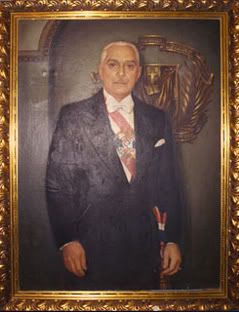
General Rafael Leonidas Trujillo Molina (a.k.a. Trujillo) who presided as the absolute ruler of the country for a total of 31 years (1930-1961) was the engineer of the baseball tournament of 1937. He ruled the country with vicious precision, eliminating enemies without recourse. His high handed rule went hand in hand with a massive megalomania. Many a town was named after him including the capital city of the Dominican Republic (From Santo Domingo to Cuidad Trujillo). So it was within political climate that politics intermingled with baseball.

With the victory of the 1936 Dominican League of the team from San Pedro (Las Estrellas Orientales), Trujillo wanted to make sure that the teams from his city would not lose again. So for the next season, the two teams that played in the nation’s capital, Los Tigeres de Licey and Los Leones de Escogido, had their best talent raided by Trujillo who made one team, named Los Dragones de Cuidad Trujillo. In response, the owners of the other teams in the league brought in some high paid talent from the Negro Leagues and Cuba. Trujillo also realized that he would need to raise the stakes by bringing in some high-class talent of his own. Trujillo would not tolerate anything short of victory.

With the recruitment of Negro Leaguers, certain factors came into play. First of all, the Latin American leagues were usually limited in how many foreign players they could have on their teams. In doing so, they often paid top dollar for the talent. By signing with the Latin American teams, the Negro Leaguers made more money in Latin America than they would have in the United States. Secondly, the potential of more pay went hand in hand with a racial environment that was different than they were used to. Unlike the blatant racial segregation that was in place through much of the United States, they did not have to deal with that in Latin America, whose population was very much made of many races and cultures.

So, when Trujillo (with the aid of Dr. Jose Aybar who ran the Cuidad Trujillo team) decided to recruit Negro League players, the action was done in earnest. Satchel Paige was the first to be approached. Then came Cool Papa Bell, Josh Gibson, Sammy Bankhead, Cy Perkins, Leroy Matlock and Harry Williams. Also on the team was Puerto Rican baseball player named Perucho Cepeda, the father of Hall of Famer Orlando Cepeda. Countering the power play of the Cuidad Trujillo team, the Santiago team (Las Aguilas Cibaeñas) countered with Negro Leaguers Horacio Martinez, Luis Tiant, Sr., Chet Brewer and Martin Dihigo (Baseball Hall of Famer). The San Pedro team was made up of a mix of Dominican and Cuban players. The Negro Leagues in contrast, had to play their 1937 season without it’s biggest and best drawing players. Those Negro leaguers who played in the Dominican faced lifetime suspensions from the league. Played in the baseball-crazed environment of The Dominican Republic, the tournament is still being talked about on the island among the baseball old timers.

With games being played on weekend, the tournament came down to the final game. In a matchup between Cuidad Trujillo and Santiago, the game was moving along swiftly with the Santiago team leading 2-0. On the mound was Negro Leaguer Chet Brewer, who had only a week earlier thrown a 1 hit shutout of the Cuidad Trujillo team. By the 5th inning things were about to change. A series of hits, capped off by a Sammy Bankhead grand slam chased Brewer from the game. The Santiago tram was able to cut the lead of the Cuidad Trujillo team to two runs (8-6) before Satchel Paige came in close the game and win the tournament for the Dragons.

Professional baseball would never be the same on the island. Due to the great cost that was incurred by all of the owners of the Dominican teams, professional baseball would not return to the island until 1951. That did not mean that there was no baseball. Amateur games were being played in the schools and among the sugar mill workers throughout the island. Also, the military had their own teams that played throughout the island. This led to the future advancement of The Dominican Baseball player in Major League Baseball with Osvaldo Virgil being the first Dominican Baseball player in the Majors (1952) and the arrival of such players as the Alou Brothers and Hall of Famer Juan Marichal. As for the Negro Leaguers, the lifetime ban was not a prudent move. They were allowed to return to their respective team by paying a week’s worth of salaries as fines.