Showing posts with label Chicago White Sox. Show all posts

Friday, May 15, 2015

The White Sox Play the First of Nine Home Games in Milwaukee May 15 1968

On This Day in Baseball History May 15, 1968: The first American League game played in Milwaukee since the Milwaukee Brewers finished in last place in 1901 with a 48-89 record is a 4-2 win by the California Angels against Chicago White Sox before 23,403 fans. This game was the first of nine home games that the Chisox would play at Milwaukee County Stadium which stood empty with the departure of the beloved Milwaukee Braves to the greener pastures of Atlanta.

Now, when I saw this historical tidbit, I had to do a double take. I had no clue that the White Sox played "home" games in Milwaukee. I immediately thought of the Brooklyn Dodgers playing "home" games in Jersey City during the 1957 season right before their departure to Los Angeles after that season. So that got me thinking: Were the White Sox on the verge of leaving Chicago? The article A short history of the Milwaukee White Sox by Frank Jackson from the Hardball Times dated March 27, 2013 does a wonderful job describing the factors that led to the White Sox playing home games in Milwaukee not only in 1968 but also in 1969. So please go and read that post. But for simplicity sake, here goes a short synopsis.

Milwaukee was the first city to gain a major league city in 50-years when the National League's Boston Braves left the Beantown for Brew City right before of the start of the 1952 season. The Braves proved successful with two World Series appearances against the New York Yankees (1957-1958) with one World Championship in 1957. The Braves drew record crowds at first but attendance would decline even though the team never put up a losing record. Also keep in mind that by playing in Milwaukee, the team had issues earning revenue from the established medium of radio and growing medium of television. Being only 90 miles from two major league franchises in the second city of Chicago resulted in the lack of media opportunities and minimal media revenues.

That would change in 1965 when the city of Atlanta came in with a classic example of boosterism to woo the recently changed ownership of the Braves. For those of you who don't know what boosterism is, according to dictionary.com, boosterism is the action or policy of enthusiastically promoting something, as a city, product, or way of life.

The city of Atlanta offered an untapped major league viable market playing in a municipally owned state of the art stadium. Consider that unlike Milwaukee who was close in proximity to Chicago, in 1965 the nearest major league franchises to Atlanta were Cincinnati at roughly 400-miles away to the North, Washington D.C. at roughly 600-miles to the Northeast and the St. Louis Cardinals at roughly 500-miles away to the West. The Braves would be the Southern most franchise on the East Coast, since Florida was the home of Spring Training. The Marlins and Rays wouldn't become MLB franchises until the 1990's. The lure of an wide open market with no media competition (the Braves would later enjoy nationwide exposure with the broadcast of Braves games on cable TV on channel TBS) was an offer too good for the Braves ownership to pass up. This produced a problem in Milwaukee.

The team was to move for the 1965 season but was held up due to a lawsuit brought about by a group led by a Milwaukee car dealer by the name of Allen H "Bud" Selig. The lawsuit delayed the inevitable by a season leaving Milwaukee team-less in 1966. Selig believed that the next round of expansion in MLB would lead to Milwaukee getting another team. In order to Selig was able to organize an exhibition game between the Minnesota Twins and the Chicago White Sox at Milwaukee County Stadium on July 24, 1967 which drew over 51,000 spectators to show that Milwaukee was major league town. Unfortunately, MLB would expand into Kansas City, Montreal, San Diego and Seattle for the 1969 season. Going back to the "home" games for the Chisox in Milwaukee, Selig looked into moving the White Sox to Brew City.

As we know, the White Sox never left the South Side of Chicago. Ownership of the team remained in the hands of those who had no interest in moving the team. Selig's persistence would result in the purchase of the bankrupt Seattle Pilots right after the end of Spring Training of 1970 and the Pilots became the Milwaukee Brewers in time for the 1970 season. For more information on the Seattle Pilots, check out Mike Fuller's SeattlePilots.com and don't forget to check out the aforementioned A short history of the Milwaukee White Sox by Frank Jackson from the Hardball Times dated March 27, 2013 for more information on the Chicago White Sox "home" series in Milwaukee.

With the movement to have Montreal get a second shot at a Major League team and rumors of the Rays potentially having to leave Tampa to stay viable, what city/cities would be a viable place for a move and/or expansion. Anyone want to take a guess?

Until Then Keep Playing Ball,
Baseball Sisco
#baseballsisco
#baseballsiscokidstyle

For Further Reading:
- The Milwaukee White Sox by Gene Mueller from the WISports website dated July 29, 2014
- Back when Milwaukee made goo-goo eyes at the Chicago White Sox by Gene Mueller from the Newsradio 620 WMTJ website dated June 24, 2012


Sunday, April 26, 2015

Nolan Ryan Ties Bob Feller April 26, 1990

On This Day in Baseball History April 26, 1990: Nolan Ryan ties Bob Feller's major league record of 12 one-hitters as the Texas Rangers defeated the Chicago White Sox 1-0. Ryan struck out 16 batters while allowing a second inning single to Ron Kittle.


Ryan would finish his Hall of Fame Career with 7 no-hitters, 12 one-hitters and 18 two-hitters.

And that is considering that Ryan was a power pitcher well into his 40's. I don't think we'll see another dominant power pitcher reach the lofty heights that Nolan Ryan reached amidst the specialized pitching system that seems to be part of MLB these days.  But, then again...you never know.

Until Then Keep Playing Ball,
Baseball Sisco
#baseballsisco
#baseballsiscokidstyle

For Further Reading:
- Click Here to access Nolan Ryan's career statistics from Baseball Reference
Click Here to access Bob Feller's career statistics from Baseball Reference

Tuesday, November 11, 2014

2014 Rookies of the Year

The first of the 2014 MLB Year End Awards have been handed out. So let's not wait anymore time and get cracking on who won the hardware.

- 2014 American League Jackie Robinson Rookie of the Year

Slugging first baseman Jose Abreu of the Chicago White Sox is the winner of the 2014 American League Rookie of the Year. Abreu earned all 30 first-place votes outdistancing Los Angeles Angels right-hander Matt Shoemaker and New York Yankees reliever Dellin Betances who finished second and third, respectively

Abreu led all rookies in home runs (36), RBIs (107), hits (176), doubles (35), runs scored (80), OBP (.383), slugging percentage (.581) and OPS (.964).

Since the Rookie of the Year Award was first given out in 1947, only four rookies have batted at least .300, hit at least 30 home runs and driven in at least 100 runs. All four including Abreu have won their league's respective Rookie of the Year award. The other three players? Walt Dropo for the Boston Red Sox in 1950, Mike Piazza for the Los Angeles Dodgers in 1993 and Albert Pujols for the St. Louis Cardinals in 2001.

Abreu is the sixth White Sox player to win the American League Rookie of the Year award after Luis Aparicio 1956, Gary Peters 1963, Tommie Agee 1966, Ron Kittle 1983, Ozzie Guillen 1985.

- 2014 National League Jackie Robinson Rookie of the Year

Starting pitcher Jacob deGrom of the New York Mets is the winner of the 2014 National League Rookie of the Year. DeGrom received 26 of the 30 first-place votes. Cincinnati Reds center fielder Billy Hamilton and St. Louis Cardinals second baseman Kolten Wong finished second and third, respectively. The vote was conducted by the Baseball Writers' Association of America.

DeGrom, 26, went 9-6 with a 2.69 ERA and 144 strikeouts in 140 1/3 innings pitched over 22 starts.

DeGrom is the fifth Mets' player to win the National League Rookie of the Year award after Tom Seaver 1967, Jon Matlack 1972, Darryl Strawberry 1983 and Dwight Gooden 1984.

Congratulations to both players and continued success in their respective careers. The next award to be given out is Manager of the Year which will be announced today Tuesday November 12th at 6 p.m.

Until Then Keep Playing Ball,
Baseball Sisco
#baseballsisco
#baseballsiscokidstyle

Monday, August 4, 2014

Tom Seaver Wins His 300th Game

On this day in Baseball History August 4, 1985, Tom Seaver of the Chicago White Sox wins his 300th game by throwing a complete game against the New York Yankees in front of 54,032 fans at Old Yankees Stadium. Stealing the thunder from Phil Rizzuto on Phil Rizzuto Day at the stadium, Seaver allowed only 6 hits and one walk, while striking out 7 ending the game by getting Don Baylor to fly-out.

Seaver became just the 17th pitcher to ever reach the 300-win plateau. Here is the list of the other 16 300-game winners at the time Seaver joined the club (in the order in which they reached the plateau):

  1. 1888 Pud Calvin
  2. 1890 Tim Keefe
  3. 1890 Mickey Welch
  4. 1891 Charles Radbourne
  5. 1892 John Clarkson
  6. 1900 Kid Nichols
  7. 1901 Cy Young
  8. 1912 Christy Mathewson
  9. 1915 Ed Plank
  10. 1920 Walter Johnson
  11. 1924 Grover Alexander
  12. 1941 Lefty Grove
  13. 1961 Warren Spahn
  14. 1963 Early Wynne
  15. 1982 Gaylord Perry
  16. 1983 Steve Carlton
Here is footage of Tom Seaver retiring Don Baylor for the final out in his 300th win:


Seaver would go on to finish his career with the Boston Red Sox in 1986 compiling a 311-205 career record with a 2.86 ERA in 20-seasons. Seaver was the 1967 National League Rookie of the Year Award a 12-times All-Star with 2 National League Cy Young Awards (1969/1973) and 5-top ten MVP votes.

Seaver would be inducted in the National Baseball Hall of Fame by the BBWAA as Player in 1992 by a whopping 98.84% of the vote (425/430 ballots). Seaver holds the distinction of being the player to be inducted by the highest voting percentage in the baseball Hall of Fame history


While special that he won his 300th in New York City, it would have been even more so had it happened in Flushing while Seaver was wearing the Mets' pinstripes. Tom Seaver was truly terrific.

Until Then Keep Playing Ball,
Baseball Sisco
#baseballsisco
#baseballsiscokidstyle

For Further Reading:
- Click Here for Tom Seaver's career statistics from Baseball Reference.com
- Click Here to access the boxscore for Tom Seaver's 300th win on August 4, 1985 from Baseball Reference.com

Friday, May 9, 2014

Latinos Making History May 9, 2014

As I wrote on my Baseball Sisco blogpage on May 8, 2014 in the post Five Players to Hit 100 Homers With Three Different Teams, Adrian Beltre became the fifth player to hit 100 homeruns for three different teams. In doing so he joined Hall of Famer Reggie Jackson, Darrell Evans, Alex Rodriguez and Jim Thome in that exclusive club.

The Cuban Beisbol renaissance continues in MLB with Jose Abreu of the Chicago White Sox being selected the American League player and American League Rookie of the month of April. He is the first American League player to do so and second overall. His fellow countryman Yasiel Puig of the Los Angeles Dodgers is the first winning the equivalent National League honors last June.

Courtesy of Von's Card Blog
There was an interesting article on the Cuban Beisbol renaissance in the Majors entitled White Sox, Furthering Legacy, Provide Warm Home For Cubans, Amid Chill by Tyler Kepner from the NYTimes website dated April 19, 2014. The article states:
For the second time this season, it included four players from Cuba: (Alexei) Ramirez at shortstop, Dayan Viciedo in right field, Adrian Nieto catching and Jose Abreu, who signed for six years and $68 million last October, at first base. No team since the 1969 Cleveland Indians had started four Cuban-born players in a game.
That is a forty-five year gap where players from The Dominican Republic, Puerto Rico and Venezuela stepped in to fill the gap left by the decreasing number of Cubans in the Majors due to the closing of the Cuban market. Add to this mix players like the aforementioned Yasiel Puig, Jose Fernandez of the Miami Marlins, Yoenis Cespedes of the Oakland Athletics and Aroldis Chapman of the Cincinnati Reds to name a few. The future of Cuban Beisbol is definitely growing bright in the MLB. Here are Jose Abreu's statistics up to May 8, 2014.

Courtesy of CBS Sports
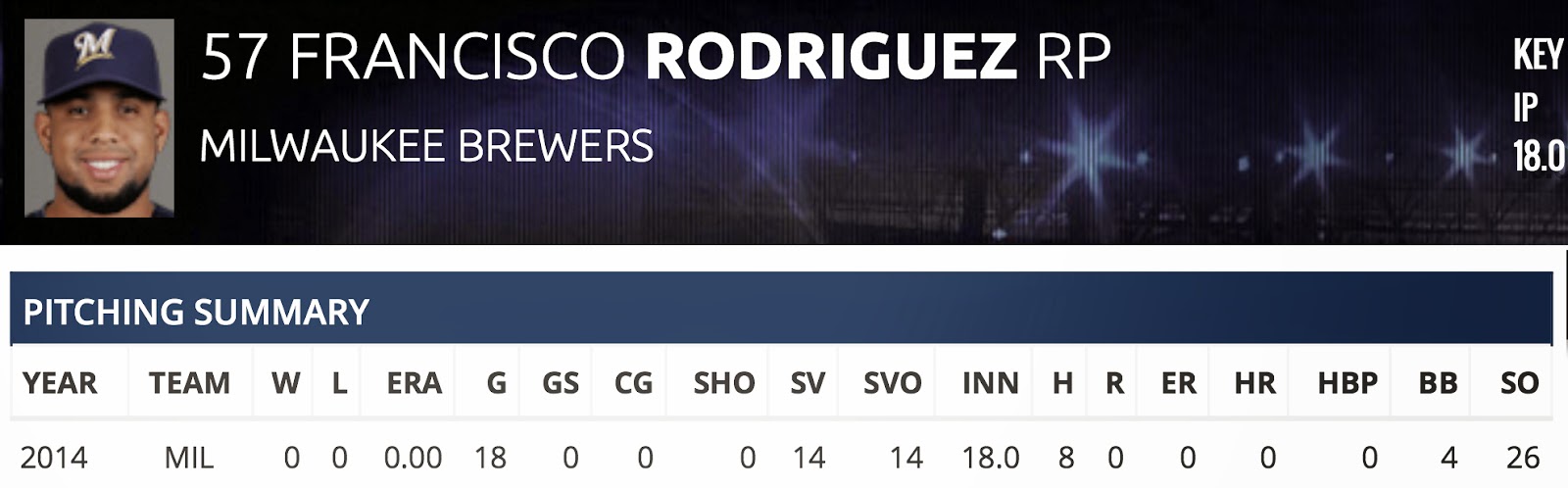
Speaking of a renaissance, Venezuelan closer Francisco "K-Rod" Rodriguez seemed to have put all his personal issues behind him this season. Through the month of April, Rodriguez went 13-for-13 in save chances tying Kaz Sasaki of the Seattle Mariners who had recorded 13 saves before May 1st in 2001.

I didn't realize that Rodriguez is only 32 years old. It seems like he's been around forever. The first time I noticed K-Rod was when he was the set-up man for the then Anaheim Angels closer Troy Percival. He was signed as a free agent in 1998 and made his debut for the Angels on September 18, 2002 at the age of 20 during the Angels run to an eventual World Series Title. It's good to see that he's been able to rebuild his career after a few tumultuous seasons with the Mets and seemingly unfocused seasons from 2011-2013. Here are Francisco Rodriguez's statistics up to May 8, 2014.


Well, that's it for now. If I missed any Latino achievements in the Major Leagues, please feel free to contact me at baseballsiscokidstyle@gmail.com, at my Twitter @Baseballsisco, My Google+ +Francisco Hilario (BaseballSisco) and at my Facebook page Baseball Sisco Kid Style

Hasta la próxima, no dejamos de jugar el Beisbol,
Baseball Sisco
#baseballsisco
#baseballsiscokidstyle

Monday, April 28, 2014

Latinos Making History Week Ending Sunday April 27

This past week was a historical one for Latinos in the Major Leagues. Let's not waste time and jump right in.

- Albert Pujols Reaches the 500 Homerun plateau
Los Angeles Angeles of Anaheim slugger Albert Pujols looks like he's back to form in dealing with a couple in injury filled seasons in California. Pujols became the 26th and youngest player to reach the 500 homerun club. At age 34, Pujols hit both homerun 499 and 500 against Washington Nationals starter Taylor Jordan on April 22. He is the first player to hit both homers 499 and 500 in the same game. El Hombre is back!!!


- Jose Abreu sets the rookie RBI record for the month of April
Cuban slugger Jose Abreu is certainly making his mark on the Majors in his first month with the Chicago White Sox. Abreu has set the major league rookie record for RBIs with 31 through April 27. Abreu is batting .262 with a league leading 10 homeruns and 31 RBIs. He still has three games to add to his rookie record for RBIs in the month of April with one game against the Tampa Bay Rays and two against the Detroit Tigers. Let's see where he ends up. Jose Abreu courtesy of the blogpage White Sox Cards. Check them out.


- Blue Jays Set Record with 6 Dominicans in the Starting Lineup
I'm not sure when Toronto Blue Jays manager John Gibbons filled out his lineup card on April 27 against the Boston Red Sox he realized that he was making history. By slotting Jose Reyes (SS), Melky Cabrera (CF), Jose Bautista (LF), Juan Encarnacion (1B), Juan Francisco (DH) and Moises Sierra (RF) into the starting lineup, this would mark the first time that six players from the Dominican Republic were in the starting lineup at the same time.


Hearing about this brought back memories of a post I wrote concerning the Pittsburgh Pirates on September 1, 1971. In my post The First All Black-Latino MLB Starting Lineup from September 1, 2011, Pirates manager Danny Murtagh filled out his lineup card with all players of color including pitcher Dock Ellis. Now can we ever get a lineup entirely made up of Dominicans on a Major League diamond? Only time will tell. =)

Hasta la próxima, no dejamos de jugar el Beisbol,
Baseball Sisco
#baseballsisco
#baseballsiscokidstyle

Friday, December 6, 2013

What A Crazy Week In Baseball

My, oh my the flurry of moves this week has been dizzying. Free agent signings and trades galore headlined the week in Baseball and the Winter Meetings where many trades and signings happen loom on the horizon.

You have Billy Beane weaving his magic wand and making trades for numerous players improving the two time American League Champion Oakland A's. You have the Miami Marlins picking up catcher Jarrod Saltalamacchia and former All-Star shortstop Rafael Furcal. The Los Angeles Dodgers brought back reliever Brian Wilson, who was pretty much lights out for them down the stretch last season. The Houston Astros picked up solid center fielder Dexter Fowler from the Colorado Rockies. The Rockies added Justin Morneau to hopefully fill the hole left with the retirement of Todd Helton.

The White Sox brought back team Captain Paul Konerko in what might be his final season on the South Side of Chicago. The Tampa Bay Rays and their GM Andrew Friedman once again wheel and deal by acquiring reliever Heath Bell and catcher Ryan Hanigan in a three team deal with the Diamondbacks and Reds. The Detroit Tigers believe they have solved their closer issues with the signing of Joe Nathan.

The news from Japan speculate that the Rakutan Golden Eagles might not post their star pitcher Masahiro Tanaka due to the proposed $20 million dollar cap on posting fees that seems to be a part of the new posting contract between the MLB and the NPB. Since they figure that they won't get as much for Tanaka in a posting fee that they would have under the old agreement, they are better off keeping him following this season which was capped by winning the Japan Series against the Yomiuri Giants. This move would put a kink in the plans of many a team in the majors who were looking forward to trying to add Tanaka to their starting rotations.

The World Champion Red Sox took a hit by losing the aforementioned Saltalamacchia and Jacoby Ellsbury but signed Edward Mujica to replace the non-tendered Andrew Bailey in the bullpen. Speaking of Ellsbury, he signed with the division rival New York Yankees who also signed Hiroki Kuroda but lost their best homegrown everyday player (since Derek Jeter) to the Seattle Mariners who signed Robinson Cano to a reported 10-year $240-million dollar contract.

Wow, that was a mouthful. And the Winter Meetings start on Monday. Who knows what surprises we'll have sprung on us from then to now. We'll just have to wait and see.

Sisco Kid.

Wednesday, July 31, 2013

Brazilians In The Major Leagues

Brazilians and Baseball seem to make strange bedfellows. When one thinks of Brazilians and sports you would think about Futbol, Basketball, Mixed Martial Arts and even Rodeo. Baseball doesn't even seem to come up in the conversation. But it seems that there has been some inroads which have translated in two major leaguers.

Cleveland first baseman-catcher
Yan Gomes. (Rich Pilling/Getty Images)
The first Brazilian born major leaguer is the catcher for the Cleveland Indians Yan Gomes. Gomes was drafted by the Toronto Blue Jays in the 10th round of the 2009 draft playing out of the University of Tennessee. After making his way through the Blue Jays minor league system, Gomes made history on May 17, 2012. Against the Yankees, Gomes got his first hit for a Brazilian born player on the day of his debut.

Gomes was born on July 19, 1987 in the city of São Paulo, Brazil. After his family moved to the United States, Gomes went to High School in Miami and was originally drafted by the Boston Red Sox in the 39th round of the 2008 Major League Baseball but decided to not sign. As I stated above he eventually was drafted in 2009 with the Blue Jays in the 2009 draft.

In his only season with the Blue Jays:

Player
GABRH2B3BHRRBI
BBSOSBCSOBPSLGAVGOPS
Yan Gomes
439892040413
63200 .264  .367 .204.631

On November 3, 2012 , Gomes was traded with Mike Aviles to the Cleveland Indians for pitcher Esmil Rogers. Gomes has seen limited duty this season backing up Carlos Santana. So far this season:

Player
GABRH2B3BHRRBI
BBSOSBCSOBPSLGAVGOPS
Yan Gomes
43145234182723
82920 .314  .510 .283.824

Up to today's date, Gomes was the only Brazilian born major leaguer until Andre Rienzo made his debut for the Chicago White Sox against Gomes' Cleveland Indians marking the first time that two (the only two) players born in Brazil faced each other on a Major League field. Rienzo is the first Brazilian-born pitcher in the Major Leagues. 

Rienzo was born on June 5, 1988 in São Paulo, Brazil. Similar to Gomes, Rienzo's family emigrated to the United States. Rienzo would sign as an undrafted free agent with the Chicago White Sox in 2009 and started in the minors. Rienzo would find himself in some controversy when he failed a drug test in 2012, testing positive for metabolites of Stanozolol which is a performance-enhancing drug. While Rienzo stated that he he unknowingly ingested the PED via a supplement that he bought in Brazil, he decided to take responsibility and served his 50-game suspension. He came back and kept working hard. His hard work would be duly rewarded.

It was announced yesterday that Chicago starter Jake Peavy would not be able to make his start in Tuesday night's game against the Indians and that Rienzo would be brought up. In his debut against the Indians, Rienzo became the first White Sox rookie since Jack McDowell in 1987 to throw seven innings in his major league debut without allowing an earned run. In total Rienzo gave up five hits giving up three unearned runs with six strikeouts and three walks in the no-decision. How did Rienzo do against his countryman Gomes?

Gomes had the upperhand against Rienzo by getting a single in the third inning and a bases loaded walk in the fifth. Rienzo would end up striking out Gomes in the seventh. 

With the impressive showing of the Barry Larkin managed Team Brazil in the 2013 World Baseball Classic with three competitive games against Pool A teams Japan, Cuba and China it seems that the future is bright. I believe that the next Brazilian major leaguer might be Tampa Bay Single-A prospect Leonardo Reginatto who seemed to me to shine in the three games that he played in the WBC. Also impressive for Brazil was Rafael Fernandes who plays in the Nippon Professional Baseball League (NPB) for the Tokyo Yakult Swallows. 

We'll have to see how that plays out. Either way its good to see the sport continually grow in markets and countries where the sport is not the main sport. 

Sisco Kid

For Further Reading

Monday, June 3, 2013

Andy Hawkins The Yankee Who Pitched a No Hitter and Lost

This post was inspired by a comment made by my friend Russ. We were talking about being realistic about the Yankees' chances this season after talking about my last post The State of The Yankees Entering June. Now the comment he made was as so:
You know I love my team, win or lose. If Andy Hawkins pitching a no-hitter and losing couldn't drive me away, nothing can. It's just a question of being realistic
Now that got me thinking. I remember that no hitter by Hawkins. So I decided to go back in time and take a look at that particular game.

As Russ also stated, that was the first no-hitter since Dave Righetti's July 4th no-hitter in 1983. That 1990 season was definitely not one for the ages for the New York Yankees. The Yankees finished the 1990 season with a 67-95 record finishing 7th and dead last in the AL East 21 games out of first place. Now Andy Hawkins joined the Yankees as a free-agent during the 1988 offseason and was a respectable 15-15 with a 4.80 ERA in his first season in the American League (1989). Hawkins had pitched his first seven seasons with the San Diego Padres. The 1990 season was one that Hawkins sure would want to forget. He would finish the 1990 season with a 5-12 record with 5.37 ERA. This is the season of the loss during his only no-hitter.

The game was on Sunday July 1 and the opponent for the Yankees were the Chicago White Sox. Opposing the Yankees was pitcher Greg Hibbard. Here is how Michael Martinez in his article No-Hitter, but With No Glory of the New York Times describes the game up to the moment of truth for Hawkins:
The Yankees were almost no-hit themselves. Greg Hibbard, the starting pitcher for the White Sox, retired the first 16 batters he faced before Bob Geren reached base on an infield hit in the sixth. Hawkins, meantime, set down the first 14 White Sox hitters, walked two and opened the eighth by getting Ron Karkovice and Scott Fletcher to hit pop flies.
With two outs in the top of the 8th Sammy Sosa (yes, THAT Sammy Sosa) grounded to 3B Mike Blowers who dropped the ball causing Sosa to reach base. Andy Hawkins wouldn't help his cause by consecutively walking Ozzie Guillen and Lance Johnson. Up to the plate came Robin Ventura.

It would seem that Hawkins would get out of the inning unscathed when he got Ventura to fly out to rookie left fielder Jim Leyritz. But knowing how the season would end for the Yankees in 1990, it was not to be. With the runners on the move with two outs, Leyritz would end up dropping the ball causing all three runners to score. With the score 3-0 and the no-hitter still intact, Ventura would score when a fly ball by White Sox slugger Ivan Calderon was lost in the sun by Yankee right fielder Jesse Barfield. In total, 2 walks and 3 Yankee errors in the bottom of the 8th inning were the difference in the game. For Hawkins would indeed a bitter achievement since he would have thrown a no-hitter but be hung for the loss. Here is how Hawkins described it:
''I'm stunned; I really am,'' he said, still standing on the field. ''This is not even close to the way I envisioned a no-hitter would be. You dream of one, but you never think it's going to be a loss. You think of Stewart and Fernando, coming off the field in jubilation. Not this.''
The reference to Stewart and Fernando? Dave Stewart and Fernando Valenzuela threw WINNING no-hitters on the same day, 48 hours before Hawkins pitched his. But Hawkins wasn't alone.

At that point there had been 13 other no-hitters for losses, the last one before that one being in 1967. Here is the salt being rubbed in the proverbial wound. According to the Major League Baseball rules on no-hitters:
An official no-hit game occurs when a pitcher (or pitchers) allows no hits during the entire course of a game, which consists of at least nine innings. In a no-hit game, a batter may reach base via a walk, an error, a hit by pitch, a passed ball or wild pitch on strike three, or catcher's interference.
Since the Yankees were on the road at Comiskey Field and on the losing end of the score, Hawkins never got to pitch the 9th inning thus invalidating his no-hitter. How's that for bad luck. Hawkins would pitch half of the 1991 season with the Yankees before being released and pick up by the Oakland A's. He would finish his career after that same season.

That is some of the stuff us older Yankee fans went through before the current stretch of successful Yankee seasons. Thanks again to Russ for the inspiration for the post.

Sisco Kid

For Further Reading
- Click Here to Access Andy Hawkins' career statistics from Baseball Reference.com
- Click Here to Access Michael Martinez's article No-Hitter, but With No Glory from the New York Times dated July 2, 1990 from NYTimes.com
- Click Here to Access the Box Score for the July 1, 1990 game against the New York Yankees and the Chicago White Sox from BaseballReference.com
- Click Here to Access the official Major League Baseball Rules from the MLB.com

Tuesday, April 16, 2013

What Ever Happened to Charles Johnson?

With all the discussion of the lack of African-American ballplayers in the MLB, a particular African-American player came to mind. I remember this person being a very dynamic catcher in the National League. Even though I thought he was a very good catcher will always be known for the trades that involved him and other players. The player that I'm thinking about is Charles Johnson.

I first remember seeing Charles Johnson while he was playing for the Florida Marlins. I always thought his style was reminiscent of Tony Peña who is currently a bench coach for the New York Yankees. Johnson was originally drafted in the first round of the 1989 draft and was picked by the Montréal Expos with the 10th pick. He declined to sign with Montreal choosing instead to attend the University of Miami. He once again was drafted in the first round this time in the 1992 draft with the 28th pick in the draft by the Florida Marlins. He decided to sign within a couple months after being drafted.

Johnson's potential was so promising that he spent a very short time in the minor leagues. Johnson spent the 1993 season playing for the Kane County Cougars of the Single A Midwest League. He was promoted to the Portland Sea Dogs of the Double A Eastern League for the 1994 season where he continued to impress. The impression made by Johnson even got him a call-up to the parent Marlins team where he played in 4 games before the players strike halted and eventually ended the 1994 season. Johnson would play in 2 games for Portland in 1995 before getting the permanent call-up to the majors. Johnson would by-pass Triple A entirely. To show you the impact made by Johnson in the minors, here is a description of Johnson from the article Charles Johnson to Return to Portland on April 18th from the Portland Sea Dogs website:
Johnson was a member of the Sea Dogs' inaugural team in 1994.  He opened the season as the Florida Marlins top prospect and he did not waste any time in making an impact in Portland.  In the Sea Dogs' inaugural game, Johnson belted two home runs including a game winner in the 14th inning as the Sea Dogs defeated the Reading Phillies 2-1.  The catcher hit .264 with 28 home runs and 80 RBI for the Sea Dogs in 1994 and was named to the Eastern League All-Star squad.  His 28 home runs led the league and were the most by an Eastern League catcher since Tony Peña hit 34 in 1979.
In making the jump to the Marlins, Johnson would be the first Marlins minor leaguer to reach the majors. In his rookie season of 1995, Johnson would end up 7th in the National League Rookie of the Year voting by hitting .251 with 11 homeruns and 39 RBI. He also made only 6 errors in the field and threw out 43% (38 of 89 runners) of would be basestealers earning the 1st of 4 straight N.L. Gold Glove awards for the catcher position. Johnson's performance would steadily improve during his seasons with the Marlins. Here is when things get a bit hectic for Johnson.

As part of the salary purge of the 1997 World Series Champions Johnson would be traded on May 14, 1998 with Manuel Barrios, Bobby Bonilla, Jim Eisenreich and Gary Sheffield to the Los Angeles Dodgers for Mike Piazza and Todd Zeile (Piazza himself would be traded by the Marlins on May 22, 1998 to the New York Mets for Preston Wilson, Ed Yarnall and minor leaguer Geoff Goetz). Johnson would finish out the 1998 season with the Dodgers and once again get traded.

On December 1, 1998 Johnson would be part of two trades. In the first transaction, Johnson was traded by the Dodgers with Roger Cedeno to the New York Mets for Todd Hundley and minor leaguer Arnold Gooch. Then he would be traded to the Baltimore Orioles for reliever Armando Benitez. You would think that being traded to the American League would afford Johnson the opportunity to grow some roots with the Orioles. Not so. After spending the 1999 season with the Orioles where Johnson hit .251 with 16 homers and 54 RBI while throwing out 38% of would be base stealers, he would be traded once again.

On July 29, 2000 Johnson would be traded with Harold Baines to the Chicago White Sox for Brook Fordyce and minor leaguers Jason Lakman, Juan Figueroa, Miguel Felix. Finally after being traded four times in three seasons, Johnson would be granted free agency and re-signed with the Florida Marlins. Johnson's homecoming would be temporary.

In two seasons with the Marlins, Johnson would average 12 homeruns with 56 RBI while hitting .245 and throwing out 42% of base stealers in 2001 and 40% of base stealers in 2002 with his second All-Star appearance in 2001. After the 2002 season Johnson would once again be backing his bags. On November 16, 2002 Johnson would be traded by the Marlins along with Vic Darensbourg, Pablo Ozuna and Preston Wilson to the Colorado Rockies for Mike Hampton, Juan Pierre and cash (Hampton would be traded to the Atlanta Braves on November 18, 2002 for Tim Spooneybarger and minor leaguer Ryan Baker).

Johnson would spend two seasons in Colorado where he would find his career stalled by the Rockies pledging to play rookie J.D. Closser as their everyday catcher. After deliberations with a failed proposed trade with the Tampa Bay Devil Rays, Johnson would be traded for the last time in his career. Right before Spring Training camp broke on March 30, 2005 Johnson was traded by the Rockies along with Chris Narveson to the Boston Red Sox for Byung-Hyun Kim and cash. That same day Johnson was released by the Red Sox and would sign with the Devil Rays on April 4th. Johnson would only appear in 15 games for the Devil Rays before he was released on June 13, 2005 effectively ending his professional career.

In total of 12 season, Johnson had the following statistics:

Player
GABRH2B3BHRRBI
BBSOSBCSOBPSLGAVGOPS
Charles Johnson
118838364659402114167570
475997610.330 .433.245 .762 
Johnson was a two-time All-Star, a four-time Gold Glove winner and won a World Series Championship with the 1997 Florida Marlins. 

Sisco Kid.

For Further Reading

Friday, March 8, 2013

Orlando "El Duque" Hernandez 15 Years Later

 15 years ago on March 7, amid fanfare the New York Yankees signed Cuban defector Orlando Hernandez, who is the half-brother of Livan Hernandez. The man known as "El Duque" would live up to his reputation from his playing days in Cuba by successfully pitching in 4 different World Series (1998, 1999, 2000 with the Yankees 2005 with the White Sox).

I remember when the Yankees signed him, there were some reservations among fans who were still thinking about the mass media signing of another foreign "can't miss" pitcher Hideki Irabu who didn't live up to the expectations placed on him here in New York. Not only did El Duque succeed during the regular season, his performances in the post season place him up there with many of the best.

After defecting from Cuba on Christmas Day 1997, Hernandez signed a 4-year $6.6 million dollar deal with the Yankees. After a number of starts in single-A and a handful of starts in AAA Columbus, El Duque made his debut with the Yankees on June 3, 1998. Against the Tampa Bay Devil Rays, El Duque held the Devil Rays to five hits and one run over seven innings. In the Yankee record season of 114-48, El Duque compiled a 12-4 record with 3.13 ERA placing 4th in the American League Rookie of the Year Vote. In a sign of things to come in the post-season, Hernandez neutralized the only team that could stop the Yankees in 1998, the Cleveland Indians.

In Game 4 of the American League Championship Series, El Duque hurled strong seven shoutout innings where he only allowed three hits. The Yankees would tie the series at 2-2 and eventually win the series in 6 games. El Duque would also pitch a masterful game against the San Diego Padres in Game Two of the World Series pitching seven innings of one run baseball. The Yankees would sweep the Padres for the first of three consecutive World Series and four of five (including 1996).

1999 would prove to be El Duque's most successful season. El Duque made 33 starts compiling an impressive 17-9 record with a 4.12 ERA. He would be even more impressive in the post-season when he started four games and finished with a 4-0 record in which he only allowed just four earned runs in 30 innings pitched including winning two games in the American League Championship Series against the Boston Red Sox. In Game One of the World Series, El Duque would be matched up against Greg Maddux who finished the season with another 19-win season. In that game, El Duque out-dueled Maddux by strucking out ten while just allowing one hit to beat the Braves and start a four game sweep and a second consecutive World Series title for the Yankees.

His 2000 campaign would be disappointing with a 12-13 record with a 4.51 ERA in 29 starts but El Duque kept his best for the post-season. In four starts, El Duque went 3-1 losing his first post-season start against the Mets. In the 2000 post-season, El Duque beat the Oakland Athletics and Seattle Mariners (twice). In total, El Duque would strikeout a total of 31 batters in 29.2 innings pitched during all four playoff starts.

In the postseasons during the Yankee three-peat years of 1998-2000, El Duque El Duque was 2-0 and 0.64 ERA in 1998, 3-0 with a 1.20 ERA in 1999 and  3-1 with a 3.94 ERA in 2000. Truly remarkable.

Injuries would be the downfall for El Duque. From 2001-2002, El Duque would go 12-12 with a 4.11 ERA in 41 total games. In five postseason appearances during 2001-2002, El Duque would go 2-3 for the Yankees as the Championship run came to an end. At the end of the 2002 season, El Duque would be traded to the Chicago White Sox then traded again to the Montreal Expos for the 2003 season but would not pitch for them. He would miss the entire 2003 season with shoulder injuries.

He would return to the Yankees for the 2004 season and after being granted free agency, El Duque signed with the Chicago White Sox. Though his season performance was a somewhat lackluster 9-9 with a 5.12 ERA, El Duque saved his last bit of magic for the American League Division Series against the World Series Champions Boston Red Sox. With the Red Sox down 2-0 in Fenway Park trailing the White Sox 4-3 but seemingly reaching into the bag of miracles, El Duque was brought in from the bullpen by manager Ozzie Guillen. Facing El Duque was bases loaded with NO outs and Red Sox Captain Jason Varitek at the plate. I remember the day vividly. I was working at Fraunces Tavern and we were full to the brim with people watching the game.

Varitek would pop out. Tony Graffanino would line out to shortstop Juan Uribe and in arguably his most important post-season strikeout, El Duque made Johnny Damon miss ball four with a check swing that would have tied the game had Damon been able to hold his swing. El Duque would pitch two more innings for the Chisox, striking out a total of four batters leading the White Sox to a three game sweep of the Champs and setting the tone for the White Sox breaking their own World Series drought when they would eventually beat the Angels in 5-games and the Houston Astros in a four game sweep to bring the World Series trophy to the South Side of Chicago for the first time since 1917.

El Duque would pitch for a couple of more years before he would be released by the Texas Rangers during the 2010 season effectively ending his career. In total, El Duque would finish with 90-65 record with a career 4.13 ERA. In the postseason, El Duque went 9-3 with a 2.55 ERA 107 strikeouts in 106 innings pitched with four World Series titles to his name. El Duque was definitely something special to watch with his high socks and his high leg kick.

Gracias para las memorias Orlando "El Duque" Hernandez.

FH

- Click Here to Access Orlando "El Duque" Hernandez's career statistics from Baseball Reference.com

Wednesday, September 28, 2011

Adios Chicago Hola Miami

Not that any of us should be surprised, but controversy and Ozzie Guillen are once again walking hand-in hand. The 8-year love and hate affair between the Chicago White Sox and Ozzie Guillen has come to an end. In a bizarre twist, manager Ozzie Guillen was released of his duties so that he could pursue a deal with the Florida Marlins. It is believed that he will be announced as the manager of the Marlins tomorrow afternoon. Mark Gonzales of the Chicago Tribune reports that since Guillen had one year remaining on his contract with the White Sox, the Marlins will have to trade two prospects as compensation for Guillen.

There had been many rumors to the effect that the Florida Marlins have been interested in hiring Ozzie Guillen as their manager for next season. With the Marlins looking at a major franchise change for the 2012 season, it is only natural that they would want to make a splash. What changes will we expect from the Marlins? They will open a new stadium, a new logo and a new name in the form of the Miami Marlins. Hiring Ozzie Guillen makes sense in that they are trying to tap into the large Latino population that lives in Miami and as we've seen multiple times, Guillen knows how to keep the spotlight burning hot on himself and his team. As the sayings go: Any publicity is good publicity and There's no such thing as bad publicity. We'll see how that part of Ozzie will play out in Miami.

What we do know his teams win for him. in 8-seasons with the White Sox, Guillen compiled a 678-617 record for a winning percentage of .524 and the White Sox only had two losing seasons under Guillen. Their best season was the 2005 season where the White Sox finished with a 99-63 record and brought the World Series trophy to a starved city of Chicago with a sweep of the Houston Astros. The cafes and restaurants of the Little Havana neighborhood in Miami will be super-charged with strong black coffee and baseball talk. Bienvenidos to Miami Ozzie. Buena suerte. Quizas lo vas a necesitar.

FH

For Further Reading
- Click Here to Access Ozzie Guillen's career managerial statistics from BaseballReference.com
- Click Here to access Mark Gonzales' article Sox set to receive two players for Guillen from the Chicago Tribune website dated September 27, 2011

Friday, February 25, 2011

Why Do Teams Keep Passing on Orlando Cabrera

I've had this conversation numerous times with friends of mine and I finally decided to something. My friend Barry, who is a lifelong Boston Red Sox fan, says he wishes Orlando Cabrera would have stayed in Boston post-2004. There is no denying that Cabrera was an important part of the magical 2004 Boston Red Sox team. After coming up with the Montreal Expos in 1997, Cabrera played in Montreal for almost eight seasons, coming to the Red Sox in a pivotal four team trade.

In case there are you who aren't familiar with the trade, the Boston Red Sox sent Nomar Garciaparra and Matt Murton to the Chicago Cubs. The Minnesota Twins sent Doug Mientkiewicz to the Boston Red Sox. The Chicago Cubs sent Francis Beltran, Alex Gonzalez and Brendan Harris to the Montreal Expos. The Chicago Cubs sent Justin Jones (minors) to the Minnesota Twins. The Montreal Expos sent Orlando Cabrera to the Boston Red Sox and into the history books as being a member of the 1st Boston Red Sox team to win a World Series since the 1918 team.

So why was he not resigned? Why did the Red Sox let an important cog to their team sign a three-year deal with league rival the Los Angeles Angels of Anaheim? The same can be asked about later teams who either traded Cabrera (to the Chicago White Sox for Jon Garland and to the Minnesota Twins for minor leaguer Tyler Ladendorf) or let him walk in free-agency (Chicago, Minnesota and Cincinnati). It seems to me that a player with a career .274 batting average and since 2001 has played in 160 or more five times and in 150 or more games eight times can be a productive member of any team. So why does he keep moving around.

It seems that the issues comes from management. I found a forum page from the Royal Rooters of the Red Sox Nation page. On this forum page, a few of the comments weigh in on a some points that could have led to the Boston Red Sox passing on signing Cabrera after the 2004 season. Many have to do with his extra-curricular activities. I won't go into some of them since they seem to be somewhat out there and somewhat salacious. Here is the link to the forum page What caused the Sox to walk away from Orlando Cabrera. Now I am not advocating this point of view in any way, shape or form. I'm just passing along what I've found and I'll let you make any judgments.

Maybe it was a case of going after a better shortstop in Edgar Renteria (which as we know had a horrible 2005 in Boston and was traded to the Atlanta Braves after the season). Looking back now, the move proved valuable to the Red Sox since they received two draft picks from the Angels for signing Cabrera which are now in the form of Jed Lowrie and Jacoby Ellsbury. In Chicago, Cabrera had arguments with official scorers, managers and calling out of teammates in radio interviews which I can see rubbing people the wrong way both on the bench and in the front office. But it still doesn't answer the question. Why can't Cabrera stay on from more than a year or two with a single team.

Maybe I'm reading too much into this. Maybe it is just a case of Orlando Cabrera being the kind of player that gets traded to a contender for the playoff push and/or he's a player that gets signed to play shortstop for one year until a prospect is ready to take his position. Will he play out the entire season with the Cleveland Indians or will he be traded mid-season to a contender. Anyone out there have a differing point of view on why this is the situation with Cabrera? Any ideas?

FH

For Further Reading:
- Click Here to access What caused the Sox to walk away from Orlando Cabrera from the redsoxnation.net webpage
- Click Here to access Tom Fornelli's article Orlando Cabrera Feels Neglected from MLB.Fanhouse.com's webpage dated May 28, 2008
- Click Here to access Mark Potash's article Orlando Cabrera Isn't The Sox' Problem from the Chicago Herald-American weblog dated September 8, 2008

Wednesday, December 8, 2010

Winter Meetings Day Three Part Two

More signing, more signings and more signings:

- Paul Konerko re-signs with the Chicago White Sox
Not to be outdone by their Northside rivals, the Southside White Sox re-signed their captain (in a negotitation much less contentious than the New York Yankees' negotiation with their own captain. Take notes boys, this is how it is done) Paul Konerko to a 3-year $37.5 million dollar deal.

According to Dave van Dyck of Chicagobreakingsports.com Konerko, will receive $12 million in each of the next two seasons, then $6.5 million in the third year. The rest will be paid in $1 million installments for seven years.

The longtime White Sox had a very productive 2010 season. Konerko batted .312 with 39 HRs and 111 RBI. In 548 at-bats, Konerko had 171 hits (30 2B/1 3B/39 HR) with 72 walks and 110 strikeouts. His OPS was a career high .977(.383 OBP%/.584 SLG%). Konerko's effort resulted in his being voted 5th in the American League MVP race.

The White Sox look offensively impressive with Konerko and Adam Dunn sharing first base and DH duties. Look for these pair of slugging teammates to put a hurting on opposing pitching.

- Click Here for Paul Konerko's career statistics from Baseball Reference.com

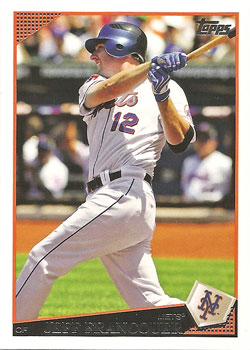
- Kansas City signs Jeff Francouer
Bob Dutton reports on his Twitter feed that outfielder Jeff Francouer has signed a contract for the 2011 season with the Kansas City Royals. According to Dutton, Francouer will receive $2.5M for 2011, with $500K in incentives, and a $3M mutual option for 2012.

Sharing time with the New York Mets and the Texas Rangers in 2010, Francouer batted a combined .249 with 13 HRs and 65 RBI. In 454 at-bats Francouer had 113 hits (18 2B/2 3B/13 HR) with 30 walks and 81 strikeouts with 8 stolen bases. His OPS was .683 (.300 OBP%/.383 SLG%)

- Click Here for Jeff Francouer's career statistics from Baseball Reference.com

- Jack Cust signs with the Seattle Mariners
Goeff Baker reports on his blogpage that he has spoken to Jack Cust who confirmed that he in fact signed a 1-year $2.5-million deal plus incentives with the Seattle Mariners.

In 2010 Cust, formerly of the division rival Oakland Athleticcs, batted .272 with 13 HRs and 52 RBI. In 349 at-bats Cust had 95 hits (19 2B/0 3B/13 HR) 68 walks and 127 strikeouts. His OPS was .834 (.395 OBP%/.438 SLG%).

Baker attributes the following as the reason that Cust chose to sign with the Mariners:

Cust told me his priority is signing was to find a team that appreciated what he could do as a player -- make that, a full-time player.

"From what it sounds like, I'm going to be in there both way (versus lefties and righties) and that's the way I like it," he said. "I've always been able to hit lefties pretty well."


- Click Here to access Jack Cust's career statistics from Baseball Reference.com

Ok folks, I guess that's enough for now. Have to get ready to head down to Rockefeller Center to see the tree and find a Santa to take our yearly family picture with. Later.

FH