Showing posts with label Nippon Professional Baseball League. Show all posts

Tuesday, April 28, 2015

Browns Send 2 Players to Japan As an 'Independence Day' Gesture April 28, 1952

On This Day in Baseball History April 28, 1952: In an interesting (and possibly) first time event between Major League Baseball and the Nippon Professional Baseball League, the St. Louis Browns owner Bill Veeck sends John Britton Jr., a third baseman and James Newberry a right-handed pitcher to the Hankyu Braves of the Pacific League of the Nippon Professional Baseball League. 

The article Browns Send 2 Players to Japan As an 'Independence Day' Gesture from the New York Times dated April 29, 1952 quotes Browns owner Bill Veeck:
"As Japan gains its independence, as the world's newest Democracy, we of the St. Louis Browns are happy to aid the mutual relations between the United States and Japan by sending two of our American ball players to the Japanese pro leagues. In Japan, as well as in America, baseball is the national game, and we feel this gesture of the part of American baseball will go a long way towards cementing good relations with the Japanese."    
Veeck was always one prone to hyperbole as part of the entertainment side of the game, Perhaps he was sincere in his statement.

What I found curious is why was Abe Saperstein involved in the negotiations. Now I already knew that Saperstein was the owner and coach of the world famous Harlem Globetrotters but the article stated that he was also a stockholder in the St. Louis Browns. After a little research online, I found out something else. Saperstein was the owner of the Birmingham Black Barons of the Negro Leagues. The article Birmingham Black Barons from the Black Past website states:
Photo Courtesy of Agate Type
The Black Barons played in three different Negro Leagues throughout their 40-year baseball career, including the Negro Southern League (1920-1923, 1931-1940), the Negro National League (1924-1930, 1941-1955), and the Negro American League (1956-1960).  In the 1930s, the team was bought by Tom Hayes in Memphis, Tennessee which forced the Black Barons to move back to the Negro Southern League.  However, in 1940, the ownership switched again to Abraham Saperstein, who moved the Black Barons back up to the Negro National League.  Under Saperstein's ownership, the team flourished in the Negro National League, winning three Negro National League pennants.  Much of the credit of the Black Barons' success can be given to all-star pitcher Satchel Paige and rookie outfielder Willie Mays.
Both Britton and Newberry were Negro League veterans who played for the Black Barons. The Baseball Reference Bullpen listings for Jimmy Newberry states:
Jimmy Newberry pitched in the Negro Leagues for 9 seasons, the Manitoba-Dakota League for 3 and the minor leagues for three. He made history, though, as the first black pitcher in Nippon Pro Baseball after World War II. He was briefly the staff ace of the Birmingham Black Barons and was one of the favorite players of owner Abe Saperstein, who often gave him advances on his salary.
In terms of John Britton, his listing on the Baseball Reference Bullpen states:
John Britton was a Negro League infielder for 11 years and played two years in Japan, where he made several notable firsts. He was a third baseman.
There was a mention of both players in September 11, 1952 issue of Jet Magazine under the headline Negros in Japanese League To Return Home stated:
Infielder John Britton and pitcher Jim Newberry, first American Negro players in Japanese professional ball, are slated to return home. Britton, playing third for the Hankyu Braves of the Pacific League, was hitting .320 while Newberry had won 10 and lost 7 games for the same club. Both are St. Louis Browns property.
So how did they do in the Land of the Rising Sun? According to the aforementioned Baseball Reference Bullpen listing for Britton:
Britton went to Nippon Pro Baseball in 1952 along with Jimmy Newberry. He was sent by the St. Louis Browns to the Hankyu Braves, making it the first deal of a MLB team sending players to a team outside of the US or Canada. Britton was the first gaijin in Hankyu club history. He hit .316/.338/.416 in 1952, not almost entirely as a contact hitter. He was the first foreign player ever picked for an All-Star team when he was on the Pacific League squad that year. He finished 5th in the PL in batting average.
Britton slipped in 1953, batting .276/.286/.331 with only 3 walks in 448 plate appearances; he only struck out 13 times, though. That was Britton's final season in professional baseball.
Baseball Reference Bullpen listing for Newberry states:
In 1952, Jimmy was signed by the St. Louis Browns and sold with John Britton to the Hankyu Braves. The first black pitcher in Nippon Pro Baseball since World War II (Jimmy Bonner had played briefly in 1936), he went 11-10 with a 3.22 ERA. He was 9th in the Pacific League in ERA and made the PL All-Star team.
While Britton retired after the 1953 season, Newberry would play for a number of of teams in the Texas minor league system. He would stop playing professional baseball after 1956.

On a side note, the listing for Newberry makes a mention of a ballplayer of the name of Jimmy Bonner who briefly played in Japan in 1936. Bonner played for Dai Tokyo of the JPBL. According to the informative post Jimmy Bonner from the Agate Type blogpage dated October 12, 2014:
Thanks to Rod Nelson, the other day I read this piece by Dexter Thomas, Jr., part of his “Negroes in Tokyo” series.  As it turns out, Jimmy Bonna was really James E. Bonner, a 5’10”, right-handed submarine pitcher who was signed by the Dai Tokyo club of the new Japanese professional league with a great deal of fanfare. He was said in the Japanese press to have gone pro immediately after graduating from middle school, and to have played for the Oakland Oaks of the PCL (though this couldn’t be correct—the Oaks certainly weren’t hiring black players in the 1930s). He had supposedly once struck out 46 batters in three games played over two days, whiffing 22 in one game. 
Unfortunately, Bonner didn’t live up to the hype. He was wild, walking 13 batters in four games, while striking out only two. His final record was 0-1, with a 10.24 ERA—although he did bat .458, 11 for 24 (as a left-handed hitter). Dai Tokyo finished in the cellar, 5-21. He last time up in Japan he tripled but got thrown out at home. He was released on November 18, and left for the United States on the same day. Bonner would never appear in Japan again. The next black American players to join the Japanese league were Johnny Britton and Jimmie Newberry in 1952.
It is amazing to read that a black ballplayer played in the Japanese Leagues a decade before Jackie Robinson broke the color line in MLB.

I'm going to post this on the Pro Yakyu community page on Google+ to see if the gals and gents of that community can add anything else to this post.

Until Then Keep Playing Ball,
Baseball Sisco
#baseballsisco
#baseballsiscokidstyle

For Further Reading:
- EARLY BLACK BALLPLAYERS IN JAPAN from the Agate Type blogpage dated February 20, 2013
Japan’s First Black Baseball Player by Dex Digital from the Negros in Tokyo dated October 7, 2014
- John Britton career statistics from Baseball Reference
- James Newberry career statistics from Baseball Reference
- Jimmy Bonner Bullpen page from Baseball Reference

Saturday, September 6, 2014

Cal Ripken Jr Becomes MLB's Iron Man September 6, 1995

On this day in Baseball History September 6, 1995: In front of a sold out crowd at Oriole Park at Camden Yards in Baltimore, MD, Cal Ripken plays in his 2,131st consecutive game breaking Lou Gehrig's Major League Iron Man record of 2,130 games that stood since 1939. Here is footage of Cal Ripken's record breaking moment (19-years later it still gives me goosebumps):


Many baseball sources point to this event as being the catalyst for the healing of the game after the 1994 strike cancelled that season and the 1994 World Series.


Ripken would break the world record for consecutive games played by breaking Sachio Kinagusa's record of 2,215 consecutive games played on June 14, 1996 at Kauffman Stadium, Kansas City (Kinagusa passed Gehrig on June 13, 1987). The Royals honored not only Ripken but Kinagusa at that game when Ripken broke Kinagusa's record. Kinagusa played for the Hiroshima Carp of the Nippon Professional Baseball League (NPB).

Cal Ripken and Sachio Kinugasa at Kauffman Stadium in 1996.
Ripken would play in 2,632 consecutive games before sitting out a September game at Yankee Stadium in 1998. Ripken would retire in 2001 and would be inducted to the National Baseball Hall of Fame in 2007 with 98.5% of the vote (537/545 ballots).


In this age of athletes being bigger, faster stronger will we ever see anyone come close to Cal Ripken's 2,632 consecutive games played record? I personally can't see it happening. Generally players take more time off due to injures and managerial decision then in days before. Players today are an investment by the teams and many times they don't want to risk their investment by having players "play through" injuries. So we'll have to wait and see if we ever see a streak in the range of Gehrig, Kinagusa and Ripken's.

Until Then Keep Playing Ball,
Baseball Sisco
#baseballsisco
#baseballsiscokidstyle

For Further Reading:
- Click here to access Cal Ripken Jr's career statistics from Baseball Reference.com
- Click here to access the article 15 Years Ago: Cal Ripken Jr. Passes Lou Gehrig by Dean Hybl from the Baltimore Sports Then and Now website dated September 05, 2010
- Click here to access the article Beyond Gehrig, Japanese ironman in world of his own by John Eisenberg from the Baltimore Sun website dated July 23, 1995
- Click here to access Sachio Kinugasa's career NPB statistics from Baseball Reference.com
- Click here to access the article Man Ripken passed was unlikely hero Kinugasa's U.S. blood made hime target in Japan by Masaru Ikei and John B Holway from the Baltimore Sun website dated June 23, 1996
- Click here to access the article Cal Ripken Jr. expects good things from Royals in second half of season by Pete Grathoff on the Kansas City Star website dated July 18, 2014

Wednesday, September 3, 2014

Sadaharu Oh Passes Hank Aaron With HR 756 September 3, 1977

Courtesy of
Japanese Baseball Cards
On this day in Baseball History September 3, 1977: With no outs and one runner on in the bottom of the third inning, Sadaharu Oh belts 3-2 pitch over the right field fence by starting pitcher Yasumiro Suzuki of the Yakult Swallows for career home run 756 passing Hank Aaron's record of 755 home runs at Tokyo's Korakuen Stadium.

According to the article Oh Passes Aaron's Homer Mark from the Ocala Star-Banner of September 4, 1977 on Google News, Oh was quoted as saying:
I was relieved when I hit the home run." Oh said "I knew it was a home run the moment I connected. It was a sinker
Hank Aaron, ever the classy gentleman had a video message recorded for Oh that was broadcast on Japanese television:
I would have loved to have been there tonight to put a crown on top of his head because he his quite a gentleman and the people of Japan have a lot to be proud of...I want to wish (Oh) the best luck in the world." said Aaron "I know he's capable of hitting a lot more home runs."
Aaron and Oh were quite familiar with each other from the home run derby against each other during the 1974 Goodwill Series between the New York Mets and the Yomiuri Giants. Aaron won that matchup 10-9.

Oh would retire at the end of the 1980 baseball season with a total of 868 home runs. Here is an interesting infographic on Sadaharu Oh's home runs milestones, compared to major league home run hitters:


For Further Reading:
- Click here for the article Oh Passes Aaron's Homer Mark from the Ocala Star-Banner dated September 4, 1977 from Google News
- Click here for the article Oh Surpasses Aaron With 756th Home Run by Andrew Malcolm of the New York Times dated September 4, 1977
- Click here for the article Hank Aaron swings away again in Japan by Dave Omauer from Stars and Stripes dated July 23, 1984
- Click here for the article Sadaharu Oh by Peter C. Bjarkman from the SABR Baseball Biography Project

Monday, September 1, 2014

Masanori Murakami becomes the first Japanese player in MLB September 1, 1964

On this day in Baseball History September 1, 1964: Relief  pitcher Masanori Murakami becomes the first Japanese baseball player to play in the major leagues. Murakami pitched a scoreless eighth inning for the San Francisco Giants in a 4-1 loss to the New York Mets at Shea Stadium.

Murakami contractual rights were owned by the Nankai Hawks of the Nippon Professional League (NPB). The Hawks had established a prospect exchange program with the San Francisco Giants Nankai Hawks in a temporary prospect exchange program. Murakami would start his United States baseball career with the Class A Fresno Giants. He would put up an 11-7 record with a 1.78 ERA in Fresno before being called up to the big leagues.

Murakami’s first year in the majors proved to be successful, with a 1-0 record in nine appearances and a 1.80 ERA and one save. After the 1964 season the Nankai Hawks asked Murakami to return to Japan, but the Giants refused on the grounds they had Murakami under contract causing some ill feelings between the two leagues.

After reviewing the contract that were signed by the league and Murakami, the Japanese baseball commissioner intervened, negotiating a compromise. Murakami spent 1965 with the Giants, going 4-1 with a 3.75 ERA and eight saves in 45 relief appearances with 85 strikeouts to 22 walks. In 1966, he returned to Japan, to pitcher for the Nankai Hawks. He would play for the Hawks (1963/1966-1974), the Hanshin Tigers (1975) and the Nippon Ham Fighters (1976-1982) of the NPB.

For an in-depth biography on Murakami, click on the link Masanori Murakami from the Baseball Reference.com Bullpen page. Here is the boxscore to the September 1, 1964 matchup between the San Francisco Giants and the New York Mets from the September 2, 1964 edition of the New York Times:


Here is the MLB Network video Remembering Masanori Murakami:


It would be until 1995, that a Japanese-born player would don a uniform for a Major League team when Hideo Nomo joined the Los Angeles Dodgers.

Recently the San Francisco Giants honored Masanori Murakami before a Giants game. Though his MLB career was short, he helped to build the path that many Japanese baseball players are using today in the MLB. As customary the last few offseasons, we've been watching to see who is the next player to leave the NPB for the MLB. Who will it be this year.

Until Then Keep Playing Ball,
Baseball Sisco
#baseballsisco
#baseballsiscokidstyle

For Further Reading:
- Click Here to access Masanori Murakami's minor league statistics for the 1964 season from Baseball Reference.com
- Click Here to access Masanori Murakami's major league statistics for the 1964-1965 seasons from Baseball Almanac
- Click Here to access Masanori Murakami's Nippon Professional Baseball statistics from Baseball Reference.com
- Click Here to access Masanori Murakami's complete professional statistics (Japan/US) from JapaneseBallplayers.com
- Click Here to access Growing the Game: The Globalization of Major League Baseball by Alan M. Klein from Google Books
- Click Here to access Remembering Japanese Baseball by Robert K. Fitts from Google Books.
- Click Here to access The Cooperstown Symposium on Baseball and American Culture, 2007-2008
 edited by William M. Simons from Google Books
- Click Here to access 50 Years Ago Today: Masanori Murakami Arrives in Arizona for Spring Training from Bill Staples Jr's blogpage dated March 14, 2014
- Click Here to access the article Japan’s Baseball Trail Blazer (Interview with Masanori Murakami by Matthew Hernon) from Tokyo Weekender dated March 8, 2012

Thursday, August 22, 2013

Ichiro Suzuki Reaches The 4,000 Career Hit Plateau (U.S. Japan Combined)

Photo Courtesy of MLB.com
In his first at-bat against the Toronto Blue Jays, Ichiro Suzuki hit a single to reach the 4,000 hit plateau. In doing so, Ichiro hit a total of 1,278 hits in the Nippon Professional Baseball League (NPB) and 2,722 In Major League Baseball (MLB)

Now some have downplayed the mention of this milestone since many consider the NPB to be a minor league compared to the MLB. This post is not for the purpose of proving or disproving that (for the record I consider the NPB to be somewhere in between the MLB and AAA). And for the record, here in the U.S. his hit total is 2,722 for 59th all-time behind Roberto Alomar who has 2,724. 

For this post, all I want to do is to lay out all of the personal achievements of Ichiro both in MLB and the NPB. This compilation comes from the press bulletin dated August 21, 2013 entitled SABR Asian Baseball Research Committee Salutes Ichiro on Career Hit 4,000 by the SABR Asian Baseball Research Committee. His impressive career includes the following achievements:

Major League Baseball (MLB):

·         - 10× MLB All-Star (2001, 2002, 2003, 2004, 2005, 2006, 2007, 2008, 2009, 2010)

·         - 10× Gold Glove Award (2001–2010)


·         - 3× Silver Slugger Award (2001, 2007, 2009)

·         - 2× AL batting champion (2001, 2004)

·         - AL MVP (2001)

·         - AL Rookie of the Year (2001)

·         - Highest Batting Average for ROY Winner (.350, appearing in 100+ games)

·         - AL stolen base leader (2001)

·         - Commissioner's Historic Achievement Award (2005)

·         - MLB All-Star Game MVP (2007)

·         - MLB Record: 262 hits, single season

·         - MLB Record: 225 singles, single season

·         - MLB Record: Most hits in 10 seasons (2,244)


Nippon Professional Baseball (NPB):

·         - 7× NPB All-Star (1994–2000)


·         - 3× PL MVP (1994–1996)


·         - 7× Golden Glove Award (1994–2000)


·         - 7× Best Nine Award (1994–2000)


·         - 3× Matsutaro Shoriki Award (1994–1995, 2004)

·         - 3× Japan Professional Sports Grand Prize (1994–1995, 2001)

·         - 7× PL Batting Champion (1994–2000)


·         - 5× PL Safe Hit Champion (1994–1998)


·         - 5× PL On-base Champion (1994–1996, 1999–2000)


·         - 1995 PL Stolen Base Champion

·         - 1995 PL RBI Champion

·         - Japan Series Champion (1996)


World Baseball Classic (WBC):
·         - 2x Champion (2006, 2009)

Regardless of what position you hold on the Ichiro Suzuki statistics/achievements stance, there's no doubt that he is an impressive Baseball player that has been able to be successful on both sides of the Pacific.

Sisco Kid

Thursday, August 8, 2013

Alfonso Soriano Has 2000 Worldwide Hits

Suzyn Waldman made it known during the Yankees post game show that the Japanese media was surrounding Alfonso Soriano. When she approached Ichiro Suzuki, she was told that Soriano with his 2-3 performance today places him at 1,999 hits in the MLB. In addition, Soriano had two hits during his brief stint in Japan which has him at 2,001 hits. Why is this important?

In order to be eligible for the Japanese Baseball Hall of Fame a player must start his Professional career in Japan AND must have a total of 2,000 hits (including hits in MLB). So Alfonso Soriano is now eligible to be inducted into the Japanese Baseball Hall of Fame.

In case you didn't know, Soriano started his career with the Hiroshima Toyo Carp of the NPB Central League. He played the 1996 season with the Hiroshima Toyo Carp's farm team and was promoted to the main team where he went 2-17 with 2 RBI, 2 runs scored, 4 Ks and 2 walks. In a move similar to Hideo Nomo's, Soriano hired agent Don Nomura to negotiate his free agency from Japan. He retired in Japan exploiting the "voluntary retirement" loophole as Nomo did a year earlier and signed a contract with the New York Yankees in 1998 against the protests of the NPB. This, Nomo's departure and the situation with Hideki Irabu would lead the NPB to enact the posting system that is in place between the MLB and the NPB.

Two interesting articles that go deeper into this are Robert Whiting's Irabu's impact on MLB-NPB relations profound (Oct 16, 2011) and Contract loophole opened door for Nomo's jump (Oct 10, 2010)

Congratulations to Alfonso Soriano on his international achievement. As with his return to the New York Yankees this season, he might be able to go home again this time to Japan if he is ever inducted into their Baseball Hall of Fame.

Sisco Kid


Saturday, August 3, 2013

Where Is Andruw Jones

Since I'm thoroughly tired of the Biogenesis drama and the eventual announcement of suspensions that are believed to be coming on Monday will only add to the drama, I want to get as far away as I can by taking a trip to the Land of the Rising Sun to check in on former Major Leaguer Andruw Jones. Remember him?

Jones recently passed the 2,000 hit mark (MLB/NPB combined) with a single in the 8th inning in a game for the Tohoku Rakuten Golden Eagles against the Nippon Ham Fighters. Jones, a 16-year MLB veteran who many believed to be a future Hall of Famer, signed with the Golden Eagles this past offseason for approximately $3.5 million dollars/¥300 million yen including signing bonus, base salary and performance bonuses.

Jones followed the news of the signing with a productive performance for the Dutch team in the 2013 World Baseball Classic with a trip to the semifinals and a loss to the eventual champion Dominican Republic. Jones batted 9-for-27 (.333) with 2 RBI and 3 runs scored  while drawing five walks in a leadership role for the young Dutch team.

So far this season for the Golden Eagles, Jones has put up the following numbers:


Those aren't the best of numbers for the 10x Gold Glover but at the age of 35 and coming off of a numbers of years as a platoon player for The New York Yankees, I believe he is making the best of his opportunity in Japan.

Jones is currently second on the team in homers with 17 and 51 RBI (behind another former Yankees platoon player Casey Mcgehee who has 20 homers and 58 RBI) and  was one of the five representative for the Golden Eagles in the All-Star Game series (the Central and Pacific League All-Stars play three games against each other) batting 1-6 in the three games in which he played. Jones is also one of the reasons why the Golden Eagles are in first place in the Pacific League, seven games ahead of the second place Seibu Lions.

It would remain to be seen whether Jones returns to MLB for the 2014 season or if he decides to continue playing in the NPB. Either way, Jones seems to be doing well for himself and is quite comfortable playing for the Golden Eagles.

I'll pop back to Japan to see how he's doing a little later in the NPB season.

Sisco Kid

For Further Reading:
- Click Here to access Andruw Jones' career MLB statistics from Baseball Reference.com
- Click Here to access Andruw Jones' career NPB statistics from the English language version of the NPB website
- Click Here to access the article from NikkanSports.com announcing the Andruw Jones signing by the Golden Eagles dated December 8, 2012
- Click Here to access Jason Coskrey's article Eagles slugger Jones gets his first taste of NPB All-Star Series from the Japan Times dated July 21, 2013


Wednesday, July 31, 2013

Brazilians In The Major Leagues

Brazilians and Baseball seem to make strange bedfellows. When one thinks of Brazilians and sports you would think about Futbol, Basketball, Mixed Martial Arts and even Rodeo. Baseball doesn't even seem to come up in the conversation. But it seems that there has been some inroads which have translated in two major leaguers.

Cleveland first baseman-catcher
Yan Gomes. (Rich Pilling/Getty Images)
The first Brazilian born major leaguer is the catcher for the Cleveland Indians Yan Gomes. Gomes was drafted by the Toronto Blue Jays in the 10th round of the 2009 draft playing out of the University of Tennessee. After making his way through the Blue Jays minor league system, Gomes made history on May 17, 2012. Against the Yankees, Gomes got his first hit for a Brazilian born player on the day of his debut.

Gomes was born on July 19, 1987 in the city of São Paulo, Brazil. After his family moved to the United States, Gomes went to High School in Miami and was originally drafted by the Boston Red Sox in the 39th round of the 2008 Major League Baseball but decided to not sign. As I stated above he eventually was drafted in 2009 with the Blue Jays in the 2009 draft.

In his only season with the Blue Jays:

Player
GABRH2B3BHRRBI
BBSOSBCSOBPSLGAVGOPS
Yan Gomes
439892040413
63200 .264  .367 .204.631

On November 3, 2012 , Gomes was traded with Mike Aviles to the Cleveland Indians for pitcher Esmil Rogers. Gomes has seen limited duty this season backing up Carlos Santana. So far this season:

Player
GABRH2B3BHRRBI
BBSOSBCSOBPSLGAVGOPS
Yan Gomes
43145234182723
82920 .314  .510 .283.824

Up to today's date, Gomes was the only Brazilian born major leaguer until Andre Rienzo made his debut for the Chicago White Sox against Gomes' Cleveland Indians marking the first time that two (the only two) players born in Brazil faced each other on a Major League field. Rienzo is the first Brazilian-born pitcher in the Major Leagues. 

Rienzo was born on June 5, 1988 in São Paulo, Brazil. Similar to Gomes, Rienzo's family emigrated to the United States. Rienzo would sign as an undrafted free agent with the Chicago White Sox in 2009 and started in the minors. Rienzo would find himself in some controversy when he failed a drug test in 2012, testing positive for metabolites of Stanozolol which is a performance-enhancing drug. While Rienzo stated that he he unknowingly ingested the PED via a supplement that he bought in Brazil, he decided to take responsibility and served his 50-game suspension. He came back and kept working hard. His hard work would be duly rewarded.

It was announced yesterday that Chicago starter Jake Peavy would not be able to make his start in Tuesday night's game against the Indians and that Rienzo would be brought up. In his debut against the Indians, Rienzo became the first White Sox rookie since Jack McDowell in 1987 to throw seven innings in his major league debut without allowing an earned run. In total Rienzo gave up five hits giving up three unearned runs with six strikeouts and three walks in the no-decision. How did Rienzo do against his countryman Gomes?

Gomes had the upperhand against Rienzo by getting a single in the third inning and a bases loaded walk in the fifth. Rienzo would end up striking out Gomes in the seventh. 

With the impressive showing of the Barry Larkin managed Team Brazil in the 2013 World Baseball Classic with three competitive games against Pool A teams Japan, Cuba and China it seems that the future is bright. I believe that the next Brazilian major leaguer might be Tampa Bay Single-A prospect Leonardo Reginatto who seemed to me to shine in the three games that he played in the WBC. Also impressive for Brazil was Rafael Fernandes who plays in the Nippon Professional Baseball League (NPB) for the Tokyo Yakult Swallows. 

We'll have to see how that plays out. Either way its good to see the sport continually grow in markets and countries where the sport is not the main sport. 

Sisco Kid

For Further Reading

Thursday, June 20, 2013

再見...Manny Ramirez says Zhai Gen aka Adios to Taiwan

Photo Courtesy of AP
Ay-yay-yay. So the Manny Ramirez era in Taiwan has come to an end with his opting out of his contract with the EDA Rhinos of the Chinese Professional Baseball League (CPBL). Ramirez states that his reasons for leaving have to do with his being homesick. This might very well be true but I really think that Manny wants to make a return to the MLB but the question remains does any team in MLB want the traveling drama show that is Manny Ramirez. Has he fully burned all his bridges in MLB or is there a team that is actually willing to give him a chance.

Rumors have it that the Chiba Lotte Marines of the Nippon Professional Baseball League (NPB) is serious in their intent to want to sign Ramirez. Lotte is currently in first place of the Pacific League and I'm sure they see Ramirez as a power bat and a potential draw. If he was indeed homesick in Taiwan, he'll surely be homesick in Japan. But I think its a masterful move. If he joins the NPB, the competition will be stronger there than in the CPBL and if he can put up similar numbers there then I would think he would seriously get better interest from an MLB team.

In 49 games with the Rhinos, Ramirez hit .352 with 8 homers and 43 RBI. His slash line was .352/.422 OBP/.555 SLG.

We'll have to see where Manny lands next. I do have to say that I'll miss the homerun calls that the Taiwanese announcers would bellow when ManRam would go deep. This ball is long gone. Just like an ex-girlfriend who will never return...Awesome

FH

Tuesday, September 6, 2011

Yu Darvish or Haven't They Learned Their Lesson Yet

I've been thinking about this one for a while and I wanted to elaborate on what the title mean. First off, in case you don't know, Yu Darvish is currently the best starting pitcher in the Nippon Professional Baseball League (NPB). The 25-year old pitcher for the Nippon Ham Fighters is currently one of the heavily scouted players by MLB teams in Japan. Why? Well, according to Jason Coskrey and Kaz Nagatsuka in their MLB scouts doing due diligence on Fighters' Darvish from the Japan Times dated September 5, 2011:

In his seventh year as a professional, Darvish is 91-36 with a 2.04 ERA and 0.99 WHIP. So far this season, Darvish is 16-4 with a 1.54 ERA. Through 21 starts, he has 206 strikeouts, marking his fourth season with at least 200.

So on paper Darvish seems to be a jewel of a find for any MLB team that would be open to post for him. A quick and concise explanation on how the posting process works can be found here at the page Posting System on BaseballReference.com. This is where things can get complicated. First off, Darvish is not a free agent at the end of the year. In the NPB the rules concerning how free agency is attained are stricter than how free agency is attained for players in MLB. According to Ryan Webber in his article Japanese Free Agency from Sportsagentblog.com dated November 13, 2009:

Starting in 2009, there are two classes of free agents: international and domestic. Domestic free agents can only sign with other NPB teams while international free agents are free to try their luck overseas as well as sign domestically...In order to qualify as an international free agent, players must play nine seasons in the NPB. To qualify as a domestic free agent, players drafted before 2007 must wait eight seasons. Players drafted after 2007 are only required to wait seven seasons before being declared domestic free agents. This is a much longer period than in MLB.

Also, in contrast to MLB regulations, players must be on the team’s top roster for 145 days in order for it to count as a “year” for free agency purposes. Time spent injured or in the minors does not count. Therefore, it can take much longer than eight or nine years for a player to be eligible for free agency in Japan.


So in Darvish's case he can become a domestic free agent during next season and an international free agent during the 2014 season. It is believed that Darvish will asked to be posted by the Nippon Ham Fighters. If approved by Nippon Ham and the league then there will be a mad dash on MLB teams to try and put together the highest posting fee and hope their's gets picked. There are at least 10 teams scouting Darvish among them being the Boston Red Sox and the New York Yankees. Herein lies the meaning of the second part of the title to this post.

I was telling a couple of friends of mine who are Yankees fans of the Yankees' attempts to scout Darvish and after a couple of perplexing looks from them, they both almost voiced the same statement in unison: Haven't they learned their lesson yet? In case you don't know, the Yankees have been burned when it comes to Japanese pitching in the form of Hideki Irabu and Kei Igawa. Theoretically you can say that every MLB team has been burned by Japanese starting pitching not living up to their expectations though Daisuke Matsuzaka did put up a 33-15 record with a 3.72 ERA in 61 games (61 starts) with 355 stikeouts and 155 walks his first two seasons with the Red Sox before injuries and ineffectiveness have limited him to a 16-15 record with a 5.03 in 45 games (44 starts) with 213 strikeouts and 127 walks. Perhaps if the Red Sox hadn't shelled out a whopping $51,111,111.11 posting fee on top of a six-year, $52 million dollar contract the ineffectiveness would be felt less by the Red Sox Nation. Position players such as Hideki Matsui, Ichiro Suzuki and to a certain degree Akinori Iwamura lived up to the expectations. No Japanese starting pitcher since Hideo Nomo has been able to meet up to the same kind of expectatios. But back to Darvish.

In the Coskrey and Nagatsuka article, they say that MLB scouts view Darvish favorably when compared to current MLB starters. How can a team looking to stay competitive such as the Yankees and the Red Sox who play in Baseball's most competitive division ignore a potential ace such as Darvish. As with any player who is scouted, it can be a crap shoot. Look at Jose Bautista, who could have predicted two years ago that he'd be such a dominant player. On the flip side, look at Jason Heyward who had an impressive rookie season and is struggling this season. The scouting is never guaranteed to bring success. Teams just have to sometimes take a chance on a player and hope for the best which is what teams hope to do with Yu Darvish. This whole thing can be made moot if Darvish does not ask to be posted or if he does ask to be posted and the team decides not to. Until then we'll just have to wait and see.

*** Photo Credit goes to the Japanese Baseball Card Blog Page

FH

For Further Reading:
- Click Here to access Yu Darvish's career statistics from the NPB website

Tuesday, September 28, 2010

Ichiro and the 200 Hit Club in Japan

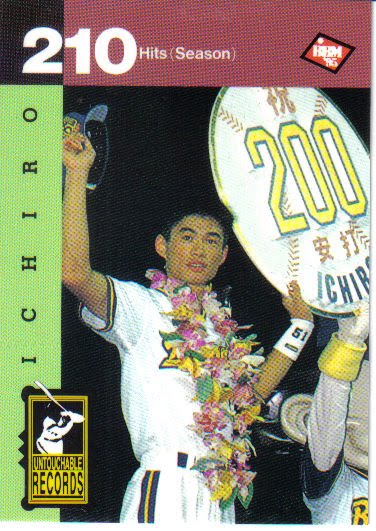
I came across an interesting piece of Baseball history while researching Ichiro's Japanese statistics for my last post. Last week Ichiro tied Pete Rose for the most 200-hit seasons for a career with 10 seasons. As I stated last week, Ichiro is the Majors season hit leader with 262 which he accomplished in 2004. But what I found interesting is that Ichiro was also the single season hit leader in Japan with 210 hits which he accomplished in 1994 while with the Orix Blue Wave. What I didn't know what until that time no player had ever eclipsed the 200-hit mark in the Nippon Professional Baseball League (NPB). (PHOTO CREDIT http://japanesebaseballcards.blogspot.com/)

This season makes the 60th anniversary of the establishment of the NPB. I found it amazing that until 1994 there hadn't been a player with 200-hits. Now granted, the NPB plays a shorter season than MLB. I'm not sure if the number of games are consistent from year to year but from what I have researched, the last few years the Japanese season has been 144 games long while the MLB season is 162 games. That's a difference of 18 games which can be between 60 and 75 at-bats over that span. In 1994, Ichiro had 210-hits in 546 at-bats for an average of .385. In a league that plays small ball over the bloop and the blast that is most common here, I would think that more players would have had 200-hits. That might be changing.

Since Ichiro set the single season record for both the Pacific League and the NPB in 1994, four players have hit for 200 or more hits in a season. Here is the breakdown:

Norichika Aoki 202 in 2005 with the Tokyo Yakult Swallows
Alex Ramirez 204 in 2007 with the Yomiyuri Giants
Matt Murton 205 in 2010 with the Hanshin Tigers
Tsuyoshi Nishioka 203 in 2010 with the Chiba Lotte Marines
Norichika Aoki 202 in 2010 with the Tokyo Yakult Swallows

(PHOTO CREDIT http://japanesebaseballcards.blogspot.com/)

Aoki, who had the spotlight of the World Baseball Classic on him during the 2009 tournament, is the only player to have multiple 200-hits seasons (2005 and 2010). Former Rockies and Cubs outfielder Matt Murton currently holds the Central League single season record of 205-hits and has 8 games left to try and break Ichiro's record of 210-hits during his inaugural season with the Hanshin Tigers.

I know for many baseball fans here in the U.S., happenings in the Japanese baseball league barely register as a blip on the radar but I like to think of myself as a more worldy baseball fan. Especially since I remember the first day I saw Ichiro being introduced to the U.S. press with his signing with Seattle Mariners for the 2001 season and wondering who was this Japanese guy with the cool shades. We all now know who he is.

FH

For Further Reading
- Robert Whiting The Meaning of Ichiro: The New Wave from Japan and the Transformation of Our National Pastime (New York, Time Warner Book Group: 2004)
- Click Here for the English Language version of the Nippon Baseball League webpage
- Click Here to access YakyuBaka.com for an awesome site devoted to all things Yakyu. That's Baseball for all you Gaijin out there. LOL.
- Click Here to access my April 8, 2010 post on Alex Ramirez being the dominant Latino ballplayer in Japan from Latinoball
- Click Here to access my July 1, 2010 post on Alex Ramirez as he progressed during the 2010 NPB season from Latinoball
- Click Here to access my post from September 1, 2010 detailing how Alex Ramirez became the 1st player in the history of the NPB to have 8 100+ RBI seasons from Latinoball