Tuesday, April 16, 2013

Jackie Robinson Day April 15


I originally wrote this post for my NYCHistory blog page entitled Jackie Robinson Day April 15 on April 15, 2009. Since today is once again April 15th, I decided to re-post this in honor of Jackie Robinson:

April 15 is known to many people as the day that the TaxMan gets his due. But for baseball people, April 15th has a different significance. On April 15th, 1947, a young 28-year-old man took the field at Ebbets Field for the Brooklyn Dodgers in a game against the Boston Braves. While playing first base, he had no hits in three at bats. Though this description is somewhat ordinary, the player was anything but. For the first time since the late 1800’s, a black man was allowed to play professional baseball within the ranks of Major League Baseball. That man was Jack Roosevelt "Jackie" Robinson (January 13, 1919-October 24, 1972).
"It kills me to lose. If I'm a troublemaker, and I don't think that my temper makes me one, then it's because I can't stand losing. That's the way I am about winning, all I ever wanted to do was finish first." Jackie Robinson
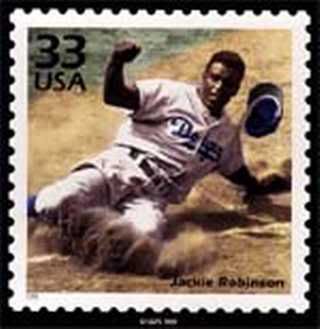
Robinson brought an energy and excitement to both the field of play that was only seen on the fields that the Negro Leagues baseball was played on. His determination on the field translated to a form of baseball that emphasized speed and aggressive base running that many of the fans of Major League baseball had not seen. Where Robinson was aggressive on the field he was patient with the abuse that was hurled towards him from not only fans but from fellow players who often insulted him and threatened to not take the field if Robinson played in the game.
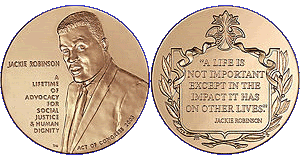
"A life is not important except in the impact it has on other lives."Jackie Robinson
The significance of Robinson’s playing for the Dodgers was not only felt within the baseball ranks. In terms of society, Robinson would become one of the icons of the growing civil rights movement. As Buck O'Neill says in the documentary Pride and Preserverance: The Story of the Negro Leagues:
"Jackie Robinson, that was the beginning of the civil rights movement. That was before Brown vs. The Board of Education. That was before Sister Rosa Parks said 'I'm not going to move to the back of the bus today'. Martin Luther King was a sophomore at Spellman at the time. That's what got the ball moving."
Robinson’s playing of professional baseball, gave many young black men and women a positive role model. If Jackie could do it, why couldn’t they do it.
"The right of every American to first-class citizenship is the most important issue of our time." Jackie Robinson
His later life was devoted to the enhancement and advancement of the civil rights movement not only for African American but for all Americans.

"With all major league players, coaches and umpires wearing Jackie's No. 42, we hope to demonstrate the magnitude of his impact on the game of baseball, Major League Baseball will never forget the contributions that Jackie made both on and off the field" Commissioner of Major League Baseball Allen H. “Bud” Selig
"The way I figured it, I was even with baseball and baseball with me. The game had done much for me, and I had done much for it." Jackie Robinson
Today, every Major League player will wear number 42 as their uniform number in honor of the breaking of the color barrier by Robinson 62 years ago.
"When Jack stepped foot on the field on April 15, 1947, and broke the color barrier in baseball, he became a catalyst for social change in America," Rachel Robinson
That he did Mrs. Robinson, and thank you for all that your husband and family have done. The world would not be the same without it.

Here are some links to check out about Jackie Robinson:
- The Official Jackie Robinson Page
- Time Magazine 100 Most Important People of the 20th Century Listing for Jackie Robinson
- U.S. Library of Congress Baseball and Jackie Robinson Page
- Afro-Am Listing for Jackie Robinson
- The National Baseball Hall of Fame and Museum listing for Jackie Robinson
- The Jackie Robinson Foundation
What Ever Happened to Charles Johnson?

With all the discussion of the lack of African-American ballplayers in the MLB, a particular African-American player came to mind. I remember this person being a very dynamic catcher in the National League. Even though I thought he was a very good catcher will always be known for the trades that involved him and other players. The player that I'm thinking about is Charles Johnson.

I first remember seeing Charles Johnson while he was playing for the Florida Marlins. I always thought his style was reminiscent of Tony Peña who is currently a bench coach for the New York Yankees. Johnson was originally drafted in the first round of the 1989 draft and was picked by the Montréal Expos with the 10th pick. He declined to sign with Montreal choosing instead to attend the University of Miami. He once again was drafted in the first round this time in the 1992 draft with the 28th pick in the draft by the Florida Marlins. He decided to sign within a couple months after being drafted.

Johnson's potential was so promising that he spent a very short time in the minor leagues. Johnson spent the 1993 season playing for the Kane County Cougars of the Single A Midwest League. He was promoted to the Portland Sea Dogs of the Double A Eastern League for the 1994 season where he continued to impress. The impression made by Johnson even got him a call-up to the parent Marlins team where he played in 4 games before the players strike halted and eventually ended the 1994 season. Johnson would play in 2 games for Portland in 1995 before getting the permanent call-up to the majors. Johnson would by-pass Triple A entirely. To show you the impact made by Johnson in the minors, here is a description of Johnson from the article Charles Johnson to Return to Portland on April 18th from the Portland Sea Dogs website:
Johnson was a member of the Sea Dogs' inaugural team in 1994.  He opened the season as the Florida Marlins top prospect and he did not waste any time in making an impact in Portland.  In the Sea Dogs' inaugural game, Johnson belted two home runs including a game winner in the 14th inning as the Sea Dogs defeated the Reading Phillies 2-1.  The catcher hit .264 with 28 home runs and 80 RBI for the Sea Dogs in 1994 and was named to the Eastern League All-Star squad.  His 28 home runs led the league and were the most by an Eastern League catcher since Tony Peña hit 34 in 1979.
In making the jump to the Marlins, Johnson would be the first Marlins minor leaguer to reach the majors. In his rookie season of 1995, Johnson would end up 7th in the National League Rookie of the Year voting by hitting .251 with 11 homeruns and 39 RBI. He also made only 6 errors in the field and threw out 43% (38 of 89 runners) of would be basestealers earning the 1st of 4 straight N.L. Gold Glove awards for the catcher position. Johnson's performance would steadily improve during his seasons with the Marlins. Here is when things get a bit hectic for Johnson.

As part of the salary purge of the 1997 World Series Champions Johnson would be traded on May 14, 1998 with Manuel Barrios, Bobby Bonilla, Jim Eisenreich and Gary Sheffield to the Los Angeles Dodgers for Mike Piazza and Todd Zeile (Piazza himself would be traded by the Marlins on May 22, 1998 to the New York Mets for Preston Wilson, Ed Yarnall and minor leaguer Geoff Goetz). Johnson would finish out the 1998 season with the Dodgers and once again get traded.

On December 1, 1998 Johnson would be part of two trades. In the first transaction, Johnson was traded by the Dodgers with Roger Cedeno to the New York Mets for Todd Hundley and minor leaguer Arnold Gooch. Then he would be traded to the Baltimore Orioles for reliever Armando Benitez. You would think that being traded to the American League would afford Johnson the opportunity to grow some roots with the Orioles. Not so. After spending the 1999 season with the Orioles where Johnson hit .251 with 16 homers and 54 RBI while throwing out 38% of would be base stealers, he would be traded once again.

On July 29, 2000 Johnson would be traded with Harold Baines to the Chicago White Sox for Brook Fordyce and minor leaguers Jason Lakman, Juan Figueroa, Miguel Felix. Finally after being traded four times in three seasons, Johnson would be granted free agency and re-signed with the Florida Marlins. Johnson's homecoming would be temporary.

In two seasons with the Marlins, Johnson would average 12 homeruns with 56 RBI while hitting .245 and throwing out 42% of base stealers in 2001 and 40% of base stealers in 2002 with his second All-Star appearance in 2001. After the 2002 season Johnson would once again be backing his bags. On November 16, 2002 Johnson would be traded by the Marlins along with Vic Darensbourg, Pablo Ozuna and Preston Wilson to the Colorado Rockies for Mike Hampton, Juan Pierre and cash (Hampton would be traded to the Atlanta Braves on November 18, 2002 for Tim Spooneybarger and minor leaguer Ryan Baker).

Johnson would spend two seasons in Colorado where he would find his career stalled by the Rockies pledging to play rookie J.D. Closser as their everyday catcher. After deliberations with a failed proposed trade with the Tampa Bay Devil Rays, Johnson would be traded for the last time in his career. Right before Spring Training camp broke on March 30, 2005 Johnson was traded by the Rockies along with Chris Narveson to the Boston Red Sox for Byung-Hyun Kim and cash. That same day Johnson was released by the Red Sox and would sign with the Devil Rays on April 4th. Johnson would only appear in 15 games for the Devil Rays before he was released on June 13, 2005 effectively ending his professional career.

In total of 12 season, Johnson had the following statistics:

Player
GABRH2B3BHRRBI
BBSOSBCSOBPSLGAVGOPS
Charles Johnson
118838364659402114167570
475997610.330 .433.245 .762 
Johnson was a two-time All-Star, a four-time Gold Glove winner and won a World Series Championship with the 1997 Florida Marlins. 

Sisco Kid.

For Further Reading

Thursday, April 11, 2013

283 Wins with 16 Gold Gloves AND Most Wins in the 1960's AND NOT in the Hall of Fame

This question from Pete was two questions that I rolled into one since the answer is the same for both. At first the question of who is the pitcher who has 283 career wins with 16 Gold Gloves and is NOT in the Hall of Fame led me to initially say that the answer was Mike Mussina. The answer was incorrect. Mussina had a career 270-153 record with 7 Gold Gloves. My next answer would prove correct.

Jim Kaat had a 283-237 career record with a total of 16 Gold Gloves in a row from 1962-1977. 14 were in American League with the Twins and White Sox while his last 2 were with the Philadelphia Phillies. The only pitcher with more Gold Gloves than Jim Kaat is Greg Maddux who has a total of 18 Gold Gloves.

For the second question: Who won the most games in the 1960's, I joked to Pete that it surely couldn't have been Jim Kaat which got a big laugh out of him. It is Jim Kaat with a catch. The question wasn't quite correct. Pete says he said A.L. but I didn't hear it.No matter, the following is still interesting.

Jim Kaat led the American League in wins during the 1960's with a record of 142-119 during that decade. The amazing thing is that with 142 wins during the 1960's and a total of 283 wins, Kaat is not in the Hall of Fame. There are 40 pitchers that are in the Hall with less wins than Kaat. I'm not totally sure why he didn't garner the 75 percent vote needed for enshrinement into Cooperstown. Kaat pitched the bulk of his career in an era where pitchers started and finished their games regardless if they won or loss. Kaat has a total of 180 complete games to his name.

The honor of the most wins among all pitchers within the American AND National Leagues belongs to "The Dominican Dandy" Hall of Famer Juan Marichal. Marichal posted a 191-88 record from 1960-1969 winning 20 games or more 7 times for an average of 19 wins and 9 losses per season. Another astounding fact of all this is that Marichal NEVER won the Cy Young Award. The Cy Young award was given to one pitcher for both leagues from 1956-1966. From 1967 on, the award was awarded to the best pitcher in the American League and the best pitcher in the National League.

There you go. Until the next round of trivia questions.

Sisco Kid.

For Further Reading
- Click Here to Access Jim Kaat's Career Statistics from Baseball Reference.com
- Click Here to Access Juan Marichal's Career Statistics from Baseball Reference.com

Wednesday, April 10, 2013

UPDATE: The Yankees Should Trade Robinson Cano If...

Back on March 7, 2013 I posted the following statement concerning Robinson Cano and the Yankees:
If the Yankees are in third place or worse by the deadline they should trade Robinson Cano. His agent, Mr. Scott Boras, is going to want to fleece the Yanks for a contract of over $200 million with at least 7 or 8-years. A 5-year deal would be much more economical but knowing how Scott Boras is when negotiating deals for his clients, economical isn't a word that he would use.
Well, now that Cano has fired Boras and signed on with Jay-Z's Roc Nation Agency I need to amend my statement somewhat. Like I stated in the original post, I'm a big Robinson Cano fan and I don't make my call to trade Cano lightly. I'm not making this amendment because Cano is hitting lights out (8 for 19 with 7 RBIs, 8 Runs scored with 3 Homers) while leading the Yankees in scoring 32 runs on 44 hits during their current three-game winning streak. I'm looking at this logically.

I do believe that with the change in representation for Cano a deal between him and the Yankees will happen. I believe Jose Cano (Robinson's father) when he says: I know he will sign for six or seven years. I've always believed that a deal within those number of years would work out the best for both sides. I think a deal similar to Josh Hamilton's 5-year $133-million would work out best. At 30, Cano can get paid top dollar with the potential for another payday at the age of 36 (similar to how Jeter signed with the Yankees in 2011). Give him $30-million a year but $30-million over five years is much more manageable than $30-million over eight to ten years.

For the Yankees, it helps to streamline their payroll in terms of number of years signed and avoid possibly having a repeat of the negative impact of a long contract like Alex Rodriguez's. In generally I feel that Baseball is better served if players signed contracts with in the five or six year range rather than the eight to ten year age, especially for players who are already 30 years old. I think the benchmark for that will be how Albert Pujols continues to perform during the length of his 10-year $240-million deal. Pujols was recently quotes as saying: "God has given me ability and talent, but the day I feel like I can't compete any more on this level, I'm not going to embarrass myself," "I'm going to walk off. Whether that's next year, two years from now, only God knows." . 

I personally feel that in signing players to shorter contracts helps to limit the amount of stagnancy that might eventually accrue on rosters from older players being locked into multi-year deals that feel like there is no end in sight.

Like I said above, I do think the Yankees will sign Cano either during the season or in the offseason. I think more rational heads will prevail in the form of Cano's new representatives. I always hinged the talk of trading Cano on the Boras-effect. I'm truly glad to see that effect gone from this situation. We'll see how it Cano's contract situation plays out over time.

Sisco Kid

Tuesday, April 9, 2013

Rami-Chan First Foreign Player in NPB to Reach 2000 Hits

Photo Courtesy of
Sports Card Jambalaya
As those of you who have read this blog in the past know that I have kept an eye on the career of Alex Ramirez of Venezuela who has played the last 13 seasons in Japan. On April 7, 2013, Ramirez (affectionately known as Rami-Chan) now with the Yokohama DeNa Baystars of the Central League in the Nippon Professional Baseball League (NPB) reached the 2,000 hit plateau in stunning fashion. Playing against the team Ramirez initially signed with in the NPB (The Tokyo Yakult Swallows) at their homepark of Jingu Stadium, Ramirez hit his 379th career homerun. In doing so, Rami-Chan became only the 42nd player and first foreigner to surpass career 2,000 hits in the NPB.

So where does Rami-Chan rank in terms of foreign players in Japan? According to Jason Coskrey in his article Ramirez possibly top foreign-born player ever in NPB dated April 9, 2013:
Currently in his 13th season in Japan, Ramirez has a career .303 average, is 22nd on the all-time home run list and 20th in RBIs with 1,262 over his career with the Yakult Swallows, Yomiuri Giants and now Yokohama BayStars. Tuffy Rhodes is the lone foreign-born player with more homers (464) and RBIs (1,269)... A few could’ve laid claim to the title of “greatest foreign player,” but Ramirez’s longevity — the 38-year old has played in 1,696 games, the most by a foreign-born player — has set him apart.
The player with the most career hits in the history of the NPB was Isao Harimoto who according to Jim Albright (and Kaz Nagastsuka @kaznagatsuka for the heads up) is the only player in the history of the NPB to reach the 3,000 hit plateau (3,085). Based on that figure, I believe that reaching 2000 hits is similar to the 3000 plateau here in the United States since only one player in Japan has reached 3,000 hits.

Ramirez's achievement is a testament to his work ethic and perseverance in an environment that can often be difficult for foreign players to not only succeed but just to simply acclimate themselves to.

Here are Alex Ramirez's career statistics as of April 9th (Statistics courtesy of the Alex Ramirez page on the NPB website):

Player
GABRH2B3BHRRBI
BBSOSBCSOBPSLGAVGOPS
Alex Ramirez
169766118612000328123791262
30312442019 -  - .303 - 

I think that it is safe to state that Rami-Chan's chances for induction to the Japanese Baseball Hall of Fame are pretty certain. Felicidades Rami-Chan (ラミちゃんおめでとう).

FH

For Further Reading
- Click Here to Access the article Ramirez becomes first foreigner to reach 2,000-hit milestone in Japanese baseball by Jason Coskrey dated April 7, 2013 from the Japan Times website
- Click Here to Access the article Where No Westerner in Japan Has Gone by Brad Lefton dated July 7, 2012 from the New York Times website
- Click Here to Access Rami-chan, the Dominant Latino Gaijin in Japan dated April 8, 2010 from my Latinoball blog page
- Click Here to Access Return to Japan to look at Rami-Chan dated July 1, 2010 from my Latinoball blog page
- Click Here to Access Latino Milestones in the U.S. and Japan dated September 1, 2010 from my Latinoball blog page
- Click Here to Access 2010 Season Recap for Rami-Chan dated December 14, 2010 from my Latinoball blog page


Monday, April 8, 2013

The Only Player to Play For The Boston Milwaukee AND Atlanta Braves

This question from Pete proved to be quite the tricky question to answer. For those of you who don't know, the Atlanta Braves started out in the city of Boston. After a number of monikers, the name of the team settled on The Braves from 1912-1935 and 1941-1952. They were called the Boston Bees from 1936-1940. Why? I haven't been able to find out as of yet. But for an interesting history on the Boston Braves check out Home of the Braves? 50 years after the Boston Braves' departure, it’s worth asking: did the wrong team leave town? by Mike Miliard. Back to the trivia question. So the Braves left Boston for Milwaukee for a period of 12 years before moving to Atlanta for the 1966 season. The player would have had to have played for the team for a window of at least 14 years from 1952 to 1966 to have played for the team in all three cities.

At first my mind gravitated to Hall of Famer Warren Spahn, which was the incorrect answer. Spahn played for Boston in 1942 before losing three seasons to military service. Spahn rejoined the team in 1946 and continued with the franchise through their move to Milwaukee. His contract was purchased by the New York Mets in 1964 and would become a free agent after being released during the 1965. Spahn would sign with the San Francisco Giants during the same season and be released at season's end.


Though Hall of Famer Hank Aaron signed as a free agent with the Boston Braves in 1952, he never played in Boston coming up with the Milwaukee Braves in 1954. He would play with the Braves in Atlanta until 1974. Aaron would play for two more seasons with the Milwaukee Brewers. After Aaron, the next logical choice for me was Hall of Famer Eddie Mathews which was indeed the correct answer.

Eddie Mathews' rookie season was 1952 with the Boston Braves and came into his own with the Milwaukee Braves as a potent tandem with Hank Aaron. While in Milwaukee, Mathews hit 452 of his 512 home runs. He would combine with Aaron to hit a total of 850 home runs while playing in Milwaukee. That is one crazy number considering that in 12 years, Babe Ruth and Lou Gehrig would combine for a total of 859 home runs.

Mathews would play the 1966 season in Atlanta before he was traded to the Houston Astros on December 31, 1966 with a player to be named later and Arnold Umbach for Bob Bruce and Dave Nicholson. Sandy Alomar Sr. was the player to be named later. He would later be traded to the Detroit Tigers during the 1967 season and play with them until the end of the 1968 season. He would be released and retire after the 1968 season.

Thanks to Pete for that one.

For Further Reading
- Click Here to read Guest Article: Looking Back at Aaron and Mathews by Andrew Godfrey from the Los Angeles Times blog page Bleacher Report: Los Angeles dated October 7, 2009
- Click Here to Access Eddie Mathews' Career Statistics from Baseball Reference.com
- Click Here to Access Hank Aaron's Career Statistics from Baseball Reference.com
- Click Here to Access Warren Spahn's Career Statistics from Baseball Reference.com

Sisco Kid

Saturday, April 6, 2013

Chris Davis Is En Fuego

In the first four games of the 2013 season, Chris Davis has become a fantasy baseball dream. At a glance he is what Davis has done: 9 for 15 (.600) with four homers and 16 RBI. According to Eduardo A. Encina in his article Chris Davis' grand slam gives Orioles 9-5 win over Twins on Opening Day from the Baltimore Sun  website dated April 5, 2013:
Davis drove in a career-high five runs on the day, giving him 16 RBIs this season, the most of any player through his team's first four games since RBIs became an official stat in 1920, according to the Elias Sports Bureau. That shattered the record of 12 set by the St.Louis Cardinals' Mark McGwire (1998) and Philadelphia Phillies' Dolph Camilli (1935)...Davis also became just the fourth player in major league history to homer in his team's first four games — joining Willie Mays (1971), McGwire ('98) and Nelson Cruz (2011).
Of the 9 hits, 7 are extra base hits (3 2B and 4HR) which has his Slugging percentage at an astronomical 1.600 and his OPS is 2.211. Ok, he's not going to continue at that torrid pace for the whole season. Perhaps this is a sign of what was expected of him after his rookie season of 2008. Lee Singer of ESPN Stats & Info wrote an article in March 22, 2010 entitled One2Watch4: Rangers 1B Chris Davis which goes in depth where Davis stood after the disappointing 2009 season.

It should be interesting to see what Chris Davis continues to do. Will he hit another homerun today to make it five homers in the first five games of the season? Will the Twins even pitch to him? We'll have to wait and see.

Sisco Kid

For Further Reading
- Click Here to Access Chris Davis' Career Statistics from Baseball Reference.com