Keeping with the theme of the last post, this time I've decided to list the brother combinations of Latino players in MLB. Here's the list that I've come up with:
Jose and Merito Acosta
Sandy Jr. and Roberto Alomar
Felipe, Mateo and Jesus Alou
Tony and Marcos Armas
Erick and Willy Aybar
George and Juan Bell
Jolbert and Orlando Cabrera
Jose and Ozzie Canseco
Andujar and Domingo Cedeno
Alex and Joey Cora
Cesar and Felipe Crespo
Hector, Jose and Tommy Cruz
Adrian and Edgar Gonzalez
Vladimir and Wilton Guerrero
Livan and Orlando Hernandez
Julio and Ruddy Lugo
Angel and Pepe Manqual
Josias and Ravelo Manzanillo
Pedro and Ramon Martinez
Bengie, Jose and Yadnier Molina
Andy and Jose Mota
Jaime and Julio Navarro
Melvin and Wilbur Nieves
Carlos, Melido and Pascual Perez
Enrique and Vincente Romo
Javier and Jose Valentin
If there are any more combinations that I failed to add to this list, please feel free to let me know.
FHJ

Saturday, July 19, 2008

Latino Father and Son Combos in MLB
While attending The All Star Fanfest a few weeks ago, I over heard a trivia question which inspired this post (Which father and son duo hit back to back hrs in the same game: Ken Griffey Sr. and Jr.). It made me wonder which were some of the Latino father and son combos that played in the major leagues. Here goes:
Sandy Sr. and Sandy Jr. and Roberto Alomar
Felipe and Moises Alou
Ruben and Ruben Amaro
Angel and Jack Aragon
Tony Armas Sr. and Jr.
Pedro and Pedro Borbon
Jose and Robinson Cano
Jose Cruz Sr. and Jr.
Tito and Terry Francona
Cesar and Maicer Izturis
Julian and Stan Javier
Elvio and Manny Jimenez
Rene and Aurelio Monteagudo
Manny and Andy and Jose Mota
Ed and Omar Olivares
Tony Peña Sr. and Jr.
Tony and Eduardo Perez
Diomedes Olivo and Gilberto Rondon
Diego and David Segui
Jose and Danny Tartabull
Pablo and Steve Torrealba
Ricardo and Gil Torres
Osvaldo Virgil Sr. and Jr.
Honorable mention, though these pairings did not play in MLB, they played professional baseball in other areas:
Luis Tiant Sr. and Jr. (Sr. played in Negro Leagues and Caribbean)
Luis Aparicio Sr. and Jr. (Jr. played in Venezuelan Winter League)
Perucho and Orlando Cepeda (Perucho played in Negro Leagues, Puerto Rican and Dominican Winter Leagues)
If I come across any more pairings, I'll update the post.
Take care,
FH
Sandy Sr. and Sandy Jr. and Roberto Alomar
Felipe and Moises Alou
Ruben and Ruben Amaro
Angel and Jack Aragon
Tony Armas Sr. and Jr.
Pedro and Pedro Borbon
Jose and Robinson Cano
Jose Cruz Sr. and Jr.
Tito and Terry Francona
Cesar and Maicer Izturis
Julian and Stan Javier
Elvio and Manny Jimenez
Rene and Aurelio Monteagudo
Manny and Andy and Jose Mota
Ed and Omar Olivares
Tony Peña Sr. and Jr.
Tony and Eduardo Perez
Diomedes Olivo and Gilberto Rondon
Diego and David Segui
Jose and Danny Tartabull
Pablo and Steve Torrealba
Ricardo and Gil Torres
Osvaldo Virgil Sr. and Jr.
Honorable mention, though these pairings did not play in MLB, they played professional baseball in other areas:
Luis Tiant Sr. and Jr. (Sr. played in Negro Leagues and Caribbean)
Luis Aparicio Sr. and Jr. (Jr. played in Venezuelan Winter League)
Perucho and Orlando Cepeda (Perucho played in Negro Leagues, Puerto Rican and Dominican Winter Leagues)
If I come across any more pairings, I'll update the post.
Take care,
FH
Tuesday, October 16, 2007
Luis Castro as the 1st Latino Major Leaguer?
It's funny how things work out. In my last post I list the pioneers of Latino baseball players. Since the last post, there has been some activity and debate on various websites on whether Luis Castro was the 1st Latino Major Leaguer. The debate is not on whether he played in the Major Leagues. That much is sure, it's whether he was born in Colombia, Panama or the United States that the issue gets confusing. To further muddle the debate, if Castro was not the 1st Latino Major League then who was, and under what criteria should the decision be made. First let me describe who Luis Castro was.
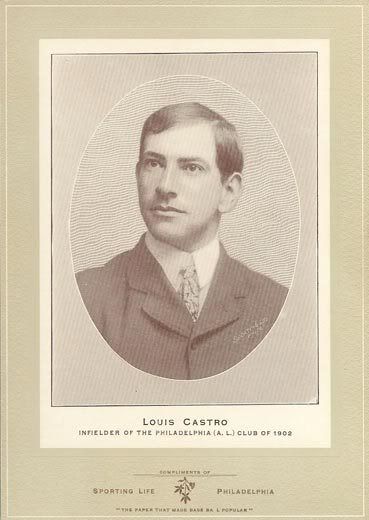 Irregardless of where he was born, it is known that he was born in 1876 (Some dates place it at November 24th). Similar to Esteban Bellan (who was profiled in my last post), Castro played his initial baseball at school while attending Manhattan College in New York City. Some dates place him there starting in 1891 and 1894, but it is known that he played for the Manhattan College team for three years. From there, his baseball experience is within various leagues. In 1898, he played for Utica, 1900 he played for Atlantic City and in 1901, he played in the Connecticut State League. How he came to be discovered by the Philadelphia Athletics for the 1902 season is not known but he did play for the Athletics in the 1902 season.
Due to a contract dispute between The Athletics and their second basemen Nap LaJoie, the second basemen position became available. The manager of the Athletics, Connie Mack, chose Luis Castro to be his second basemen. Here are his statistics for 1902:
Castro was let go after the 1902 season and played Minor League baseball among various leagues for about 17 years. What he did after baseball is not known but it is known that he lived with his wife in Flushing, NY and died in New York City on September 24, 1941. Pretty straightforward or so it seems.
The debate starts at this point. As per the 1910 census, Luis Castro is listed as being born in Colombia but this changes with the 1930 census where his birthplace is listed as New York City. Why the change? Speculation lies in that he was afraid of being deported. Also, since it is believed that he was in financial straits in his later years, in order to get benefits he may have needed to be a citizen of the United States. Who truly knows. The following piece of information may shed some new light where he was truly born. Based on the research of Nick Martinez, a ship's log of the SS Colon which left Colombia in 1885, a man named Nestor Castro and his eight year old child Luis (who was born in Colombia) were on the ship coming to New York City for business. Instead they stayed in the United States to make a new life for themselves.
So was he the 1st Latino Major Leaguer? If he was born in Colombia, then absolutely. If he was born in NYC, then I guess not if you subscribe to the idea that a person born in a non Latino country to a Latino parent(s)is not Latino. Though my position lies somewhere between both points of view. I believe that at least for the 1st Latino Major Leaguer he should have been at least born in Latin America. For later players, I think that if at least one of your parents were Latino, then you are Latino. Some authors have different views which can be seen in the following links:
Ian Herbert Smithsonian Magazine 9/1/2007
Peter Bjarkman's blog post 9/25/2007
Louis Castro website by Nick Martinez
Jesse Sanchez article on MLB.com 4/23/2007
So let me be devil's advocate for a second. If Castro wasn't the 1st, then who was. I personally think that Esteban Bellan should be listed as the 1st since he played in the Major League of his time (National Association) and whether the MLB, Elias Sports Bureau or any other agency doesn't recognizes it shouldn't change the fact that Bellan played Professional baseball before any other Latin ballplayer. But if we do go with the theory that the National Association wasn't a major league then who should it be. I just found about a baseball player called Charles "Chick" Pedroes who in 1902 played 2 games for the Chicago Orphans who was born in Havana but came to Chicago at the age of 2 years old. So where does he stand. I believe that this issue will only be further developed though research and I hope to be able to bring you some of that research in the near future.
Thanks,
FHJ
Irregardless of where he was born, it is known that he was born in 1876 (Some dates place it at November 24th). Similar to Esteban Bellan (who was profiled in my last post), Castro played his initial baseball at school while attending Manhattan College in New York City. Some dates place him there starting in 1891 and 1894, but it is known that he played for the Manhattan College team for three years. From there, his baseball experience is within various leagues. In 1898, he played for Utica, 1900 he played for Atlantic City and in 1901, he played in the Connecticut State League. How he came to be discovered by the Philadelphia Athletics for the 1902 season is not known but he did play for the Athletics in the 1902 season.Due to a contract dispute between The Athletics and their second basemen Nap LaJoie, the second basemen position became available. The manager of the Athletics, Connie Mack, chose Luis Castro to be his second basemen. Here are his statistics for 1902:
Year | G | AB | R | H | 2B | 3B | HR | RBI | SB | BB | SO | AVG |
|---|---|---|---|---|---|---|---|---|---|---|---|---|
1902 | 42 | 143 | 18 | 35 | 8 | 8 | 1 | 15 | 2 | 4 | 0 | .245 |
Castro was let go after the 1902 season and played Minor League baseball among various leagues for about 17 years. What he did after baseball is not known but it is known that he lived with his wife in Flushing, NY and died in New York City on September 24, 1941. Pretty straightforward or so it seems.
The debate starts at this point. As per the 1910 census, Luis Castro is listed as being born in Colombia but this changes with the 1930 census where his birthplace is listed as New York City. Why the change? Speculation lies in that he was afraid of being deported. Also, since it is believed that he was in financial straits in his later years, in order to get benefits he may have needed to be a citizen of the United States. Who truly knows. The following piece of information may shed some new light where he was truly born. Based on the research of Nick Martinez, a ship's log of the SS Colon which left Colombia in 1885, a man named Nestor Castro and his eight year old child Luis (who was born in Colombia) were on the ship coming to New York City for business. Instead they stayed in the United States to make a new life for themselves.
So was he the 1st Latino Major Leaguer? If he was born in Colombia, then absolutely. If he was born in NYC, then I guess not if you subscribe to the idea that a person born in a non Latino country to a Latino parent(s)is not Latino. Though my position lies somewhere between both points of view. I believe that at least for the 1st Latino Major Leaguer he should have been at least born in Latin America. For later players, I think that if at least one of your parents were Latino, then you are Latino. Some authors have different views which can be seen in the following links:
Ian Herbert Smithsonian Magazine 9/1/2007
Peter Bjarkman's blog post 9/25/2007
Louis Castro website by Nick Martinez
Jesse Sanchez article on MLB.com 4/23/2007
So let me be devil's advocate for a second. If Castro wasn't the 1st, then who was. I personally think that Esteban Bellan should be listed as the 1st since he played in the Major League of his time (National Association) and whether the MLB, Elias Sports Bureau or any other agency doesn't recognizes it shouldn't change the fact that Bellan played Professional baseball before any other Latin ballplayer. But if we do go with the theory that the National Association wasn't a major league then who should it be. I just found about a baseball player called Charles "Chick" Pedroes who in 1902 played 2 games for the Chicago Orphans who was born in Havana but came to Chicago at the age of 2 years old. So where does he stand. I believe that this issue will only be further developed though research and I hope to be able to bring you some of that research in the near future.
Thanks,
FHJ
Monday, August 13, 2007
1st Latino Pioneers
Latinos have been a part of professional baseball for over a century. Playing throughout the many varied leagues in the United States, Latinos have played an important role in not only advancing the game in The United States but also in their homelands. Here is the list of the 1st Latino ballplayers from Latin America. Though the list is not in order of appearance for each individual Latino, it is broken down by the 1st player from each represented country to play in the Major Leagues.
Colombia: Luis Castro 1902 Philadelphia Athletics
Cuba: Armando Marsans/Rafael Almeida 1911 Cincinnati Reds
Mexico: Baldomero “Mel” Almada 1933 Boston Red Sox
Venezuela: Alejandro Carrasquel 1939 Washington Senators
Puerto Rico: Hiram Bithorn 1942 Chicago Cubs
Panama: Humberto Robinson 1955 Milwaukee Braves
Dominican Republic: Osvaldo Virgil Sr. 1956 New York Giants
Nicaragua: Dennis Martinez 1976 Baltimore Orioles
Honduras: Gerald Young 1987 Houston Astros
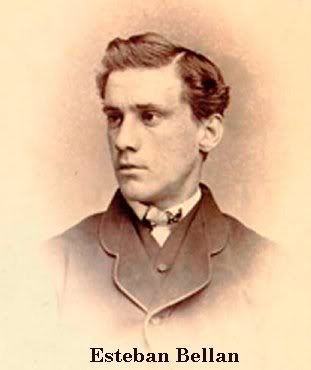 Now, technically the 1st Latino to play professional baseball in the United States was Esteban Enrique Bellan (1850-8/8/1932) of Cuba. Also known as Steve Bellan, he played his college baseball at The University of Fordham during the years of 1863-1868 on the Fordham Rose Hill Baseball Club. The Fordham Baseball Club had the distinction of being the first school to play in the first ever nine-man team college baseball game in the United States against St. Francis Xavier College on November 3, 1859.
Professionally, Bellan played for the Unions of Morrisania, an upstate New York team. In 1869 Bellan joined the Troy Haymakers for whom he played third base until 1872. In 1871 the Haymakers joined the National Association of Professional Baseball Players (NAPBBP) also known as the National Association. Eventually a number of its teams became the National League on February 2, 1876.
After his time with the Haymakers, Bellan played a year with the New York Mutuals and then returned to Cuba. On December 27, 1874 Bellan played in the first organized baseball game in Cuba. From 1878-1886 he served as both a player and manager for the recently founded Havana baseball team. He led Havana to multiple Cuban baseball championships (1878-79, 1879-1880, and 1882-1883).
Why is Bellan not recognized as the 1st Latino to play in MLB?
Though the National Association is commonly considered the first professional baseball league, its status as the first Major league disputed. By the official history of Major League Baseball, the National Association is not recognized as one of the recognized historical major leagues and MLB does not recognize the compiled statistics from that league. So, based on that reasoning, Bellan is not considered to be the 1st Latino to play in MLB.
In future posts, I will attempt to highlight each of the 1st Latino Baseball players. If you have any questions and/or comments, please feel free to post and comment. Any and all information helps to round out my blog.
Thank You.
FHJ
Colombia: Luis Castro 1902 Philadelphia Athletics
Cuba: Armando Marsans/Rafael Almeida 1911 Cincinnati Reds
Mexico: Baldomero “Mel” Almada 1933 Boston Red Sox
Venezuela: Alejandro Carrasquel 1939 Washington Senators
Puerto Rico: Hiram Bithorn 1942 Chicago Cubs
Panama: Humberto Robinson 1955 Milwaukee Braves
Dominican Republic: Osvaldo Virgil Sr. 1956 New York Giants
Nicaragua: Dennis Martinez 1976 Baltimore Orioles
Honduras: Gerald Young 1987 Houston Astros
Now, technically the 1st Latino to play professional baseball in the United States was Esteban Enrique Bellan (1850-8/8/1932) of Cuba. Also known as Steve Bellan, he played his college baseball at The University of Fordham during the years of 1863-1868 on the Fordham Rose Hill Baseball Club. The Fordham Baseball Club had the distinction of being the first school to play in the first ever nine-man team college baseball game in the United States against St. Francis Xavier College on November 3, 1859. Professionally, Bellan played for the Unions of Morrisania, an upstate New York team. In 1869 Bellan joined the Troy Haymakers for whom he played third base until 1872. In 1871 the Haymakers joined the National Association of Professional Baseball Players (NAPBBP) also known as the National Association. Eventually a number of its teams became the National League on February 2, 1876.
After his time with the Haymakers, Bellan played a year with the New York Mutuals and then returned to Cuba. On December 27, 1874 Bellan played in the first organized baseball game in Cuba. From 1878-1886 he served as both a player and manager for the recently founded Havana baseball team. He led Havana to multiple Cuban baseball championships (1878-79, 1879-1880, and 1882-1883).
Why is Bellan not recognized as the 1st Latino to play in MLB?
Though the National Association is commonly considered the first professional baseball league, its status as the first Major league disputed. By the official history of Major League Baseball, the National Association is not recognized as one of the recognized historical major leagues and MLB does not recognize the compiled statistics from that league. So, based on that reasoning, Bellan is not considered to be the 1st Latino to play in MLB.
In future posts, I will attempt to highlight each of the 1st Latino Baseball players. If you have any questions and/or comments, please feel free to post and comment. Any and all information helps to round out my blog.
Thank You.
FHJ
Wednesday, July 11, 2007
Inter-American League of 1979
This is the last of a four-part entry on the role of minor league teams in Latin America. As we highlighted in the three prior posts, Cuba was the location of the first two minor league teams in Latin America (Havana Cubans and Havana Sugar Kings). This time around, the idea was more ambitious. Organized by Roberto “Bobby” Maduro, the league was to be played within the U.S. and Latin America. The league was to be played within the framework of an AAA class league with no affiliation to Major League Baseball. With the league commencing play in 1979, the following cities were chosen:
Miami Amigos (U.S.)
Caracas Metropolitanos (Venezuela)
Maracaibo Petroleros de Zulia (Venezuela)
Santo Domingo Azucareros (Dominican Republic)
Puerto Rico Boricuas
Panama Banqueros
Though the idea that baseball was very popular in Latin America, the interest in the new league by the local population did not reflect that. Very often, the team’s average attendance was in the low one thousands and in some cases in the hundreds. This lack of revenue from the gates with limited revenues from radio and television plus the expense of international travel put a dent in the league’s operations. With the financial losses mounting, the Panamanian and Puerto Rican franchises folded on June 17 leaving only 4 teams continuing play. This was only to last for another 13 days when the rest of the league was disbanded. Of the six teams, only the Maracaibo Petroleros de Zulia and Miami Amigos were the only teams remaining that wanted to continue the financially troubled league.
The final team standings were as follows:
Here is a description of the 6 franchises:
1. Miami Amigos
The team played its games at Miami Stadium leading the league with a 51-21 record. With the league folding during its inaugural season, the Amigos were crowned as the only Champion of the Inter-American Baseball League. Being the best team of the league, they naturally led in the league in most categories. Former Major-League player and future Major-League manager Davey Johnson managed the Amigos. The team’s average attendance was 1,350 fans per game.
2. Caracas Metropolitanos
The team played its games within the Venezuelan capital of Caracas finishing with a record of 37-27 for second place. Jim Busby managed the team, and the team drew an average 3,500 fans per game, which made it the most popular team in the league in terms of attendance.
3. Santo Domingo Azucareros
The team played its games within the Dominican capital of Santo Domingo finishing with a record of 38-29 for third place. Mike Kekich managed the team, and the team drew an average of 1,000 fans per game.
4. Maracaibo Petroleros de Zulia
The team played its games within the Venezuelan city of Maracaibo; the team went 31-36 for fourth place. Former major leaguers Pat Dobson, Gus Gil and Hall of Famer Luis Aparicio managed the team, and the team drew an average of 1,100 fans per game.
5. Panama Banqueros
The Panama Banqueros went 15-36 for fifth place. Chico Salmon and Willie Miranda managed the team, and the team drew an average of 800 fans per game.
6. Puerto Rico Boricuas
The team played its games within the Puerto Rican capital of San Juan; the team went 16-39 for sixth place. Jose Santiago managed the team, and the team drew an average of 650 fans per game. As with the Panama Banqueros, financial difficulties forced them to fold at the end of the first half of the season.
Why did the league fail?
For obvious reasons, a lack of profits was the main reason. With only one team having a television deal (Caracas) and only three with radio deals, it was hard to promote and generate revenues from a product that was not visible to the local population. In addition, the expense of international travel between locations was crippling league’s dwindling finances.
Similarly to the situation with the Montreal Expos who played a number of games in Puerto Rico a couple of seasons ago it was hard to convince the local population to attend games. In comparison to the Winter League games that are played in Puerto Rico and the rest of the Caribbean, many of the fans are allowed free entry after a certain amount of time after the game has started. In addition, the expense of attending a Winter League game is less for the fan that it would be for a fan at a Major League Game.
Can a league like this succeed today?
In my opinion, if the league does not have substantial financial banking then it can’t survive. Only with the backing of Major League Baseball can an endeavor like this succeed. The league would need operate within the off-season of the Caribbean Winter Leagues so as to not affect their season. With the potential shift of power in Cuba at the end of the Castro regime, the movement for the reintroduction of professional baseball in the Caribbean/Latin American could be looming on the horizon.
Miami Amigos (U.S.)
Caracas Metropolitanos (Venezuela)
Maracaibo Petroleros de Zulia (Venezuela)
Santo Domingo Azucareros (Dominican Republic)
Puerto Rico Boricuas
Panama Banqueros
Though the idea that baseball was very popular in Latin America, the interest in the new league by the local population did not reflect that. Very often, the team’s average attendance was in the low one thousands and in some cases in the hundreds. This lack of revenue from the gates with limited revenues from radio and television plus the expense of international travel put a dent in the league’s operations. With the financial losses mounting, the Panamanian and Puerto Rican franchises folded on June 17 leaving only 4 teams continuing play. This was only to last for another 13 days when the rest of the league was disbanded. Of the six teams, only the Maracaibo Petroleros de Zulia and Miami Amigos were the only teams remaining that wanted to continue the financially troubled league.
The final team standings were as follows:
| Teams | W | L |
|---|---|---|
| Miami | 51 | 21 |
| Caracas | 37 | 27 |
| Santo Domingo | 38 | 29 |
| Maracaibo | 31 | 36 |
| Panama | 15 | 36 |
| Puerto Rico | 16 | 39 |
Here is a description of the 6 franchises:
1. Miami Amigos
The team played its games at Miami Stadium leading the league with a 51-21 record. With the league folding during its inaugural season, the Amigos were crowned as the only Champion of the Inter-American Baseball League. Being the best team of the league, they naturally led in the league in most categories. Former Major-League player and future Major-League manager Davey Johnson managed the Amigos. The team’s average attendance was 1,350 fans per game.
2. Caracas Metropolitanos
The team played its games within the Venezuelan capital of Caracas finishing with a record of 37-27 for second place. Jim Busby managed the team, and the team drew an average 3,500 fans per game, which made it the most popular team in the league in terms of attendance.
3. Santo Domingo Azucareros
The team played its games within the Dominican capital of Santo Domingo finishing with a record of 38-29 for third place. Mike Kekich managed the team, and the team drew an average of 1,000 fans per game.
4. Maracaibo Petroleros de Zulia
The team played its games within the Venezuelan city of Maracaibo; the team went 31-36 for fourth place. Former major leaguers Pat Dobson, Gus Gil and Hall of Famer Luis Aparicio managed the team, and the team drew an average of 1,100 fans per game.
5. Panama Banqueros
The Panama Banqueros went 15-36 for fifth place. Chico Salmon and Willie Miranda managed the team, and the team drew an average of 800 fans per game.
6. Puerto Rico Boricuas
The team played its games within the Puerto Rican capital of San Juan; the team went 16-39 for sixth place. Jose Santiago managed the team, and the team drew an average of 650 fans per game. As with the Panama Banqueros, financial difficulties forced them to fold at the end of the first half of the season.
Why did the league fail?
For obvious reasons, a lack of profits was the main reason. With only one team having a television deal (Caracas) and only three with radio deals, it was hard to promote and generate revenues from a product that was not visible to the local population. In addition, the expense of international travel between locations was crippling league’s dwindling finances.
Similarly to the situation with the Montreal Expos who played a number of games in Puerto Rico a couple of seasons ago it was hard to convince the local population to attend games. In comparison to the Winter League games that are played in Puerto Rico and the rest of the Caribbean, many of the fans are allowed free entry after a certain amount of time after the game has started. In addition, the expense of attending a Winter League game is less for the fan that it would be for a fan at a Major League Game.
Can a league like this succeed today?
In my opinion, if the league does not have substantial financial banking then it can’t survive. Only with the backing of Major League Baseball can an endeavor like this succeed. The league would need operate within the off-season of the Caribbean Winter Leagues so as to not affect their season. With the potential shift of power in Cuba at the end of the Castro regime, the movement for the reintroduction of professional baseball in the Caribbean/Latin American could be looming on the horizon.
Tuesday, July 10, 2007
Havana Sugar Kings 1954-1960
Continuing with the four part series on Minor League baseball in Latin America, this third entry is about the Havana Sugar Kings of the International League. This period was one where baseball and politics walked hand in hand. Things not only in the Minor Leagues changed but things were never the same in organized baseball.
The Havana Sugar Kings were an AAA affiliate of The Cincinnati Reds from the years 1954-1960. Playing within the prestigious International League, the league truly had an international feel, with teams in Cuba and Canada (Havana and The Hamilton Tigers, Montreal Royals, Toronto Maple Leafs).
Though the team was short lived, it did find success. Twice the team reached the post-season in 1955 and 1959, and it was in 1959 that the team reached its peak. Ending up with 3rd place in the league, The Sugar Kings upset both the Columbus Jets (AUTHOR'S NOTE: Thanks to Terry Proctor for the correction in the comments section. The Columbus Jets played from 1955-1970 before moving to Charleston, West Virginia becoming the Charleston Charlies in 1971. The Columbus Clippers were created in 1977) and the Richmond Virginians in the playoffs for a berth in the Junior Series. Politically, the rise of the Havana Sugar Kings was paralleled by the rise to power of Fidel Castro.
Meeting the representative of the American Association and the defending Junior World Series champion Minneapolis Millers (An affiliate of The Boston Red Sox with a young Carl Yazstremski on the playoff roster), the series was a riveting affair. Going the full seven games, two of the games (including the decisive seventh game) were decided in the last of the ninth inning, as well as, two others being decided in extra innings.
The series opened at Metropolitan Stadium in Bloomington, Minnesota. Though winter weather tends to come to the Minneapolis area earlier than other locations in the US, a rare blast of early winter weather arrived leading to small crowds. With the series tied at one (Havana won Game One 5-2, Minneapolis won Game Two 6-5), and snowflakes dotting the Minneapolis landscape, the series was shifted to the warm weathered locale of Havana. Though the weather was to the liking of both teams, the political climate was not. Armed troops were located throughout the city and especially at the Gran Stadium where the games were being played. The Millers were told not to leave the hotel during their free time, for their own safety.
Havana jumped out to three games to one lead on two consecutive extra inning victories (3-2 in 10 and 4-3 in 11). Not conceding defeat, the Millers roared back with two consecutive victories, tying the series and forcing a deciding Game Seven which Havana ended up winning leading to a massive celebration within the city of Havana. The celebration and joy would be short lived.
Though Castro vowed to support the Minor League endeavor, his nationalization of American industries in Cuba led to the eventual withdrawal of the Havana Sugar Kings. On July 13, during the 1960 season, The Havana Sugar Kings were no more. With the move to Jersey City, they became known as the Jersey City Jerseys. They played out the 1960 season in Jersey City to a 76-77 record. The move of the Sugar Kings not only signaled the end of Minor League baseball in Cuba, but also the end of all professional sports in Cuba. Many Cuban born professional athletes decided to stay in the United States, never again seeing their native land becoming enemies of the state. Throughout the years, a many number of players would also defect the island nation to the shores of the United States and the fulfillment of the dreams to play professional baseball.
Though the loss of Havana was felt throughout the International League, the league officials tried to maintain a foothold in the Caribbean. In 1961, the Miami Marlins (the same of the former Florida International League with the Havana Cubans from 1946-1954) were moved to San Juan, Puerto Rico. Financial difficulties led to the team to be moved to Charleston, West Virginia becoming the Charleston Marlins.
Playing on the Sugar Kings championship team of 1959 was Mike Cuellar, a Cuban from Las Villas who would pitch on the powerhouse Baltimore Orioles of the late 1960’s, Luis Arroyo, a Puerto Rican who played on the 1961 Yankees, and former major leaguer Cookie Rojas. Here is the final record count for the Havana Sugar Kings:
Our next and last post on Minor League Baseball in Latin America is an ambitious effort to bring Minor League Baseball to the Latin Caribbean basin. Though the idea had potential, it was possible way ahead of its time.
The Havana Sugar Kings were an AAA affiliate of The Cincinnati Reds from the years 1954-1960. Playing within the prestigious International League, the league truly had an international feel, with teams in Cuba and Canada (Havana and The Hamilton Tigers, Montreal Royals, Toronto Maple Leafs).
Though the team was short lived, it did find success. Twice the team reached the post-season in 1955 and 1959, and it was in 1959 that the team reached its peak. Ending up with 3rd place in the league, The Sugar Kings upset both the Columbus Jets (AUTHOR'S NOTE: Thanks to Terry Proctor for the correction in the comments section. The Columbus Jets played from 1955-1970 before moving to Charleston, West Virginia becoming the Charleston Charlies in 1971. The Columbus Clippers were created in 1977) and the Richmond Virginians in the playoffs for a berth in the Junior Series. Politically, the rise of the Havana Sugar Kings was paralleled by the rise to power of Fidel Castro.
Meeting the representative of the American Association and the defending Junior World Series champion Minneapolis Millers (An affiliate of The Boston Red Sox with a young Carl Yazstremski on the playoff roster), the series was a riveting affair. Going the full seven games, two of the games (including the decisive seventh game) were decided in the last of the ninth inning, as well as, two others being decided in extra innings.
The series opened at Metropolitan Stadium in Bloomington, Minnesota. Though winter weather tends to come to the Minneapolis area earlier than other locations in the US, a rare blast of early winter weather arrived leading to small crowds. With the series tied at one (Havana won Game One 5-2, Minneapolis won Game Two 6-5), and snowflakes dotting the Minneapolis landscape, the series was shifted to the warm weathered locale of Havana. Though the weather was to the liking of both teams, the political climate was not. Armed troops were located throughout the city and especially at the Gran Stadium where the games were being played. The Millers were told not to leave the hotel during their free time, for their own safety.
Havana jumped out to three games to one lead on two consecutive extra inning victories (3-2 in 10 and 4-3 in 11). Not conceding defeat, the Millers roared back with two consecutive victories, tying the series and forcing a deciding Game Seven which Havana ended up winning leading to a massive celebration within the city of Havana. The celebration and joy would be short lived.
Though Castro vowed to support the Minor League endeavor, his nationalization of American industries in Cuba led to the eventual withdrawal of the Havana Sugar Kings. On July 13, during the 1960 season, The Havana Sugar Kings were no more. With the move to Jersey City, they became known as the Jersey City Jerseys. They played out the 1960 season in Jersey City to a 76-77 record. The move of the Sugar Kings not only signaled the end of Minor League baseball in Cuba, but also the end of all professional sports in Cuba. Many Cuban born professional athletes decided to stay in the United States, never again seeing their native land becoming enemies of the state. Throughout the years, a many number of players would also defect the island nation to the shores of the United States and the fulfillment of the dreams to play professional baseball.
Though the loss of Havana was felt throughout the International League, the league officials tried to maintain a foothold in the Caribbean. In 1961, the Miami Marlins (the same of the former Florida International League with the Havana Cubans from 1946-1954) were moved to San Juan, Puerto Rico. Financial difficulties led to the team to be moved to Charleston, West Virginia becoming the Charleston Marlins.
Playing on the Sugar Kings championship team of 1959 was Mike Cuellar, a Cuban from Las Villas who would pitch on the powerhouse Baltimore Orioles of the late 1960’s, Luis Arroyo, a Puerto Rican who played on the 1961 Yankees, and former major leaguer Cookie Rojas. Here is the final record count for the Havana Sugar Kings:
| Year | Record | Position | Playoffs |
|---|---|---|---|
| 1954 | 78-77 | 5th | None |
| 1955 | 87-66 | 3rd | Lost 1st Round |
| 1956 | 72-82 | 6th | None |
| 1957 | 72-82 | 6th | None |
| 1958 | 65-88 | 8th | None |
| 1959 | 80-73 | 3rd | Won JWS |
| 1960 | 76-77 | 5th | None |
Our next and last post on Minor League Baseball in Latin America is an ambitious effort to bring Minor League Baseball to the Latin Caribbean basin. Though the idea had potential, it was possible way ahead of its time.
Sunday, June 24, 2007
The Havana Cubans 1946-1953
The next stage of Minor League baseball in Cuba was made up in two parts. From 1946-1954 the Havana Cubans were a part of the Florida International League (FIL). The team was put together by famed Washington Senators scout Joe Cambria who was known as the main finder of Cuban baseball players for the major leagues. Originally a Class C league, the league moved up to Class B in 1947. The league was made up of teams that played in Miami, Miami Beach, Tampa, West Palm Beach and Key West. The team was an affiliate of the Washington Senators and was made up of the following future major leaguers: like Conrado “Connie” Marrero, Julio Moreno, Miguel “Mike” Fornieles and Sandalio “Sandy” Consuegra.
Success came quickly for the Havana Cubans in its early years. For its first five years in the league (1946-1950), Havana won titles in each compiling a combined 474-249 record. As quickly as success came, rougher times lay ahead. In the final three years of the Havana Cubans, the team fared no better than fourth place (1953) though they were managed by Cuban legends Adolfo Luque (1951) and Armando Marsans (1953). The best of the Havana Cuban teams was the 1947 team.
The 1947 Havana Cubans led the league with a 105-45 record and defeated the Miami Sun Sox in a five game series and defeated the Tampa Smokers four games to one to win the Championship banner of the FIL. Though the Cubans led the league with a .268 team batting average, their strength was with their pitching. Led by future major league Conrado “Connie” Marrero, won the pitching Triple Crown with a 25-6 record, a 1.66 ERA and 251 strikeouts with only 46 walks in 271 IP.
By 1954, team owner Bobby Maduro (who we’ll hear more about in the next post) decided to change the name of the team from the Cubans to the Sugar Kings and moved the team from the Florida International League to the AAA International League. The Florida International League eventually folded with the exit of its Havana franchise. All of the other franchises, except for Miami, joined the Class D Florida State League. Miami became Miami Marlins of the International League in 1956.
For our next post, I’ll be highlighting the Havana Sugar Kings of the International League. I’ll try to highlight how outside factors led to the demise of not only the Sugar Kings but of professional baseball on the island of Cuba.
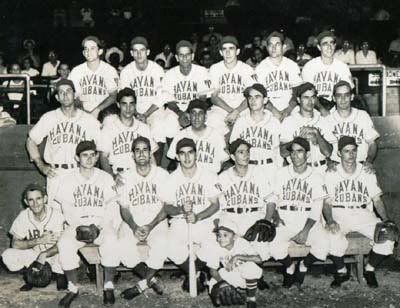
Success came quickly for the Havana Cubans in its early years. For its first five years in the league (1946-1950), Havana won titles in each compiling a combined 474-249 record. As quickly as success came, rougher times lay ahead. In the final three years of the Havana Cubans, the team fared no better than fourth place (1953) though they were managed by Cuban legends Adolfo Luque (1951) and Armando Marsans (1953). The best of the Havana Cuban teams was the 1947 team.
The 1947 Havana Cubans led the league with a 105-45 record and defeated the Miami Sun Sox in a five game series and defeated the Tampa Smokers four games to one to win the Championship banner of the FIL. Though the Cubans led the league with a .268 team batting average, their strength was with their pitching. Led by future major league Conrado “Connie” Marrero, won the pitching Triple Crown with a 25-6 record, a 1.66 ERA and 251 strikeouts with only 46 walks in 271 IP.
By 1954, team owner Bobby Maduro (who we’ll hear more about in the next post) decided to change the name of the team from the Cubans to the Sugar Kings and moved the team from the Florida International League to the AAA International League. The Florida International League eventually folded with the exit of its Havana franchise. All of the other franchises, except for Miami, joined the Class D Florida State League. Miami became Miami Marlins of the International League in 1956.
For our next post, I’ll be highlighting the Havana Sugar Kings of the International League. I’ll try to highlight how outside factors led to the demise of not only the Sugar Kings but of professional baseball on the island of Cuba.
Subscribe to:
Posts (Atom)