Sunday, April 1, 2018

Who Was Walt Bond April 1, 2018

With the news that 6'7" Aaron Judge of the New York Yankees was playing Centerfield against the Blue Jays this past Saturday, it was reported that Judge would break the record for tallest Centerfielder. The previously tallest player to play CF was Walt Bond (October 19, 1937 - September 14, 1967.). It got me thinking, I can't say that I had ever heard about Walt Bond. What I found out about him was very tragic.

Bond played in the majors from 1960 to 1967. He would play first base and the outfield for the Cleveland Indians from 1960-1962, Houston Colt 45's/Astros from 1964-1965 and the Minnesota Twins in 1967. Bond's best season came in 1964 when he his .254 with 20 Homers and 85 RBIs in 147 games with the Colt 45's. So what happened to Walt Bond?

While serving in the Army, Bond was diagnosed with Leukemia. He would fight Leukemia throughout his baseball career, eventually dying from the illness on September 14, 1967 at the young age of 29.

Its a shame to hear about a ballplayer being taken so young due to illness. At least with Aaron Judge playing in CF this past Saturday, a small measure of light was shed on the short career of Walt Bond. May you continue to Rest in Peace Walt Bond.

For Further Reading:

- Walt Bond's career statistics from Baseball Reference.com
- Walt Bond Dies at the age of 29 from the Morning Record dated September 15, 1967

Sunday, May 29, 2016

MLB's Anti-Trust Exemption Granted May 29, 1922

On This Day in Baseball History May 29, 1922: In the case Federal Baseball Club v. National League, 259 U.S. 200 (1922) aka Federal Baseball Club of Baltimore, Inc. v. National League of Professional Baseball Clubs, The United States Supreme Court rules that organized baseball is a sport and not a business, which exempts major league clubs from antitrust laws and interstate commerce rules.

The case came about due to the attempts to start a third Major League in the form of the Federal League which was in operation from 1913-1915. Many of the Federal League clubs were bought out by the National and American Leagues with the exception of the Baltimore franchise of the Federal League. The city of Baltimore had prior experience with both National and American leagues in the past.

The Baltimore Orioles played in the National League from 1882-1899 and although they were very successful, the team was contracted when the N.L. went from a 12-team league to an 8-team league in 1899. Baltimore once again became a Major League city in Ban Johnson's new American League that began operations in 1901 as direct competition to the National League. As part of the agreement between the two leagues after hostilities ended, the American League was allowed to have a team play in the New York City market. Tammany Hall politicians, Frank J. Farrell and William Stephen Devery purchased the rights to the New York A.L. market and the Baltimore A.L. team (also known as the Orioles) was moved to New York City becoming the Highlanders and later the Yankees. Aside from the Federal League team that played in Baltimore from 1913-1915, the city of Baltimore would not beome a Major League city again until the St. Louis Browns moved to Baltimore for the 1954 season, adopting the Orioles moniker for the team. Back to the Federal's lawsuit.

The Federal League brought an anti-trust lawsuit during the offseason of 1914-1915 due to the attempts of both the National and American leagues to derail the advances made by the Federals via a monopolization of Baseball by the two established leagues. After years of legal wrangling and maneuvers, the case was argued on April 19, 1922 and the decision by the court in favor of the National League of Professional Baseball Clubs on May 29, 1922.

Justice Oliver Wendell Holmes
The decision, given by Justice Oliver Wendell Holmes, was summarized on the Justia website as follows:
1. The business of providing public baseball games for profit between clubs of professional baseball players in a league and between clubs of rival leagues, although necessarily involving the constantly repeated traveling of the players from one state to another, provided for, controlled, and disciplined by the organizations employing them, is not interstate commerce. P. 259 U. S. 208.
2. Held that an action for triple damages under the Anti-Trust Acts could not be maintained by a baseball club against baseball leagues and their constituent clubs, joined with individuals, for an alleged conspiracy to monopolize the baseball business resulting injuriously to the plaintiff. P. 259 U. S. 209.
269 F. 681, 50 App.D.C. 165, affirmed.
Error to a judgment of the Court of Appeals of the District of Columbia reversing a judgment for triple damages under the Anti-Trust Acts recovered by the
Page 259 U. S. 201
plaintiff in error in the Supreme Court of the District and directing that judgment be entered for the defendants.
Page 259 U. S. 207
The verdict has pretty much given Professional Baseball a free hand to do what it wanted though their power has slowly eroded due to the results stemming from the Flood v. Kuhn (407 U.S. 258) case. Though the decision in that case upheld MLB's anti-trust exemption by 5-3, it helped to usher in the era of free agency for the players.

Why did the U.S. Supreme Court and Oliver Wendell Holmes in 1922 decide in favor of the league, thereby giving them a free pass in terms of antitrust legislation? Since I am not an expert in law and legislation, I can't answer that. Maybe the Justices of the U.S.S.C. didn't realize how much of a money maker Baseball would become in the future? Perhaps they believed as many did at the time, even after the Black Sox scandal, in the purity and sanctity of Baseball being America's pastime and a sport and not being a money making endevour? Perhaps I can get more insight from a few friends of mine who are lawyers. I'll revisit this when I get more information.

Until Then Keep Playing Ball,
Baseball Sisco
#baseballsisco
#baseballsiscokidstyle

For Further Reading:


Monday, May 23, 2016

Random Thoughts on an Article From May 24, 1991

Sometimes you come across an article in an old newspaper that catches your eye. The article It's a Thrill Every Minute With Sax at Third Base by Michael Martinez of the New York Times dated May 24, 1991 did just that with me. The New York Yankees of the early 1990′s were a horrible bunch and the 1991 Yankees were no exception finishing the season with a 71-91 record. A couple of things in this article stood out to me.

First is the list of players that played the hot corner for the Yankees after they traded Graig Nettles in 1984. Looking at the list to the right, in eight seasons, they had 29 different players at third base, including Dave Winfield. What the hell was Lou Piniella thinking putting Dave Winfield at third for two games in 1986. Even I, as a lifelong Yankees have no idea who Mike O'Berry, Jeff Moronko and Leo Hernandez are, let alone when they played third for the Yankees. But I digress.

The list shows how truly valuable a player the caliber of Graig Nettles was to the Yankees from the mid 1970′s to 1984. It also makes you wonder why Graig Nettles isn’t in the Hall of Fame. He was arguably the best defensive third baseman since Brooks Robinson and though he wasn’t the kind of hitter that Mike Schmidt and George Brett were, he wasn’t too shabby either. I guess people can point to his .248 batting average as to a reason why he wasn’t inducted to the Hall but I challenge anyone to point to a better third baseman than Nettles after Robinson, Schmidt and Brett. And if you say Buddy Bell, I’d take a one armed Nettles over Bell anyday.


The second thing that I noted was the subject of the article: Steve Sax. Even today, I wonder what the hell happened to Steve Sax. That guy was money with the Los Angeles Dodgers. Sax was the 1982 NL Rookie of the Year and played in 150 games or more in five out of his eight seasons with L.A. He was durable as well for the Yankees. In his three seasons with the Yankees, he only missed 15 games in three seasons. But for whatever reasons, he just seemed to stop being able to field the ball at second base.

While not a Gold Glove winner for the Dodgers, thanks to Ryan Sandberg who owned all the N.L. Gold Glove awards from 1983-1991, Sax was a solid second baseman. Solid enough that the Yankees let long time Yankee Willie Randolph leave via free agency. Ironically, Randolph would replace his replacement on the Yankees in Los Angeles. Offensively he was everything the Yankees expected to get, but Sax just seemed to forget how to play second base. I wouldn't quite say he had the "yips" but he had so many troubles that the Yankees brought up Pat Kelly from AAA in 1991 to play second and moved Sax to third.

Sax would be sent to the Chicago White Sox in the offseason for Domingo Jean, Melido Perez and Bob Wickman. He would never regain his stride having retired after the strike season of 1994.

I know New York is a tough place to play, especially while wearing the Yankees pinstripes. But here is an example of how one player could overcome the madness in the Bronx to arguably become a Hall of Famer and a player who showed tons of potential upon his arrival to the Bronx, just became a shell of the player we was.

Until Then Keep Playing Ball,
Baseball Sisco
#baseballsisco
#baseballsiscokidstyle

For Further Reading:

Friday, October 2, 2015

The Last Weekend of the 2015 Regular Season

I know there are many Baseball fans that are against the Wild Card but year in and year out there are meaningful games being played heading into the last series of the MLB season and as a fan you can't ask for anything more than that.

The Los Angeles Angels are hanging on to their Wild Card hopes heading into a weekend series against the American League West leaders Texas Rangers. While the Rangers have clinched a postseason spot, they have yet to clinch the division. The Houston Astros are only three games back of the Rangers and a sweep by the Angels along with a sweep by the Astros of the Arizona Diamondbacks guarantees us a 163rd game of the season between the Rangers and Astros to decide who gets the AL West and the second Wild Card spot.

Not to be forgotten, the Minnesota Twins are also one game behind the Astros for second the AL Wild Card slot. Tied with the Angels, if the Twins sweep the Kansas City Royals and the Astros/Angels stumble the Twins could feasibly win the second Wild Card spot.

Over in the National League, both the Los Angeles Dodgers and the New York Mets are playing meaningful games to decide who gets the home field advantage in the first round of the playoffs. The Dodgers and Mets play division rivals in the San Diego Padres and Washington Nationals respectively and both teams need to win the next three games to ensure they don't have to be the first team to travel cross country in the best of five National League Divisional Series matchup. If both teams end up tied, The Mets would gain the home field advantage in the NLDS matchup with the Dodgers virtue of their head-to-head record during the season.

While the Chicago Cubs and Pittsburgh Pirates have clinched the two NL Wild Card spot, both teams play to decide who gets the home field advantage in the one-game playoff. The Pirates end the season at home against the Cincinnati Reds while the Cubs finish on the road against the Milwaukee Braves. The Pirates hold a two game lead over the Cubs. If the Pirates and Cubs finish the season tied with the same record, the Cubs would host the wild card game because they won the season series against the Pirates 11-8.

So here we go folks. Meaningful games are to be played in the first weekend of October. Enjoy the ride into the postseason.

Until Then Keep Playing Ball,
Baseball Sisco
#baseballsisco
#baseballsiscokidstyle

Friday, July 31, 2015

First Reigning Cy Young Award Winner Traded At The Deadline July 31, 1989

On This Day in Baseball History July 31, 1989: Minnesota Twins ace and reigning American League Cy Young Award winner Frank Viola was traded to the New York Mets for Rick Aguilera, Tim Drummond, Kevin Tapani, David West and Jack Savage.

While the trading of ace pitchers during the in-season trading period isn't rare, this transaction between the Twins and Mets marked the first time that a reigning Cy Young Winner was traded the following season after winning the award. Since the 1989 trading deadline deal that sent Viola to the Mets, only two reigning Cy Young Award winners have been traded the following season after winning the award.

In 2007, C.C. Sabathia was the American League Cy Young Award winner with the Cleveland Indians. He would be traded to the Milwaukee Brewers during the 2008 season for Rob Bryson , Zach Jackson, Matt LaPorta and Michael Brantley where he would go 11-2 with a 1.65 ERA down the stretch helping to catapult the Brewers into the postseason.

In 2008, as with C.C. Sabathia, Cliff Lee was the American League Cy Young Award winner with the Cleveland Indians and he would be traded by the deadline with Ben Francisco during the 2009 season to the Philadelphia Phillies for Jason Knapp, Carlos Carrasco, Jason Donald and Lou Marson. Lee would go 7-4 with a 3.39 ERA as the Phillies would lose to the New York Yankees in their bid to repeat as World Series Champions.

As for Frank Viola? His trade to his hometown team didn't prove to be as successful as he would have wanted. Viola went 5-5 with a 3.38 ERA down the stretch for the Mets in 1989. He would finish third in the 1990 NL Cy Young race by posting a 20-12 record with a 2.67 ERA. Though Viola was an All-Star for the Mets the following season, Viola would finish with a disappointing 13-15 record. Viola would become a free agent at the end of the season and sign with the Boston Red Sox for the 1992 season.

The Twins on the other hand would fare better in the deal. Both Rick Aguilera and Kevin Tapani were pivotal players in the Twins' march to becoming World Series Champions in 1991. Aguilera would save 42 games for Tom Kelly's Twins while Tapani would go 16-9 with a 2.99 ERA.


With the trading deadline looming, I don't think we'll see reigning Cy Young Award winners Corey Kluber or Clayton Kershaw being moved from their respective teams. But as we've seen in recent days, big name pitchers like Johnny Cueto, Cole Hamels and David Price can be moved for the right price. Any guesses on who else gets traded by the deadline?

Until Then Keep Playing Ball,
Baseball Sisco
#baseballsisco
#baseballsiscokidstyle


For Further Reading:
- Click Here to access Frank Viola's career statistics from Baseball Reference.com
- Click Here to access Rick Aguilera's career statistics from Baseball Reference.com
- Click Here to access Kevin Tapani's career statistics from Baseball Reference.com
- From Left Field: Only 3 Teams Have Traded A Reigning Cy Young Winner by Jim Mancari from the Mets Merized Online blogpage dated November 15, 2012

Saturday, July 25, 2015

My First Memories of the 2015 Hall of Fame Class

Looking at the 2015 National Baseball Hall of Fame class of Craig Biggio, Randy Johnson, Pedro Martinez and John Smoltz, I started to think about when I first remember seeing each player.

Photo: Julio Cortez, Associated Press
As I have mentioned before on this blog, I grew up as a kid in an era where we didn't have 24-hour/7-day a week sports networks, up to the minute news updates through the internet and apps. The majority of my Baseball information came the old fashioned way via baseball cards, newspapers, the local televised ballgames and the weekly games of the week. So after establishing that I am one of the last of the dinosaurs ;) here are my recollections of the first time I saw the Hall of Fame class of 2015.

Craig Biggio

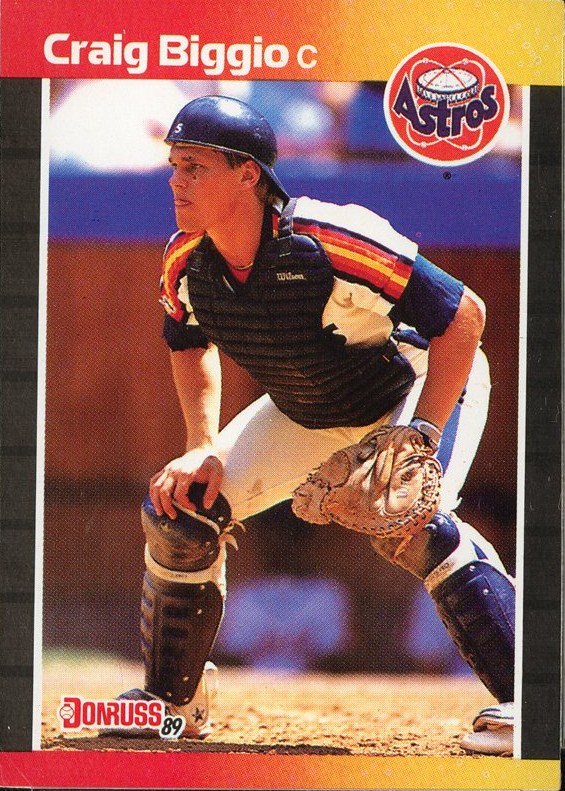
I remember Craig Biggio coming up as a catcher for the Houston Astros. Watching a game that contained the Astros would require me to watch a New York Mets telecast on WWOR-9. I honestly believe that the first time I remember Biggio was from his Baseball Card. One such card was the 1989 Donruss #561 card of Craig Biggio at the plate in his catching gear.

Biggio made his debut for the Astros in 1988 and for three season he would share duties at catcher, various outfield positions and second base. He was such a versatile athlete that he played 161 games at second base during the 1992 season and the rest as we know today is history

- Click Here for Craig Biggio's career statistics from BaseballReference.com
- Craig Biggio: From Kings Park to Cooperstown by Steven Marcus from Newsday.com dated July 24, 2015

Randy Johnson

My first recollection of Randy Johnson is in the powder blue uniforms that the Montreal Expos used to wear. Now those uniforms were truly unique and add to the mix that Randy Johnson was 6'10" and as wild as Major League's Rick Vaughn. But when I really got to know Randy Johnson was when he was traded to the Seattle Mariners in 1989. Not so much for because he was traded but because of who he was traded for.

I used to play Micro League Baseball religiously on my old Commodore 64-C (see, I am one of the last dinosaurs) and Mark Langston was always money for me in that game. I used to update the lineups every couple days a week and when the trade happened, I remember wonder who this Randy Johnson was. I remember seeing footage of his being wild either on This Week in Baseball or on the George Michael Sports Machine.

Luckily for Johnson, he would learn to utilize his size and velocity to become the Hall of Fame pitcher he is today.

- Click Here for Randy Johnson's career statistics from BaseballReference.com
- Cooperstown-bound Randy Johnson recalls the moment everything changed for him by Daniel Brown from the San Jose Mercury dated July 24, 2015

Pedro Martinez

My first memory of Pedro Martinez wasn't so much about Pedro himself but about the hype of his being the little brother of Dodgers prospect Ramon Martinez. Ramon Martinez was supposed to be the next great Los Angeles Dodgers pitcher when he came up in 1988. Ramon posted a 20-6 season in 1990 with a 2.92 ERA and 12 complete games which earned him a spot on the All-Star team and was the runner up for the 1990 NL Cy Young Award behind Doug Drabek of the Pittsburgh Pirates.

While Ramon was establishing himself as a mainstay of the Dodgers rotation, Pedro made his debut September 24, 1992. Luckily for Pedro, he wouldn't get much of a chance with the Dodgers. Pedro would be traded to the Montreal Expos for outfielder Delino DeShields after the 1993 season. It was in Montreal that Pedro would develop and shine. The 1997 trade to Boston only cemented the legendary status that Pedro Martinez would earn on his way to Cooperstown.

- Click Here for Pedro Martinez's career statistics from BaseballReference.com
- What made Pedro Martinez so great by Peter Abraham from the Boston Globe dated July 23, 2015

John Smoltz

I'm sure that I had heard of John Smoltz before the moment that I am going to mention. But if I hadn't, that Game 7 performance of the 1991 World Series against Jack Morris of the Minnesota Twins is a good place to start. Smoltz was part of an amazing starting rotation the Atlanta Braves that included Hall of Famers Greg Maddux and Tom Glavine. Also anchoring the rotation was veteran Charlie Liebrandt and prospect Steve Avery. But it was Smoltz performance that stood out to me in that classic World Series.

Smoltz matched goose-eggs on the scoreboard with Jack Morris through seven innings. And though Morris will always be remembered for arguably the second best World Series performance of 10-shutout innings, it was at this point that John Smoltz stands out in my memory.

Smoltz would not only be an outstanding starter, but also an amazing closer putting him in the same league as Denniz Eckersley as having succeeded not only as a starter but as a closer. And as Eck, Smoltz became a Hall of Famer.

- Click Here for John Smoltz's career statistics from BaseballReference.com
- Unparalleled John Smoltz a worthy Hall of Fame recipient Bby Ivan the Great from the Talking Chop blogpage on SBNation.com dated on Jul 24, 2015

What were your first recollections about the 2015 Hall of Fame class. Make sure to let me know in the comments box. I'd like to hear when it was that you discovered these future Hall of Famers.

Until Then Keep Playing Ball,
Baseball Sisco
#baseballsisco
#baseballsiscokidstyle

Sunday, July 19, 2015

Two Young Latino Pitchers Dominate the Opposition on July 19, 1960

On This Day in Baseball History July 19, 1960: A pair of young Latino pitchers throw complete game 1-hitters, both losing their no-hit bids in the eighth inning.

25-year old Cuban Pedro Ramos of the Washington Senators defeated the Detroit Tigers 5-0 at Detroit's Navin Field by hurling a 1-hit, 9-strikeout, 4-walk game that was disrupted by Rocky Colavito's eighth inning leadoff single that just got by Senators' shortstop Jose Valdivielso.

Ramos' gem was one of the only bright spots of the 1960 season for the Cuban hurler. Ramos was on track to lead the American League in losses for a third year in a row. Ramos would go 14-18 in 1958, 13-19 in 1959, 11-18 in 1960 and he would also add another consecutive league leading 11-20 record in 1961. Ramos would finish his 15-year career with a 117-160 record.

Here is the boxscore for Pedro Ramos' 1-hit complete game victory against the Detroit Tigers from the July 20, 1960 edition of the New York Times:


For Further Reading:

As I posted on my BaseballSisco blog, Juan Marichal made his career debut with a 1-hit, 12-strikeout, 1-walk complete game 2-0 gem against the Philadelphia Phillies at Candlestick Park. As with Pedro Ramos, Marichal would lose his no-hit bid in the eighth inning by allowing a single to Clay Dalrymple.

Marichal would fare considerably better in his career than Pedro Ramos did. Marichal would become one of the premier pitchers during the era of the Pitcher of the 1960's. Pitching against such stiff competition as Sandy Koufax, Don Drysdale, Bob Gibson and Warren Spahn, Marichal was able to finish with a 243-142 record over a 16-year career.

Marichal led the league in victories twice with a 25-8 record in 1963 and a 28-9 record in 1968. Marichal also put up seven straight sub 3.00 ERA seasons from 1963-1969 with a league and career best 2.10 ERA in 1969. Even more impressive was Marichal throwing 260+ innings in a season eight times with a league leading 321.1 in 1963 and a league leading and career high 325.2 in 1968. Marichal would finish the 1960's with 191 wins and 195 complete games.

Here is the boxscore of Marichal's 1-hit complete game victory against the Philadelphia Phillies from the July 20, 1960 edition of the New York Times:


For Further Reading:


Though both Latino hurlers had careers that went in different directions, they both share a moment in time when both threw 1-hit complete games on the same day.

Hasta la próxima, nunca dejaremos de jugar el Beisbol,
Baseball Sisco
#baseballsisco
#baseballsiscokidstyle